



Bangladesh’s garment export basket remains heavily tilted towards basic products, leaving the country underrepresented in higher-value categories that make up a much larger share of global apparel trade.
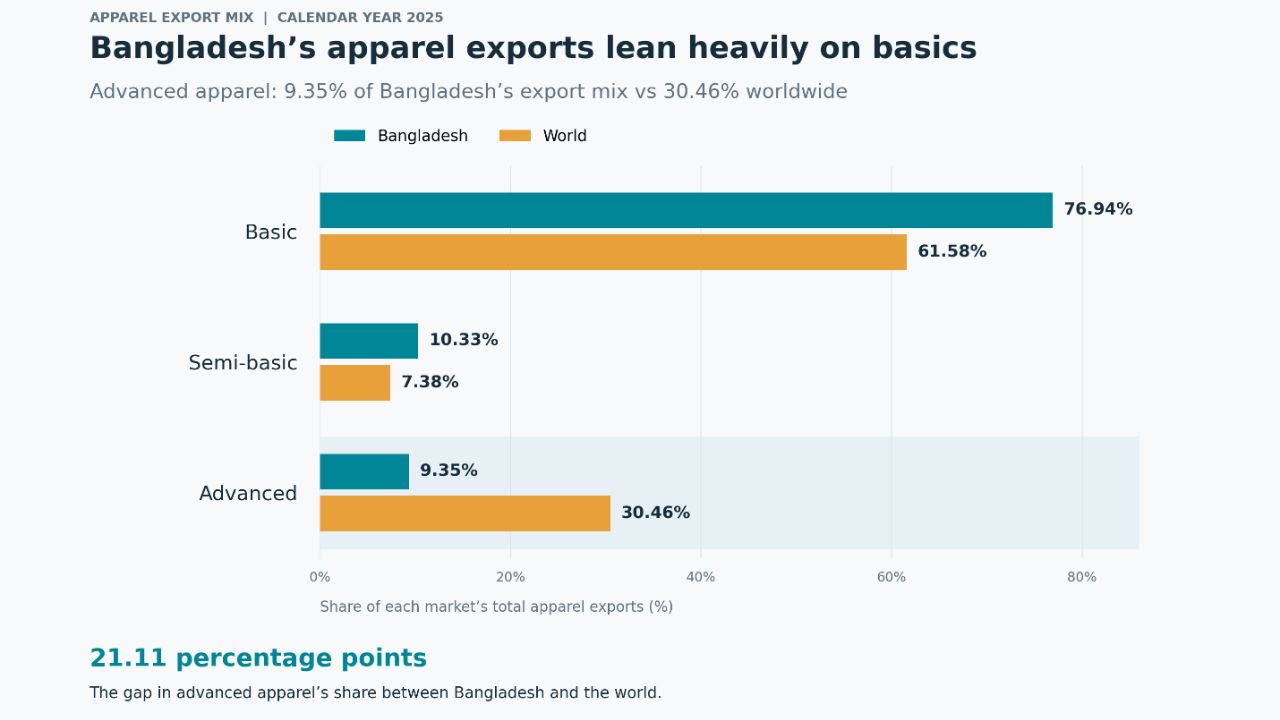
Advanced products including outerwear, dresses, technical garments, sportswear and suits accounted for only 9.35 per cent of Bangladesh’s apparel exports in 2025, against 30.46 per cent globally, according to an analysis by Bangladesh Apparel Voice based on data from the Export Promotion Bureau and the International Trade Centre’s Trade Map.
The imbalance matters because global demand is stronger in non-cotton and more sophisticated products, while Bangladesh remains concentrated in basic and cotton-based garments.
Industry executives and experts say the gap is limiting export growth and margins, and that moving up the value chain will require investment in skills and technology, reliable energy, easier financing and lower business and logistics costs.
Bangladesh exported about $38.83 billion worth of garments in calendar year 2025, of which about $29.87 billion came from basic products. Global apparel trade totalled about $426 billion during the year.
Bangladesh Apparel Voice, groups the export basket into basic, semi-basic and advanced products.
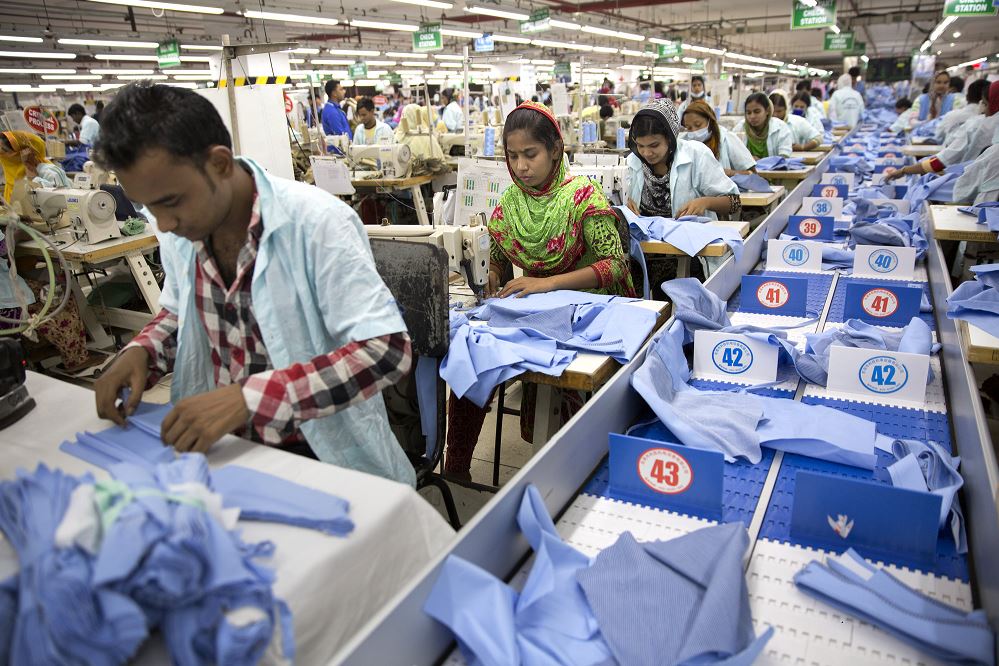
Basic products — including bottom wear, T-shirts and vests, sweaters, underwear, children’s clothing and small accessories — account for more than 76 per cent of Bangladesh’s apparel exports.

Within that group, bottom wear alone makes up 33.68 per cent of exports, compared with 21.68 per cent globally, while T-shirts and vests account for 18.64 per cent against 10.09 per cent worldwide.
Small accessories show the opposite pattern, accounting for only 0.35 per cent of Bangladesh’s apparel exports compared with 7.52 per cent globally.
Semi-basic products, mainly shirts and blouses, account for 10.33 per cent of Bangladesh’s apparel exports against 7.38 per cent globally, with men’s shirts dominating Bangladesh’s shipments in that segment.
Bangladesh exported about $3.63 billion worth of advanced products in 2025.
The gap is particularly wide in outerwear, where jackets, coats and similar products account for only 3.83 per cent of Bangladesh’s exports against 13.45 per cent globally.



The fibre mix shows another mismatch. Bangladesh Apparel Voice found that most global garment trade involves fibres other than cotton, while nearly three-quarters of Bangladesh’s apparel exports remain cotton-based.
Mohiuddin Rubel, founder and CEO of Bangladesh Apparel Voice, said the industry remained too dependent on basic and cotton-based products despite much stronger global demand for non-cotton garments.
Bangladesh has only a limited presence in outerwear, sportswear and technical apparel, he said. With competition intense and margins thin in basic products, manufacturers need to expand into polyester and other man-made fibres as well as higher-value garments.
Rubel said diversification should also raise domestic value addition and be backed by a better business environment rather than reliance mainly on cash incentives.
He called for lower costs and faster processes from raw-material imports to finished-garment exports, uninterrupted gas and electricity supplies, an end to extortion in transport, lower logistics and handling costs, effective implementation of the National Single Window and faster administrative procedures.
Factory operators say the shift in buyer demand is already visible.
Kazi Zubayer Ahmed, managing director of Zayaan Outerwear Limited, told TIMES of Bangladesh that demand for basic garments such as T-shirts and trousers was softening, while demand for outerwear and sportswear was increasing.
But many Bangladeshi factories still lack the skills and technological capability required to produce more complex garments, he said.
Factories need to invest in worker training, modern machinery and automation, while many international buyers still have greater confidence in China and Vietnam when sourcing technically demanding products.
Bangladesh can make such garments, Ahmed said, but manufacturers still need to build buyer confidence.
Larger factories that have invested in modern technology are performing better, while many small and medium-sized manufacturers are reluctant to take the investment risk or struggle to access government support.
Some factories that fall behind in adopting technology eventually return to basic production because they cannot remain competitive in more sophisticated categories, Ahmed said.
Difficulty securing bank financing and shortages of gas and electricity are also major barriers to diversification.
Mustafizur Rahman, distinguished fellow at the Centre for Policy Dialogue, said Bangladesh needed to move further into man-made fibres, including polyester, and higher-value apparel because competition in basic garments was intense and margins were low.
He said the shift would require higher domestic value addition and a more efficient business environment.
The economist said port delays, high logistics and handling costs, transport extortion, slow administrative procedures and unreliable gas and electricity supplies all raise production and delivery costs.
He also called for more effective implementation of the National Single Window, saying improvements in these areas would make it easier for factories to invest in and export a broader range of higher-value garments.