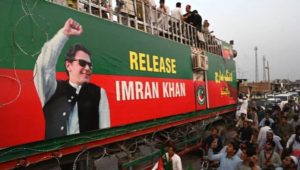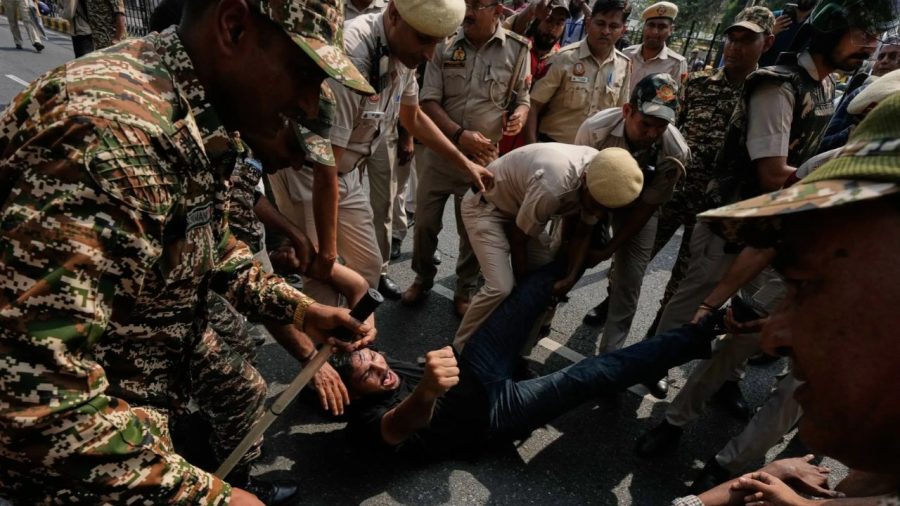



Indian authorities imposed sweeping security restrictions across New Delhi on Saturday, detaining hundreds of protesters and opposition leaders to prevent a planned peaceful demonstration demanding the resignation of Chief Election Commissioner Gyanesh Kumar and the rollback of a controversial revision of electoral rolls.
Thousands of police and paramilitary personnel were deployed across the capital as authorities sealed off Jantar Mantar, the designated protest site, suspended mobile internet services in parts of the central business district and shut dozens of metro stations and markets.
The demonstration was called by the Cockroach Janata Party (CJP), alongside student groups and Left organisations, amid allegations that the Special Intensive Revision (SIR) of electoral rolls disproportionately benefits Prime Minister Narendra Modi’s ruling Bharatiya Janata Party (BJP).
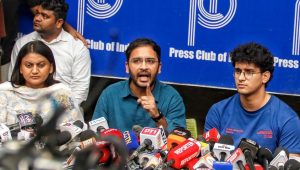
Police detained hundreds of demonstrators, according to reports from India. CJP founder Abhijeet Dipke and the party’s senior leaders Saurav Das and Ashutosh Ranka were detained after arriving in Delhi from Mumbai.
Delhi Police also detained All India Students’ Association (AISA) President Neha Bora amid the security crackdown ahead of the planned “Jantar Mantar 2.0” protest. Protesters surrounded the police bus carrying her and attempted to block it, raising slogans and demanding her release, Indian media reported.
In a message posted on social media, Bora urged people to gather at Safdarjung Flyover. “I am in detention. The movement is not,” she wrote.
Opposition leaders, including West Bengal Chief Minister Mamata Banerjee, former Delhi chief minister Arvind Kejriwal and former Kerala chief minister Pinarayi Vijayan, were also shown being detained in television footage.
Aam Aadmi Party (AAP) national convenor Kejriwal was later released from Jaffarpur police station in Delhi, according to a video posted by the Press Trust of India (PTI) on X.
Trinamool Congress (TMC) chief Banerjee also declined to comment in detail on her detention, saying she would wait for the INDIA bloc’s planned united stand on Sunday.
In a video shared by PTI on X after her release, Banerjee said she did not want to pre-empt the opposition alliance’s position.

CPI(M) leaders were detained before reaching the protest venue. Clashes broke out between Delhi Police personnel and party leaders, including Minakshi Mukherjee. Mukherjee and Sujan Chakraborty were taken into custody.
The CPI(M) Kerala unit said on X that several of its senior leaders, including party general secretary MA Baby, MV Govindan Master, A Vijayaraghavan, KK Shailaja, Rajya Sabha MP John Brittas, KN Balagopal, Brinda Karat and PK Sreemathi, were detained after arriving at Jantar Mantar.
Actor Imran Khan was detained by Mumbai Police at August Kranti Maidan, the proposed venue for a separate gathering in support of the CJP’s protest call.
Leader of the Opposition in the Lok Sabha Rahul Gandhi urged young people to “keep protesting” and said, “We are going to ensure that this regime and the people who have attacked the Constitution are defeated.”
Gandhi, who was in Chennai for his Chhatron Ki Goonj event, also described “cowardice” as the “core characteristic” of Modi and the Rashtriya Swayamsevak Sangh (RSS).
He said Modi, Home Minister Amit Shah, RSS chief Mohan Bhagwat, Chief Election Commissioner Gyanesh Kumar and National Security Adviser Ajit Doval were slowly finding the space closing around them.
Representatives of several digital news outlets said police briefly detained four of their reporters while they were covering the demonstrations. A Reuters journalist was also briefly detained before being released. Lawyers protesting outside the Supreme Court were picked up and later freed, according to the president of the court’s bar association.

Although Jantar Mantar was sealed before the rally could begin, small demonstrations broke out elsewhere in the capital, including at a popular crafts market and the memorial to independence leader Mahatma Gandhi.
“Long live the revolution,” some young protesters chanted as police chased demonstrators and dragged scores of people into buses, a Reuters witness reported.
“This is violating the rights of the people and the country will not tolerate this anymore,” protester Yogendra Solanki told Reuters as police escorted him away.
Climate activist Sonam Wangchuk warned that he could launch a peaceful protest, hunger strike or march in Leh or Delhi if those detained during Saturday’s demonstrations were not released within 24 hours.
He also described the situation in the country as an “undeclared emergency”.
Lockdown across capital
Authorities established checkpoints on major roads and at entry points to the sprawling capital, which has a population of about 20 million. Police boarded buses to search for protesters, while vehicles were subjected to inspections.
Barricades and concrete blocks disrupted traffic, and anti-riot vehicles equipped with tear-gas launchers were stationed along key routes.
The scale of the security deployment underscored the authorities’ determination to prevent the gathering, which organisers had expected to draw thousands of people.
The CJP condemned what it called the “authoritarian detention” of its leaders and demanded their immediate release, saying the protest movement would continue.
Television footage showed Dipke challenging officers who approached him aboard his aircraft after it landed in Delhi.
“I have come to be arrested, arrest me … I am not afraid of you guys,” he said.
“No, this is not an arrest,” an officer replied. “Please cooperate.”
Voter roll revisions under scrutiny
The demonstrations have emerged as a fresh challenge for Modi’s government amid allegations that election authorities improperly revised voter lists ahead of recent state elections.
Criticism of the chief election commissioner intensified last month after The Indian Express reported that two election commissioners had raised objections to decisions concerning voter rolls, registration procedures and the Election Commission’s digital systems.
The newspaper reported that the two commissioners had raised at least 14 formal objections over a period of 10 months.
Election Commission data shows that more than 130 million names have been removed from voter lists since the latest round of revisions began last year. The figure exceeds Japan’s population.
The commission says the deletions include entries identified during the draft revision process and maintains that eligible voters whose names have been incorrectly removed can re-enrol.
Opposition parties allege that the revisions have disadvantaged their supporters and affected the outcomes of some state elections won by the BJP. They have questioned the neutrality of the election authorities and demanded Kumar’s resignation.
Kumar and the two other election commissioners have not publicly commented on the specific allegations. The Election Commission, however, has defended its internal deliberations.
“Differing views and observations are a normal part of deliberation in any institution,” the commission said.
The BJP has denied wrongdoing, arguing that its electoral victories reflect Modi’s popularity and the country’s economic growth. Party leaders have accused opposition groups of spreading misinformation after losing elections.
Fresh political challenge for Modi
The crackdown prompted sharp criticism from the opposition Congress party.
KC Venugopal, a senior Congress leader, said Saturday’s restrictions showed that Modi’s government had “officially waged war against its own people”.
BJP spokesperson Sambit Patra, meanwhile, said democracy had prevailed over mob rule.
Kumar, 62, has had a contentious relationship with opposition parties since becoming chief election commissioner. Opposition lawmakers submitted a motion seeking his removal in Parliament earlier this year, but it was rejected.
A former Indian administrative service officer, Kumar joined the service in 1988 after earning a degree in civil engineering. He subsequently worked in the defence and home ministries before retiring in January 2024. He was appointed an election commissioner two months later and eventually became the chief election commissioner.
The protests come ahead of a series of important state elections beginning in early 2027. They also follow demonstrations over examination paper leaks that led to the resignation of India’s education minister.
With opposition parties continuing to challenge the electoral roll revisions and the Election Commission defending its procedures, the dispute is likely to remain a major political issue in the run-up to the next round of state polls.