


Kamal Chowdhury expected a routine correction to his citizenship certificate at the Cumilla City Corporation to be done easily. However, after trying for a month, the resident of Ward 8 failed to fix it because he shares the same name as another person.
He said the problem arose because the appointed official now responsible for the ward could not identify them.
In Rajshahi, Raihan Ali of Haridagachhi village under Ward 8 of Kesharhat Municipality has spent nearly one and a half months trying to obtain his father’s trade licence, yet the work remains unfinished.
Across city corporations, municipalities and unions, residents tell a similar plight: services that once took hours or a single day now drag on for weeks — all due to the absence of elected local representatives.
For over two years, citizens have struggled to access local government services as administrators and officials appointed from different departments perform duties that were once handled by councillors, commissioners, and elected representatives.
Yet, the BNP government has shown little interest in holding local elections so far, backtracking on its election pledge to strengthen local governance and limit administrative appointments.
The interim government dissolved city corporations, municipalities, district councils, upazila and union councils after the 2024 July uprising. But many representatives elected on Awami League tickets or as rebel candidates went into hiding. Administrators or officials from other departments were then given additional responsibilities to perform their duties.
BNP-affiliated people have been appointed administrators in city corporations, while government officials are serving as administrators in municipalities. Officials from different departments are also performing the duties of councillors or commissioners.
The arrangement has created a basic service problem: officials often do not know the residents they are supposed to serve.
“Ordinary people cannot approach an administrator in the same way they can approach an elected representative. Administrators or those in charge of wards do not know the residents. As a result, people face difficulties in getting services,” Kishoreganj journalist Saifuddin Ahmed Lenin told TIMES.
Badiul Alam Majumdar, head of Electoral System Reform Commission during the interim government, believes if elections are delayed, people will be deprived of services and local government institutions will effectively become dysfunctional.
One-day work takes 10 days
The delays are affecting both basic services and local development.

Road repairs and drain work have slowed, while trade licences, inheritance certificates and applications for old-age and widow allowances are taking longer. Work that once took a day now takes 10 to 12 days and sometimes a month.
Ward secretaries in Dhaka’s two city corporations said councillors previously signed certificates in advance, allowing secretaries to verify documents and issue them quickly.
Now, ward secretaries check applications before sending them to regional offices, where officials verify them again before a regional officer signs the certificate. One regional officer may handle seven to 10 wards, creating heavier workloads and daily file backlogs.
Saiful Islam Jewel, general secretary of the Kishoreganj district branch of Bangladesh Poribesh Andolon, said, “To reduce public suffering, it is urgent to quickly hold elections and return responsibility for running municipalities to elected representatives.”
Badrul Huda Jenu, former president of the Cumilla branch of Sachetan Nagarik Committee-SANAK, said, “From villages to cities, public suffering is severe everywhere. The longer local government elections are delayed, the more public suffering will increase.”
In Barishal, people were found seeking services including birth registration at the Ward 17 office on 23 September.
Niaz Morshed, who had gone for a birth certificate, said, “The registration was completed after nearly two weeks.”
Former councillor of Ward 4 of Kishoreganj Municipality Sultan Mia said, “In unions where elected representatives are still in office, birth registration services can be obtained within a day.”
Municipal administrator and Deputy Director of Local Government Jebun Nahar Shammi said, “It is comparatively difficult for an official to provide services as easily as elected representatives can.”



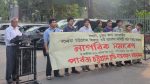
In Jamalpur, Shawon Mollah of Daripara was told to return the next day for a citizenship certificate, although the work previously took one or two hours.
The problem extends to union councils. In Jamalpur, 80 per cent of representatives in 68 unions have been in hiding since the fall of the Awami League government on 5 August 2024.
Residents said the impact goes beyond paperwork. Government officials generally do not perform the dispute-resolution and mediation roles once handled by elected representatives.
Disputes that could once be settled in a single sitting are now leading to lawsuits, fights, clashes, attacks, counter-attacks and even killings.
Residents of Ward 5 of Cumilla City Corporation also alleged that dish-line cables are being cut almost every day. Previously, they said, such problems could be taken to ward councillors and often resolved.
Officials struggle with extra duties
The officials replacing elected representatives say they are struggling too.
Assistant Conservator of Forests Naeema Akter is performing the duties of councillor of Ward 19 of Rajshahi City Corporation while handling her regular job and additional responsibilities in two other districts.
That makes it impossible for her to sit regularly at the ward office.
“Even if I want to, it is not possible to work like an elected councillor,” Naeema told TIMES.
Motaleb Ali of Debipur village under Ward 1 of Durgapur Municipality said the municipal administrator rarely visits except for monthly meetings and important work.
Upazila Assistant Commissioner (Land) Laila Noor Tanju is carrying out the role of municipal administrator as an additional responsibility.
“We will have to work like this until elections are held,” she said.
In Barishal, Director of the Divisional Health Directorate Refayetul Haider has been given responsibility for Ward 17 of the city corporation but has not been able to visit the ward office even once while handling his health administration duties.
He said ward secretaries bring files to his office and he signs them there.
An official of Cumilla City Corporation described a similar burden.
“It is difficult to handle official work along with the work of two or three wards. I cannot do any work properly. Even after seeing people’s suffering, I cannot solve it. It is really not possible to continue like this,” the official said.
Sylhet City Corporation assigned 14 officials from different government departments to oversee 42 wards on 27 October 2024.
Tuhin Ahmed, a resident of Ward 4, said the officials often failed to answer calls and could not easily be met at their offices, even in emergencies.
Mahmud Khan of Ward 11 said residents sometimes have to go from office to office for a single document and are forced to use brokers.
An executive officer of a municipality in Jamalpur said, “Officials come to the office for a fixed period. But elected representatives can provide services even at night. You can go to their homes and get signatures.”
What the BNP manifesto promised
The continuing dependence on administrators also sits uneasily with the BNP’s election manifesto.
The manifesto pledged to strengthen local government and said power should be exercised closer to citizens.
“The country will not be governed from the secretariat in Dhaka. The country will run on the basis of the wishes and opinions of grassroots people. Solutions will be arranged where the problems exist,” it said.
It also pledged, “Government administrators will not be appointed to local government institutions unless a post becomes vacant due to death or a court order.”
The manifesto further said, “The BNP wants to organise all national and local elections through democratic processes based on the votes of the people.”
Prime Minister’s Information and Broadcasting Adviser Zahed Ur Rahman said on 7 July that local elections would begin in October.
But the timetable later became uncertain.
On 14 September, Election Commissioner Abul Fazal Md Sanaullah announced that local elections would be held in seven phases from 12 November.
The government reacted negatively, with Local Government State Minister Mir Shah Alam saying there had been no communication with the Election Commission over the plan.
At an event in Rangpur on 29 September, however, he said local elections would begin next January and be completed by 6 June.
Badiul Alam Majumdar said, “The political commitment made over elections is not being implemented. If elections continue to be delayed in this way, people will suffer on the one hand, while the institutional foundations of local government bodies will also be damaged on the other.”
Election Commission data show it has the legal authority to hold elections to around 4,700 local government institutions across the country, including 13 city corporations, 495 upazila councils, 330 municipalities, more than 3,800 union councils and 61 district councils.
Under the law, elections must be held within 180 days after a council is dissolved.
Report prepared with information from correspondents in Sylhet, Rajshahi, Barishal, Cumilla, Kishoreganj and Jamalpur.