The business community has broadly welcomed the government’s move to engage experienced international operators to manage terminals at Chattogram Port, saying global expertise could improve efficiency, speed up cargo handling and enhance service quality.
Business leaders, however, say the nationality of the operator is less important than ensuring faster, transparent and reliable services without hidden charges or bureaucratic delays.
Workers and domestic berth operators have raised a different concern. They fear that the proposed involvement of foreign operators, particularly in the General Cargo Berth (GCB), could put the jobs of around 10,000 workers at risk.
On October 1, the Cabinet Committee on Economic Affairs gave in-principle approval to a draft concession agreement for operating the New Mooring Container Terminal (NCT) and Overflow Container Yard (OCY) for 15 years. The government has not officially disclosed the proposed international operator, although protesters have claimed that Dubai-based DP World is being considered for the NCT.
Humayun Kabir, coordinator of the Bondar Rokkha Shongram Porishad, said ongoing discussions between the government and DP World had led them to believe that the company had effectively been selected to operate the NCT.
Meanwhile, a separate process has begun regarding the possible appointment of Saudi Arabia-based Red Sea Gateway Terminal International (RSGTI) to operate the Chattogram Container Terminal (CCT) and GCB. On September 28, the Ministry of Shipping directed Invest Bangladesh Authority to initiate the process of engaging RSGTI for the two terminals.

Business focus on efficiency
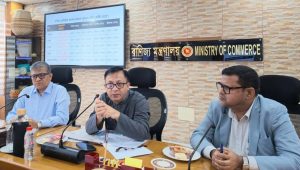
BGMEA Vice President Mohammad Rafique Chowdhury told TIMES of Bangladesh that timely delivery of goods without hidden charges would benefit businesses regardless of whether terminals are operated by domestic or foreign companies.
He said delays in paperwork and customs procedures often hold up cargo clearance and increase costs through demurrage and other charges. The business community therefore expects quicker container unloading, smoother cargo clearance and an effective “one-stop service”.
Sakeef Ahmed Salam, Deputy Managing Director of Asian Group and a BGMEA director, said the company viewed the potential entry of experienced global terminal operators positively.
“Port efficiency directly translates to faster turnaround times and optimized logistics costs, which are critical for maintaining our competitiveness in the global RMG market,” he said.




He added that international operators should also be viewed as an opportunity to develop local expertise and train port-management personnel to international standards.
Workers fear job losses
The proposed changes have generated concern among domestic berth operators and workers, particularly over the future of employment at the GCB.
In 2025, the CCT handled around 16 percent of Chattogram Port’s container volume, while the NCT handled about 44 percent, the GCB around 36 percent and the Patenga Container Terminal about 4 percent.
Saif Powertec currently operates two berths at the CCT and says it employs more than 2,500 workers across the NCT and CCT. Its existing CCT contract has roughly two months remaining.
The GCB consists of 12 berths, six of which handle container vessels and six general cargo ships. Twelve domestic berth-operating companies currently manage these berths. According to the operators, around 10,000 skilled workers are directly employed through them.
Fazle Ekram Chowdhury, president of the Berth Operators, Ship-handling Operators, and Terminal Operators Owners Association, said the domestic operators had no objection to foreign investment or participation as long as national interests, port authority and workers’ employment were protected.
“We did not come here to operate the terminals indefinitely; our tenure is for five years. We have never lacked the capacity or competence to handle containers,” he said.
Tk7,650cr GCB investment proposal
Domestic berth operators submitted a proposal in September 2025 seeking long-term operation and development of the GCB, with an estimated investment of about Tk8,000 crore.
The proposal, based on a preliminary study by BDRS Limited, noted that the GCB is Chattogram Port’s oldest terminal. Six jetties were constructed in 1954 and another six in 1979, meaning all have exceeded their original economic lifespan.
The operators proposed a 25- to 30-year operating arrangement involving phased reconstruction of the jetties and installation of modern cargo-handling equipment.
They said the proposed initial investment amounted to $627 million, equivalent to approximately Tk7,650 crore, but the port authority did not accept the proposal.
Shipping Secretary Zakaria said the Saudi government had expressed interest in operating the CCT through the Public-Private Partnership authority.
Relevant information has been sent to the Chattogram Port Authority for feasibility assessment and further action, he said. Any final decision will require recommendations from the port authority and approval from the Cabinet Committee on Government Purchase.
He said DP World had previously expressed interest in operating the CCT, while Saudi Arabia and Qatar had also shown interest. However, no final decision had yet been taken regarding the CCT and the process remained at a preliminary stage.
Meanwhile, the Bondar Rokkha Commitee and Bondar Rokkha Shongram Porishad have continued protests against the proposed leasing arrangements for the NCT and CCT.
The Bondar Rokkha Commitee has announced a day-long sit-in at the port’s main gate on October 5. Its demands include cancellation of the proposed 15-year NCT-OCY concession, withdrawal of the directive to begin the CCT leasing process, and an end to lawsuits and alleged administrative harassment against workers and movement leaders.