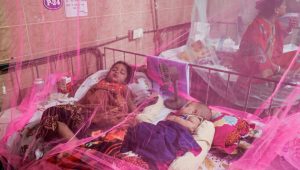
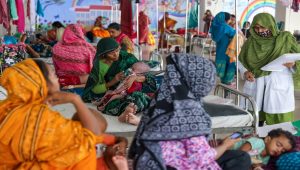
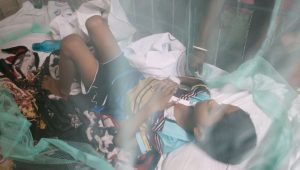
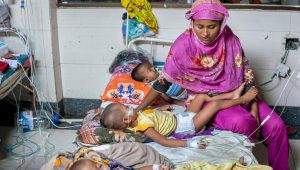
Inside a narrow alley in Korail, one of Dhaka’s largest slums, stands a dilapidated two-story house sheltering eight to ten families. On the ground floor, in a semi-finished room, lives one such family with two young brothers: Junaid, three, and Mahin, eight months.
When Junaid developed measles, he was taken to a nearby private hospital, where he recovered. But recovery brings another challenge: nutrition.
Doctors say children need protein-rich, vitamin-dense food after measles. Yet rising costs make this difficult for low-income families. “Fish, beef, eggs, milk—he needs to eat these; they also told us to give him fruits,” his grandmother Rizia Akther told TIMES of Bangladesh.
Mentioning that the price of everything has gone up in the last few days, she said, “We’ve spent over Tk5,000 on treatment, and if I provide fruits and such, it will cost over at least Tk500 every day. We can’t afford that.”
In places like Korail, where most families live on low incomes, recovery from measles is no longer just a medical issue. It is increasingly shaped by rising food costs and the daily struggle to afford proper nutrition.
Experts warn of long-term consequences
Currently, Bangladesh is under mounting economic strain as energy supply disruptions persist, with the Middle East war now nearing two months.

On 16 April, the government raised fuel prices, triggering a rise in transport fares and the cost of daily essentials, further squeezing household budgets.
The price increase has hit lower and lower-middle income groups the hardest. Living hand to mouth, it has become difficult for them to provide adequate food for children recovering from measles.
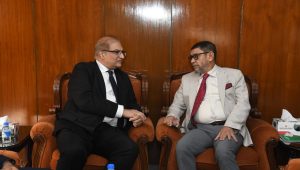
Institute of Nutrition and Food Science University of Dhaka Professor Abu Torab Md Abdur Rahim told TIMES that measles can have lasting effects on children’s development.
“Children infected with measles can see their potential drop by 10, 20 or even 30 per cent,” he said, adding that early nutritional deficiencies inevitably limit future life prospects.


He added that poor nutrition in early childhood leads to long-term physical setbacks, including reduced stamina, which can affect growth and productivity later in life.
Measles is known to damage immune system, leaving children vulnerable to secondary infections such as pneumonia and diarrhea. When combined with protein deficiency and lack of key micronutrients like Vitamin A, the risk of severe complications rises sharply.
Research indicates that measles can erase the immune memory of previous infections and vaccinations, a condition known as “immune amnesia.” This effect means that the immune system forgets how to fight off previously encountered pathogens, increasing susceptibility to other infections.
A Study titled “Measles virus infection diminishes preexisting antibodies that offer protection from other pathogens” found that measles can reduce the immune memory of previously acquired infections by up to 30%. This loss of immune memory can persist for months or even years, leaving individuals vulnerable to diseases they were previously protected against.
World Health Organization advises measles patients to eat healthy, nutritious foods to support immune function, prevent severe complications, and aid recovery from the virus.
Medical professionals say measles often leads to malnutrition, weight loss, and a decrease in appetite, a diet rich in vitamins and protein is crucial for recovery.
Calls for stronger safety nets
Professor Mohammad Mushtuq Husain, a public health expert, said children recovering from measles may face complications if they do not fully recover and receive proper nutrition.
He said they can develop conditions such as nyctalopia due to vitamin A deficiency, as well as pneumonia and severe diarrhoea later. He also warned that with the dengue season approaching, these children could become even more vulnerable.
He said that Ministry of Social Welfare should address this and take proper steps to tackle the problem.
Health economists suggest that as the family card programme is already in place, it should be expanded across all areas. If properly scaled up, this existing system can make a meaningful difference to tackle the problem.
The government launched the family card programme on 10 March at the T&T Field adjacent to Korail slum in Dhaka. Under the initiative, the government will provide a monthly allowance of Tk2,500 to beneficiary families.
Dhaka University health economics Professor Syed Abdul Hamid said that, if possible, the current assistance could be increased to Tk3,000 or even Tk4,000 for measles-affected families to further strengthen the nutrition response.
“The intention at the top level seems to be there, but faster implementation would help these vulnerable communities benefit sooner,” he told TIMES.
When asked whether there is any government project on this issue, Mohammad Yunus Ali, director of the Institute of Public Health Nutrition, told TIMES that no plan has yet been adopted.
However, he said that discussions and decisions on the matter would be made in the future, adding that the availability of the budget will be a major factor in this decision.