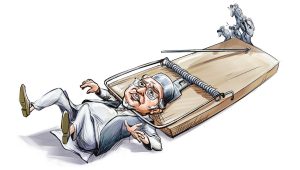
The Election Commission (EC) has published a draft code of conduct for upcoming local government elections, maintaining a ban on posters while introducing new restrictions on social media campaigning, artificial intelligence (AI) use, and the operation of microphones and vehicles.
The draft was uploaded on the EC website on Wednesday and sent to the country’s 56 registered political parties via email, with a request to submit feedback by 30 June.
Although separate codes previously existed for Union Parishad, Municipality, Upazila Parishad, District Parishad, and City Corporation, the draft has been prepared with largely uniform provisions for all five tiers.
Candidates wishing to campaign through digital or social media must first submit their account IDs, email addresses, and other identifying information to the returning officer. No campaigning will be allowed without prior submission.

The draft explicitly prohibits the malicious use of AI in election campaigning. Hate speech, misinformation, image distortion, and fabricated election-related content are banned.
No hate speech, personal attacks, or inflammatory language based on nation, religion, caste, gender, or community will be permitted. Religious or ethnic sentiments cannot be exploited for electoral gain.


False, misleading, biased, obscene, or defamatory content – whether general, edited, or AI-generated – aimed at confusing voters or damaging a candidate’s character is also prohibited.
Following the precedent set during the 13th National Parliament election, the EC has proposed continuing the ban on posters in local government polls.
However, leaflets, handbills, festoons, and banners may be used, provided they are not made from non-biodegradable or environmentally harmful materials such as rexine, polythene, or plastic.
The draft bars the use of trucks, buses, motorcycles, boats, trains, or other mechanical vehicles for processions or torch rallies. Helicopters or any other aircraft are also banned for campaigning.
Caravans or mobile vehicles made from biodegradable materials may operate from 12 noon until sunset, provided they do not disrupt traffic or cause public suffering.
No more than one microphone or sound-amplifying device may be used per ward. Microphones cannot be used before noon or after sunset, and sound levels must not exceed 60 decibels.