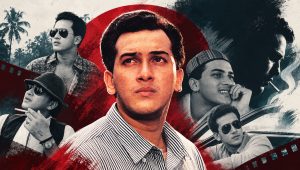
‘Ononto Prem’ occupies a special place in the history of Bengali cinema. Released on March 18, 1977, the film was not only a commercial success but was also regarded as bold and exceptional for its time for several reasons. It marked the directorial debut of legendary actor Razzak and became known as the first Bangladeshi film to feature a kissing scene.
The film, however, was not originally directed by Razzak. Its principal director and producer was renowned film editor Bashir Hossain. In 1974, Khan Ataur Rahman wrote a screenplay titled ‘Omor Prem’ together with screenwriter and lyricist Kazi Aziz Ahmed.
Bashir Hossain later showed interest in directing the project. The title was eventually changed to Ononto Prem because another film with the same name was being produced at the time. He decided to produce the film under his own production banner, and shooting began with an ensemble cast including Razzak and Babita, under the direction of Reza Latif.
However, due to illness, heavy editing commitments and financial difficulties, production came to a halt midway. At that point, Razzak expressed interest in directing the film himself.

Initially, Razzak began working on the film under Bashir Hossain’s production. Later, when the situation became more complicated, he purchased the rights to the project and completed it under his own production banner, Rajlokkhi Productions.
Composer Azad Rahman was brought in to replace Khandaker Nurul Alam, who had originally been responsible for the music. Some songs were re-recorded and Kazi Aziz Ahmed made revisions to the screenplay. The film was then completed and prepared for release.
Alongside Razzak and Babita, the film also featured ATM Shamsuzzaman, Khalil, Black Anwar and several others.



The story of Ononto Prem unfolds around a university campus. Razzak and his three friends, Khalil, ATM Shamsuzzaman and Black Anwar, are students at the same university. Khalil develops feelings for his classmate Babita. The friends devise a plan to frighten her in a secluded place and stage a fight so that Khalil can appear heroic. The plan initially succeeds.
However, events take a darker turn when Khalil later takes Babita away and attempts to assault her. Hearing her cries for help, Razzak and the others rush to the scene. During the ensuing struggle, Khalil is killed by Razzak. To protect Babita’s honour, Razzak takes full responsibility for the death and later escapes from police custody.
Meanwhile, Babita is pressured into marriage but also manages to escape. The two eventually meet on a train and flee together to the forests of the Chittagong Hill Tracts. There, they gradually fall in love. Meanwhile, two of their friends are killed in police firing, leaving no one to reveal the truth about the incident. Eventually, the police track them down and, while attempting to flee, both are shot dead near a fountain.
The film’s final scene originally featured a deep kiss between Razzak and Babita, which was considered extremely daring in the context of that time. Initially, Babita was reluctant to perform the scene, but Razzak eventually convinced her.
After filming, however, Babita became uncomfortable and concerned about how the scene might affect her future. Understanding her concerns, Razzak assured her that the scene would be removed if necessary.
After watching the completed film, Babita herself agreed that the scene could remain. Ultimately, however, Razzak decided to remove it, believing that it might create difficulties for Babita in the future. In a statement before the film’s release, he said the scene had been removed in response to requests from many viewers, including concerned women, even though the censor board had approved it.
The film’s songs also gained great popularity among audiences. Azad Rahman composed the music. Tracks such as ‘Alo Tumi Nibhe Jao’,
‘Tomari Kache Ami’ and O Cheye Chokh Phele Jaani remain memorable.
In particular, the song ‘O Chokhe Chokh Poreche Jokhoni’, written by Gazi Mazharul Anwar and sung by Khurshid Alam and Sabina Yasmin, has become a classic of Bengali cinema. The song was filmed in the scenic surroundings of Kaptai.