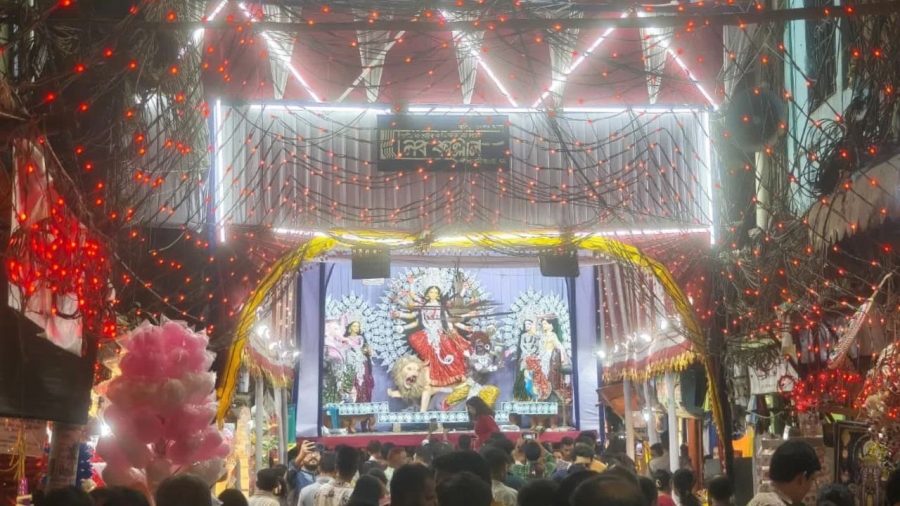



Old buildings frame both sides of narrow alleys, where glittering lights shine overhead and puja mandaps stand at the entry points. Shankharibazar is vibrant with the rhythmic beating of dhak drums and the resonant blowing of conch shells.
Residents gather on balconies and rooftops to view the deities, while a similar festive mood fills neighbouring Tantibazar.
Rather than expansive fields or wide avenues, it is in these tight lanes of Old Dhaka that the tradition of Durga Puja has endured for over a century. The formal rituals of Durga Puja commenced on Friday, with Maha Shashthi.
Despite space constraints, aged structures, and the press of urban life, local residents, traders, and organisers join hands every year to erect puja mandaps. Transcending religious bounds, these pujas serve as a grand reunion for neighbourhood communities.
Centuries of history, expanding mandaps
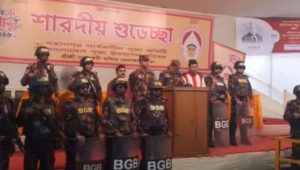
This year, 23 mandaps have been set up across Shankharibazar and Tantibazar, alongside 25 mandaps in the Sutrapur area. To ensure smooth celebrations, law enforcement agencies have strengthened security around these sites.
The history of Durga Puja in Dhaka stretches back several centuries.
Historian and economist Bhabatosh Dutta mentioned in his autobiographical writings that grand Durga Puja celebrations took place around 1830 at Nandalal Babu’s residence in Sutrapur’s Maisundi, where idols nearly two storeys high were crafted.

Although Durga Puja was once largely confined to the inner quarters of zamindars and elite families, it gradually spread from neighbourhood to neighbourhood.
From the 1930s onwards, universal community pujas expanded beyond private family arrangements. Following the 1947 partition, neighbourhood-based celebrations gained further momentum.
Local residents, business owners, and youths began organising the festivities collectively, constructing mandaps at alley entrances and turning the entire neighbourhood into the heart of the festival.
Shankharibazar and Tantibazar heritage
When discussing Durga Puja in Old Dhaka, Shankharibazar takes pride of place. Renowned since the Mughal era as the settlement of shankha (conch shell) artisans, the area constructs its puja mandaps amidst old buildings.
During the festival, the influx of visitors makes walking through the alleys difficult, prompting many to view the deities from balconies and rooftops.



Sadhan Kumar Shankhari, a veteran resident and puja organiser of Shankharibazar, said that from his father’s and grandfather’s time, worship in the alley has continued for a hundred years.
He added that although space is tight and stepping through the narrow lanes becomes challenging on festival days, the deep emotional bond and joy remain immeasurable.
Neighbouring Tantibazar and Swarnakarpatti also possess a rich Durga Puja legacy.
Local accounts indicate that puja celebrations in Tantibazar began in the 1920s through the initiative of goldsmiths and the Basak community, earning the area renown for idol craftsmanship, mandap decoration, and artistic lighting.
Ratan Chandra Basak, a trader in Tantibazar, said that wholesalers and artisans once stayed up night after night decorating the alley pandal together.
He noted that while modern touches have altered mandaps and illumination over time, the traditional warmth and ancient charm inside the alleys remain unchanged.
Community bonds across Old Dhaka neighbourhoods
In Laxmibazar, the spread of community pujas was driven by local residents and youths.
Celebrations at historic houses in Sutrapur’s Maisundi and Farashganj form an integral part of the region’s cultural history, while festivities in Banglabazar expanded with the active involvement of local traders and printing press workers.
Amaresh Chandra Kor, a veteran citizen and local history enthusiast of Sutrapur, said that alley pujas in Old Dhaka are not merely religious places of worship, but bridges of mutual harmony spanning a century.
He explained that when deities are installed inside crowded alleys, people of the entire neighbourhood unite regardless of religion or caste, creating a unique social solidarity that defines Old Dhaka.
Security measures and festival calendar
To maintain peace, security arrangements across mandaps have been intensified.
Dhaka Metropolitan Police (DMP) informed that 24-hour police presence and CCTV surveillance have been deployed at mandaps, with special monitoring planned for processions and gatherings on the day of idol immersion.
Bijoy Saha, general secretary of the Tantibazar Puja Committee, said that the festival began with Shashthi and expressed hope that with full administrative cooperation and security, the remaining five days would conclude smoothly.
KM Rabiul Islam, officer-in-charge of Kotwali Police Station, said that comprehensive security has been established using male and female police officers, Ansar personnel, and CCTV cameras.
According to the panjika (almanac), Maha Saptami falls on 17 and 18 October, Maha Ashtami on 19 October, Maha Navami on 20 October, and Bijoya Dashami on 21 October. Following Sindoor Khela and traditional rituals on the final day, the festival will conclude with the immersion of idols.
Organising pujas in Old Dhaka requires locals to constantly navigate space constraints, pedestrian movement, and shop operations.
Yet the core spirit remains intact, preserving Old Dhaka’s history, community bonds, and long-standing memories of communal harmony amidst old buildings and narrow lanes.