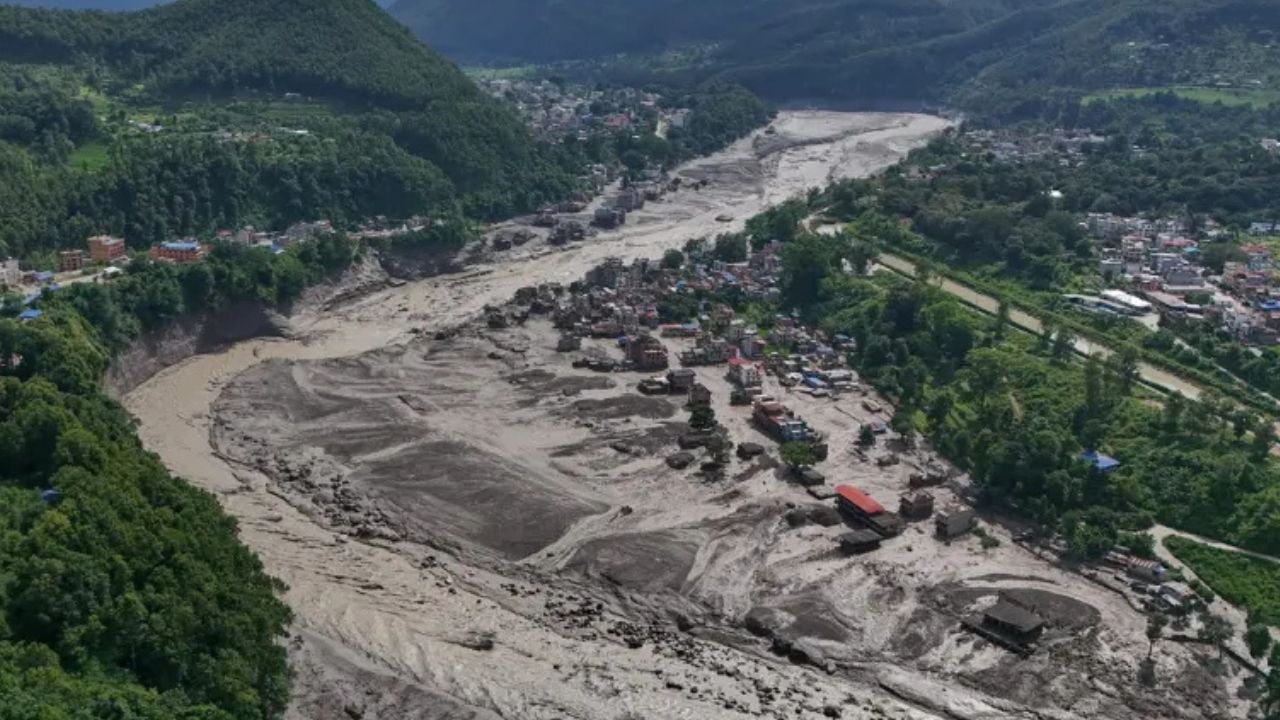



More than 1,300 people were reported missing and at least 165 confirmed dead after flash floods and landslides struck the Nepal–Tibet border.
Nepal’s disaster agency said Thursday that 823 people remained unaccounted for, including at least 579 Nepali and foreign tourists. The agency did not specify the nationalities of the uncontacted foreigners, AFP reports.
Across the border, China reported 558 missing, nearly half of them foreigners.
Hikers and climbers from around the world travel to the Himalayan nation to test themselves on its highest peaks, including Mount Everest.
What triggered the flash floods?
Officials said they were caught off‑guard on Wednesday because there had been no rainfall at the time. The disaster began high in the Himalayas when part of a glacier collapsed, unleashing a chain of events that sent a powerful surge of water and debris downstream.
Satellite imagery showed a large section of the glacier’s lower end broke away at about 5,200 metres (17,000 feet), plunging roughly 1,200 metres (3,900 feet) onto the valley floor. As it fell, the mass gathered rock and sediment, forming an ice‑rock avalanche.
The avalanche struck the Lhende River in Tibet, about 20km (12 miles) northeast of the Nepal–China border crossing. Debris temporarily dammed the river before the blockage gave way, releasing a destructive flood downstream.
Early reports suggested a magnitude 4.4 earthquake had triggered the collapse. But the US Geological Survey later clarified that the seismic signal was generated by the landslide itself, not an earthquake. The event eventually registered as a magnitude 5.2 seismic incident.
Where did the floods hit?
The disaster struck the mountainous Nepal–Tibet border region, with severe damage in Nepal’s Rasuwa district, just south of the Chinese border.
The initial surge entered the Lhende Khola, which flows into the Bhote Koshi and then the Trishuli River, carrying floodwaters south through Nepal. Water levels in the Trishuli reportedly rose by as much as 9 metres (27 feet) in only 30 minutes.

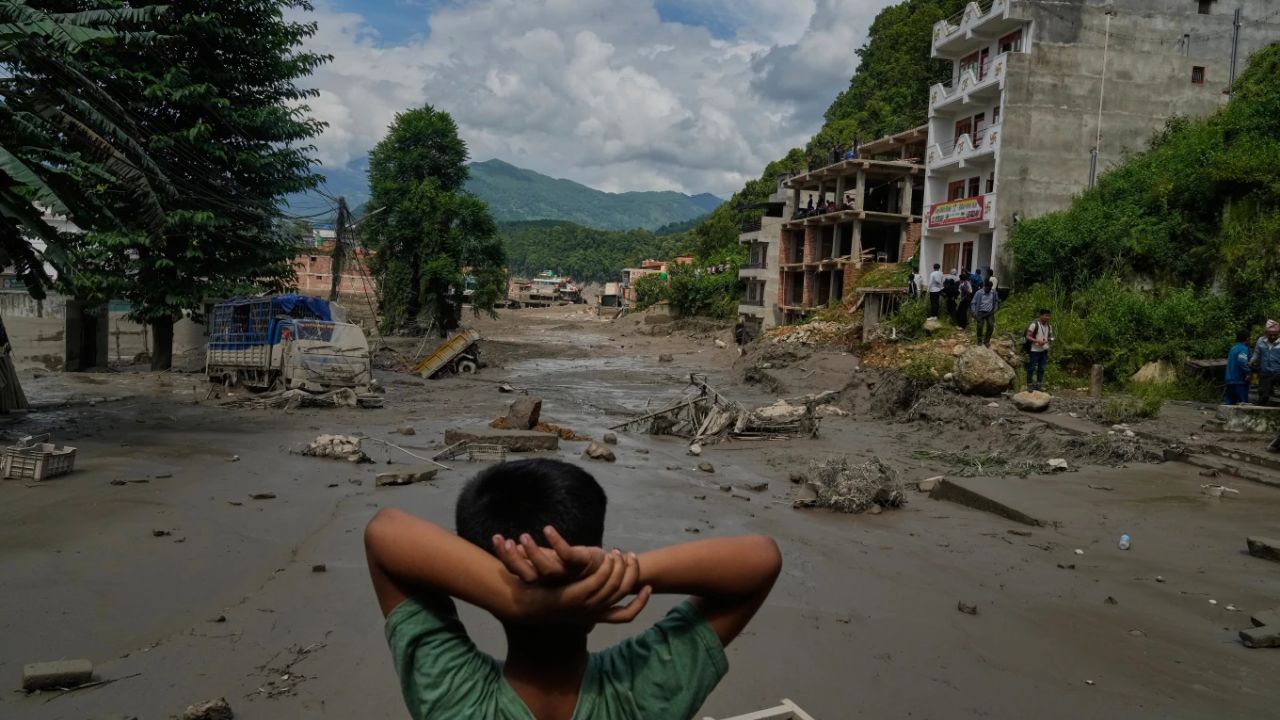
In Rasuwa, the settlements of Timure and Syapru Besi were among those hit. Further downstream, flooding reached parts of Nuwakot and Dhading districts, damaging homes, roads and infrastructure.
Across the border in Tibet, mud and debris struck Gyirong Port in the Shigatse region.
The Trishuli eventually joins the Narayani River, which flows into India’s Bihar state, where it is known as the Gandak River.
Who is missing?
Officials cautioned that the missing figures are likely to change. It is not uncommon for the number of missing people to increase but also decrease in the wake of a major disaster.
Double-counting of dual nationals, matching bodies with people listed as missing and the chaos of a calamity can all contribute to fluctuations in the figures.

China
In China, authorities said Thursday that 298 Chinese people were missing in the wake of the disaster.
India
According to the Nepal Tourism Board list that has not been updated since Wednesday, 142 nationals from neighbouring India were missing.
They were in the country with three travel agencies: Samrat Tours & Travels, Leaf Holiday and Himalayan Glacier.
Nepal’s latest figure of unaccounted for tourists lumped together foreigners and Nepalis, and did not breakdown the foreigners’ nationalities.
Ukraine
Ukraine’s foreign ministry said Nepal’s Tourist Police had informed them that they believed 53 Ukrainian nationals were missing.
They included a group of 46 Ukrainian tourists with whom the authorities in Nepal had lost contact, the ministry added.
Australia
Thirty-four Australians are missing following the floods, said Prime Minister Anthony Albanese.



“Our thoughts are with all those who will be concerned about their loved ones today,” he said.
The missing include 15 who were part of a group of pilgrims that include two teenagers, their tour company told AFP on Thursday.
Malaysia
Prime Minister Anwar Ibrahim said Thursday that more than 50 Malaysians in Nepal are unreachable following the floods.
United Kingdom
Twelve UK citizens with the Alpine Eco Trek agency were unaccounted for, the tourism board said on Wednesday.
And Himalayan Glacier said two Britons were among a group missing in the Rasuwagadhi area.
South Korea
South Korea’s foreign ministry said Wednesday that nine hydropower workers were out of contact in the Rasuwa district following the floods.
Japan
Prime Minister Sanae Takaichi said she was “concerned” by media reports that five Japanese nationals were missing.
“I am fervently praying that each and every irreplaceable life will be protected,” she said in a post on X.
South Africa
Four South Africans travelling with the same Alpine Eco Trek agency as the British citizens were missing, according to the tourism board’s list from Wednesday.
United States
Three US citizens, also with Fishtail Tours & Travels, were unaccounted for, the board said on Wednesday.
Himalayan Glacier managing director Sanket Pandey also said eight Americans were among the group missing.
Portugal
Portugal’s foreign ministry said a woman and a man had gone missing in the floods.
“We continue to monitor the situation minute by minute,” a ministry spokesperson told AFP.
Netherlands
A Dutch citizen travelling with the same company as the missing Australian was also unaccounted for, the board added on Wednesday.
Italy
The Italian foreign ministry said two of its nationals and their guide were stranded upstream from a landslide but were receiving help.
The ministry is aware of 90 Italian citizens currently in Nepal and Tibet, but does not know if any might have been affected.
New Zealand
The foreign affairs ministry said five New Zealanders were unaccounted for.
Other nationalities
Also among the missing are 10 Canadians and two Singaporeans, Himalayan Glacier managing director Sanket Pandey said.
Nationalities unconfirmed
The missing figure released Thursday by China included 260 foreigners, but no breakdown on nationalities was provided.
Several of the tour groups operating in Nepal also announced missing foreigners whose nationalities had not been confirmed.
They included 77 with Trekkers Society, 26 with Kailash Journey and eight with Richa Tours & Travels.
Who is leading search and rescue efforts?
South Korea has set up a government task force after several of its nationals working at a hydropower project were reported missing. Seoul said it would dispatch a rapid‑response team of government, fire and police personnel to Nepal to assist in the search.
The United States announced it was sending a disaster response adviser and providing $500,000 in aid.
Canadian Prime Minister Mark Carney said Canada was closely monitoring the situation, describing the floods as “absolutely devastating.”
On the Chinese side, President Xi Jinping ordered an “all‑out” search‑and‑rescue operation in Tibet and called for measures to prevent further disasters.
More than 5,000 Nepalese army and police personnel are engaged in rescue operations, searching for survivors and recovering bodies. Helicopters are delivering tents, food and other emergency supplies to communities cut off by the floods.

Officials warned the death toll is expected to rise as rescuers reach areas still inaccessible due to damaged roads, high water levels and thick mud.
In Tibet, Chinese authorities are also monitoring a dammed lake upstream from Gyirong that could complicate rescue work and pose an additional flood risk.
Who is sending humanitarian aid?
India has sent a rescue aircraft carrying about 10 tonnes of emergency supplies to Nepal, including temporary shelters, blankets, hygiene kits, solar lamps and medicines. Prime Minister Narendra Modi spoke with Nepalese Prime Minister Balendra Shah and pledged India’s support.
The International Federation of Red Cross and Red Crescent Societies (IFRC) has released 1 million Swiss francs ($1.2m) in emergency funding to support the Nepal Red Cross Society’s relief operations and damage assessments.
How are international bodies helping?
The United Nations has deployed personnel in Nepal to support government‑led relief efforts, while its office in China said it was ready to assist operations in Tibet. UN Secretary‑General Antonio Guterres expressed condolences to those affected and said the organisation stood in solidarity with communities hit by the disaster.
The European Union has activated its Copernicus Emergency Management Service, which uses satellite imagery to map disaster zones and provide data to help authorities assess damage and coordinate rescue operations.