



For more than a decade, Swarit Hriti Bhore’s family has relied on rice bran oil for cooking. Over the years, the price of the oil has increased far less than soybean oil, helping keep household cooking expenses relatively stable.
When rice bran oil entered the market in 2010, it was priced at around Tk185 per litre. Sixteen years later, it remains available at around Tk220 per litre, with a five-litre bottle selling for around Tk1,070 after discounts at supermarkets.
In contrast, soybean oil prices have risen from Tk84 to Tk204 per litre during the same period.
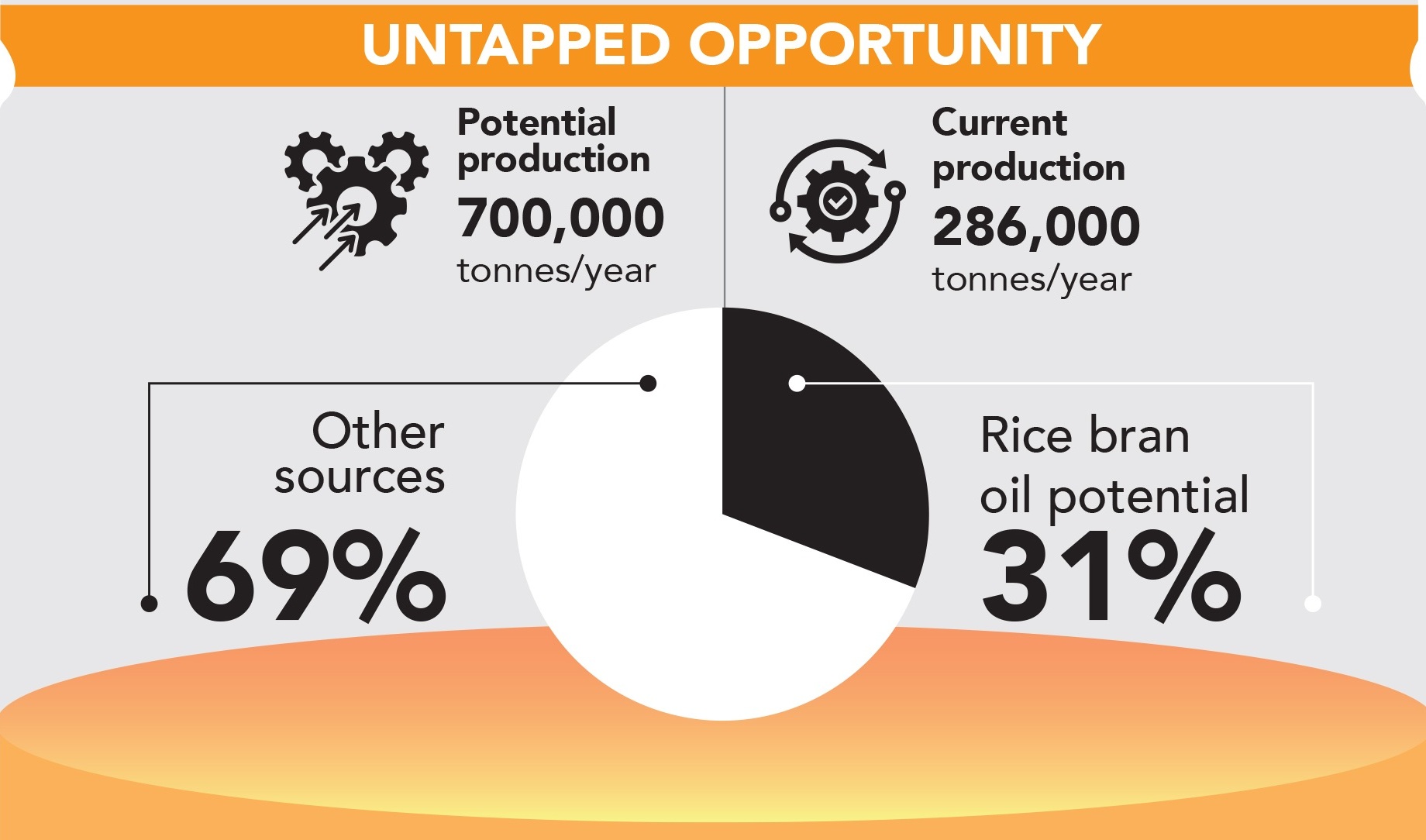
Despite its price advantage and Bangladesh’s large paddy production base, rice bran oil remains far below its potential. Industry estimates suggest the country is currently utilising only around one-third of its possible production potential, leaving a significant portion of its capacity unused.
Greater utilisation of this potential could increase domestic edible oil supply, reduce prices further and help lower Bangladesh’s dependence on imported soybean and palm oil.
According to the Bangladesh Trade and Tariff Commission (BTTC), the country consumes around 2.2–2.3 million tonnes of edible oil annually. Based on domestic paddy production, the country has the potential to produce around 700,000 tonnes of crude rice bran oil every year.
Bangladesh produces more than 42 million tonnes of paddy annually. Farhad Hossain Chowdhury, general secretary of the Naogaon Rice Mill Owners’ Group, told TIMES that one tonne of coarse paddy produces around 120kg of bran, while fine paddy produces around 100kg.
Based on this calculation, Bangladesh can produce more than four million tonnes of rice bran annually.

Rice bran contains 15–25 per cent oil, while commercial mills can extract around 18–22 per cent crude oil from bran. Around 6–7kg of bran is required to produce one litre of oil.
This means rice bran oil has the potential to meet around 31 per cent of Bangladesh’s annual edible oil demand, reducing pressure on foreign currency reserves spent on imports.
However, the industry has struggled to expand in line with this potential, mainly due to difficulties in securing rice bran, the industry’s key raw material, along with electricity shortages, limited domestic demand and policy challenges.
Around 20 rice bran oil factories in Bangladesh have a combined annual production capacity of 450,000 tonnes. Actual output stands at around 286,000 tonnes, leaving around 167,000 tonnes, or nearly 37 per cent of installed capacity, unused.
Industry operators said the gap between installed capacity and actual production reflects the shortage of raw materials needed to run factories at full capacity.
Debabrata Mallick, manager of Majumdar Bran Oils Ltd, told TIMES that production has declined due to a shortage of rice bran, with electricity load shedding worsening the situation.




“Previously, a single rice mill could supply one truck of bran daily. Now, it is difficult to collect one truck even from five mills combined,” he said.
He said the company was able to collect 25–30 trucks of bran daily even 15–20 days ago, but the volume has now fallen to around five trucks.
Majumdar Bran Oils’ two units in Noapara and Chenguria have daily raw material processing capacities of 500 tonnes and 400 tonnes respectively. However, the plants cannot operate at full capacity due to insufficient raw materials.
Debabrata said several rice bran oil mills in the southern region have been facing the same crisis for the past two months.
Ranjan Chakraborty, a representative of Majumdar Products Ltd, said Bangladesh had 11–12 rice bran oil factories five or six years ago, but the number has now increased to around 18–19. However, raw material supply has not increased at the same pace.
“To operate a large plant at full capacity, around 600 tonnes of rice bran are required daily. But considering the two paddy harvesting seasons, factories can operate at relatively full capacity for only about five months a year,” he said.
Industry operators said uninterrupted electricity supply, improved bran collection systems, fair prices for farmers and stable market policies are needed to unlock the sector’s potential.
Despite limited domestic consumption, exports have helped sustain the industry. More than 25 per cent of total production is exported.
Initially, a significant portion of Bangladesh’s rice bran oil industry depended on exports, particularly crude oil exports to India. According to BTTC data, around 70,000 tonnes of crude rice bran oil were exported annually in 2024.
Later, domestic demand increased after the oil was marketed through the Trading Corporation of Bangladesh (TCB). On 20 May, the government decided to purchase one crore litres of refined rice bran oil from several local companies.
However, the export market has also created a policy dilemma: whether Bangladesh should prioritise increasing domestic supply to reduce edible oil import dependence or continue promoting exports to earn foreign currency.
To increase local availability, the government has changed export duties on rice bran oil several times over the past two years.
In February 2025, a 25 per cent regulatory duty was imposed on exports of crude and refined rice bran oil. After the expiry of that duty, a notification issued on 17 September 2025 reduced the rate to 20 per cent.
In June 2026, the government cancelled the previous notification and set a 10 per cent regulatory duty on exports of rice bran oil and its fractions, whether refined or crude.
Exports remained significant. According to a BTTC report, Bangladesh exported around 75,000 tonnes of rice bran oil in the 2024–25 fiscal year, earning around Tk974 crore.
In September 2025, the government allowed 23 companies to export an additional 58,000 tonnes of rice bran oil.
Mahmadul Hasan, deputy chief of the Trade Policy Department at BTTC, told TIMES that increasing domestic supply of rice bran oil could help reduce edible oil import dependence if that remains the government’s priority.
“However, if higher foreign currency earnings can be generated through exports, that should also be considered from an economic perspective,” he said.
Explaining the export argument, he said, “If importing soybean or palm oil costs Tk15, while exporting the same quantity of rice bran oil earns Tk30, exports may be economically more beneficial.”
He said the decision requires a balance between domestic food security goals and export earnings, considering international prices, import costs, export revenue and the overall economic situation.
For Bangladesh, the challenge is no longer whether rice bran oil can be produced, but whether the country can build the supply chain needed to convert its unused potential into actual production.