Bangladesh’s leather industry is leaving billions of dollars in value on the table, with more than 65 per cent of the country’s hides and skins exported as low-value crust leather.
According to a policy paper presented by South Asian Network on Economic Modeling (SANEM) at a policy dialogue at BRAC Centre Inn, Mohakhali on Thursday, processed leather accounts for just 6.8 per cent of the sector’s export earnings.
Leading buyers such as China, Vietnam and Italy are importing this raw or semi-processed material, adding value, and re-exporting it at a premium, representing the single largest untapped opportunity for Bangladesh.
Despite holding 2.4 per cent of the world’s livestock, Bangladesh accounts for roughly 1.13 per cent of global leather production, with more than 200 tanneries producing around 35 million square feet of leather annually.
Although leather remains the country’s second-largest export earner after ready-made garments, employing approximately 198,000 workers and reaching 105 markets, its contribution to GDP has remained stagnant at around 0.5 per cent over the past decade.

Selim Raihan, executive director of SANEM and professor of economics at Dhaka University, pointed to coordination gaps among ministries, weak monitoring, and unstreamlined incentive structures as major barriers to the sector’s potential.
Calling for a shift towards finished products, Syed Nasim Manzur, president of Footwear, Leathergoods and Accessories Exporters Association (FLAXA), suggested that Bangladesh could import raw hides for processing in the same manner it imports cotton for the textile industry.
He asserted that a comprehensive strategy and a targeted roadmap could make a $5 billion export target achievable.




The research was supported by Australian High Commission in Bangladesh.
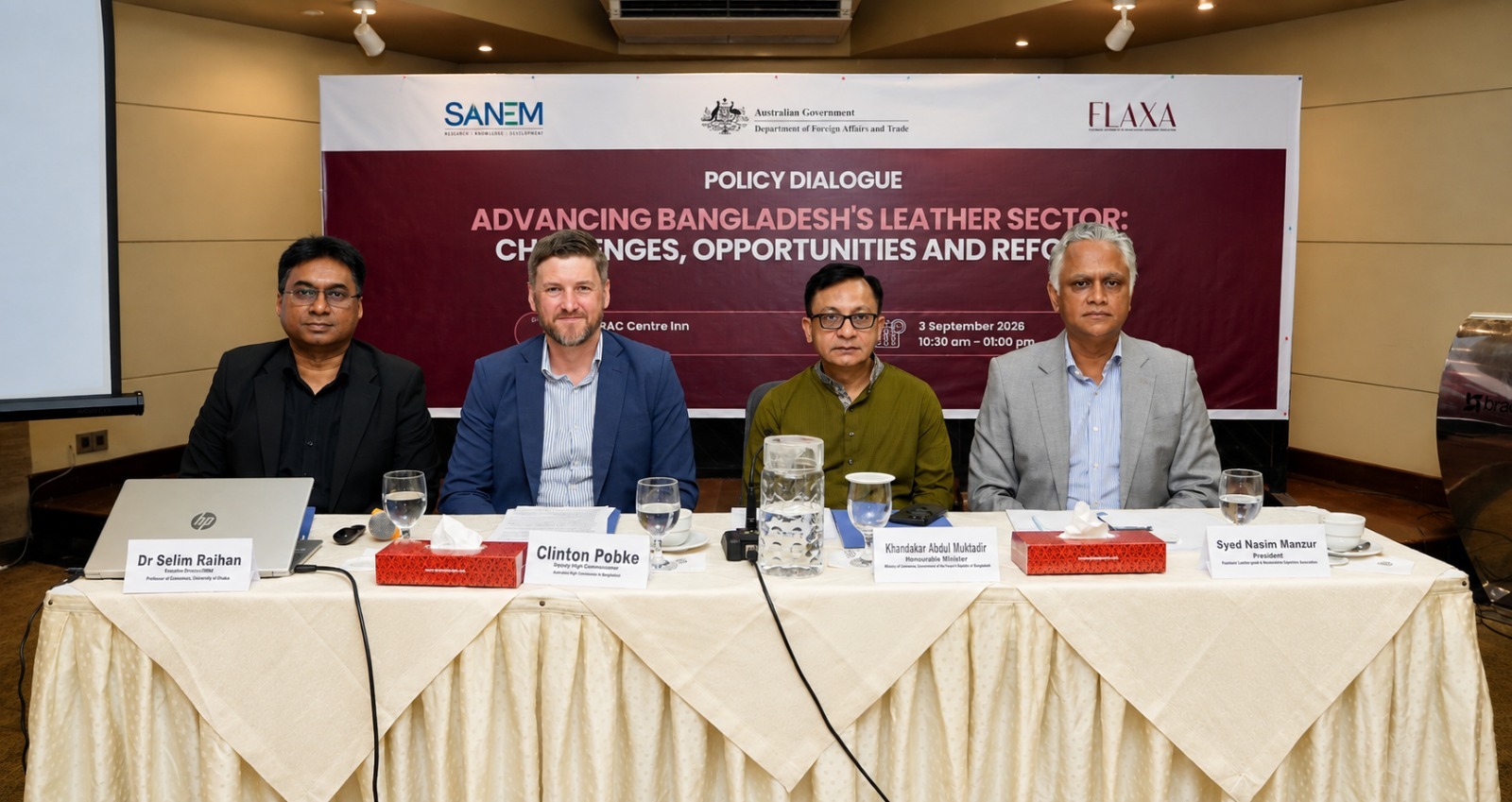
Deputy High Commissioner Clinton Pobke emphasised that decisions taken in the next two years will shape whether the sector captures value domestically or continues to pass it downstream, particularly as the nation prepares to graduate from least developed country (LDC) status.
Participants at the dialogue called for policy parity with the garment sector, highlighting that non-leather exporters holding bond licences are excluded from the cash incentives available to other exporters.
They also urged the government to establish single-window licensing to ease the heavy burden of certificates and licences, increase domestic testing capacity, and set up a coordinating mechanism across multiple ministries.
Additionally, industry figures pointed to the massive potential of non-leather footwear, which is growing faster than leather footwear and already accounts for nearly one-third of the sector’s exports, despite Bangladesh currently holding less than half a per cent of the $100 billion global market.
In response to these concerns, Commerce Minister Khandakar Abdul Muktadir announced that Bangladesh will seek full duty-free access to Japan for both leather and non-leather products, noting that Japan has placed leather in its main negotiation category.
He added that a separate arrangement with South Korea already provides zero-duty access.
Muktadir committed to simplifying customs and bond-related processes and working to attract Spanish and Italian investment to the tannery estate.
He announced that a design and skills institute near Hemayetpur, jointly managed by the industry and an international partner, is expected to begin operating in 2027. The government is also set to announce its national leather sector plan shortly.
Stressing the need for domestic value addition, the minister concluded that hides should be processed into finished products locally before export, stating, “We have the employment capacity for it, and we have every reason to want the foreign currency.”