The senate, the highest policy-making body of Rajshahi University (RU), has remained inactive for nearly a decade, raising concerns over transparency, accountability, and participatory governance at the autonomous institution.
Under Section 21 of the Rajshahi University Act, 1973, the vice-chancellor is required to convene at least one Senate meeting annually.
However, the university senate’s last session – the 22nd – was held on 19 May 2016 under then vice-chancellor, Prof Muhammad Mizanuddin.
Following the July-August uprising in 2024, elections were held for student representatives in the Senate, raising hopes that the long-dormant body would finally be revived.
However, nine months on, student representatives say little progress has been made towards holding a session.
They attribute the delay to a failure to hold elections for registered graduate representatives and complete the appointment process for other membership categories. The university administration, however, maintains that it is working to restore the Senate’s operations.
This is not the first prolonged hiatus for RU’s Senate. Following the 20th session on 28-29 June 2001, the body lay dormant for 14 years before Prof Mizanuddin convened the 21st session on 18 May 2015.

The 22nd session followed the next year, but no meetings have been held since.
Under Section 20 of the Act, the RU Senate comprises 105 members. The vice-chancellor serves as the ex-officio chairman, with the pro-vice-chancellor and treasurer as members, and the registrar acting as secretary.
The senate also includes government nominees, MPs nominated by the speaker, academics appointed by the chancellor, representatives from research institutions, college principals, teachers, education board delegates, registered graduate representatives, and elected faculty and student representatives.
Of the 150-member body, 20 seats including five members of parliament nominated by the speaker remain vacant.
With the exception of the vice-chancellor, pro-vice-chancellor, treasurer, registrar, and five student representatives, the terms of most members expired long ago.



The senate plays a critical role in university governance, including electing the vice-chancellor, approving budgets, amending university statutes, and sanctioning new departments and institutes.
Its prolonged inactivity has raised serious questions about the legitimacy and rigor of the institution’s decision-making processes.
Calls for revival
Prof Amirul Islam of the Department of Biochemistry and Molecular Biology, who also serves as General Secretary of the Jatiyatabadi Shikkhak Forum, emphasised that major administrative decisions should ideally pass through the Senate.
“While certain decisions can be made through alternative channels, decisions taken by the senate ensure greater transparency and give stakeholders a voice. Regular senate sessions are therefore essential,” he said.
Following the political shifts of 2024, Prof. Saleh Hasan Naqib of the Department of Physics assumed office as vice-chancellor, during whose tenure elections for the Rajshahi University Central Students’ Union (RUCSU) and Senate student representatives were conducted.
Addressing the delay in convening the senate, Prof. Naqib explained that the administration encountered significant difficulties updating membership records.
“After taking charge, we attempted to verify the status of existing Senate members. Many could not be traced, some had passed away, and the whereabouts of others remained unknown,” he said, adding that years of neglect had complicated the auditing and updating process.
Students demand action
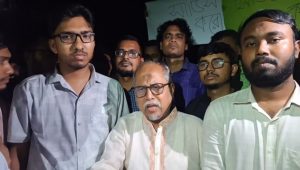
Senate student representative Fahim Reza said that students have repeatedly pressed the administration to convene a meeting.
“Other universities have taken concrete steps to reactivate their senates. Despite repeated assurances, we have seen no tangible progress here,” he said, warning that students would launch a democratic movement if formal measures are not taken soon.
RUCSU General Secretary and Senate student representative Salahuddin Ammar noted that holding fresh elections for registered graduate representatives is vital to reconstituting the body.
“The responsibility for arranging these elections lies with the university administration. While the vice-chancellor is sincere about resolving the issue, administrative hurdles have delayed the process,” he said.
Administration rejects criticism
RU Vice-Chancellor Prof Faridul Islam said that his administration is actively working to make the senate functional.
“Following the July-August political changes, the previous administration remained in office for 17 months. Why did they fail to convene the senate during that period? My administration has been in place for only two and a half to three months,” he said.
“We are exploring all viable avenues to restore the senate so that key university decisions can once again be made through this forum.”
Immediate past vice-chancellor, Prof Saleh Hasan Naqib, dismissed criticism of his tenure, arguing that the Senate’s inactivity stems from a systemic, long-term issue.
“We were in office for only a year and a half. The context of the preceding 15 years must also be taken into account,”
Prof Naqib said. “The current administration has four years ahead of it to restore the Senate. Holding us solely responsible for this situation is unjust.”