
Bangladesh entered the new fiscal year with renewed pressure on its external sector as imports rose sharply while exports declined, widening the trade deficit by nearly 38 per cent in July despite strong growth in remittances.
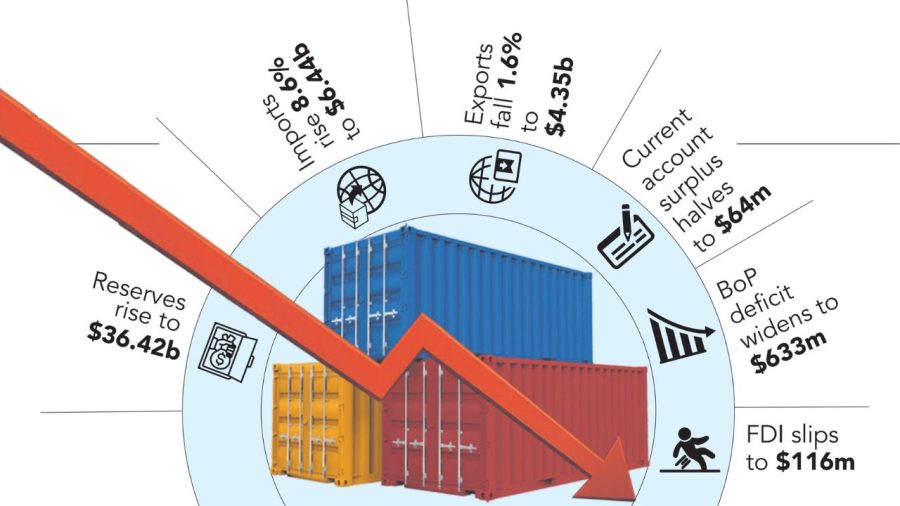
The divergence between imports and exports emerged as the main source of pressure. Imports rose 8.6 per cent year-on-year to $6.44 billion, while exports fell 1.6 per cent to $4.35 billion. As a result, the trade deficit widened to $2.09 billion from $1.51 billion a year earlier.
Strong remittance inflows prevented the deterioration in trade from pushing the current account into deficit. Workers’ remittances increased 15.4 per cent to $2.86 billion, while private transfers rose 14.9 per cent to $2.90 billion.

But even that increase was not enough to absorb the growing trade pressure. The current account surplus almost halved to just $64 million from $125 million a year earlier. The decline is particularly significant because other components of the current account improved. The services deficit narrowed to $460 million from $526 million, while the primary income deficit fell to $283 million from $360 million. Official interest payments also dropped to $143 million from $203 million.



This leaves merchandise trade as the main source of renewed external pressure at the start of FY2026-27. The weakness was also visible in Bangladesh’s biggest export industry. Readymade garment exports fell 1.9 per cent to $3.89 billion from $3.96 billion a year earlier, leaving the country’s main foreign-exchange earning sector unable to offset the rise in imports.
The pressure spilled over into the overall balance of payments. The BoP deficit widened to $633 million in July from $545 million a year earlier. The financial account offered little relief, remaining in deficit at $677 million. Net foreign direct investment slipped to $116 million from $122 million, while portfolio investment swung from a $12 million inflow to a $38 million outflow.
Longer-term external financing also remained weak. Medium and long-term loan disbursements fell 12.6 per cent to $180 million, while repayments were more than twice that amount at $391 million. Net aid flows consequently remained negative at $212 million.
Bangladesh, however, entered the fiscal year with a substantially stronger reserve buffer. Gross official reserves stood at $36.42 billion in July, compared with $29.80 billion a year earlier. Reserves measured under BPM6 increased to $31.60 billion from $24.78 billion. The reserve stock was sufficient to cover 4.8 months of goods and services imports, up from 4.3 months a year earlier.