

Proposed changes to recruitment rules and the formation of a minister-led committee to fast-track appointments have raised concerns among students, former bureaucrats and public administration experts over the potential for political influence in government recruitment.
The controversy centres on two moves: increasing the marks allocated for viva examinations for Class 11 to Class 20 government jobs and forming a four-member committee headed by the state minister for public administration to expedite recruitment for sub-assistant agriculture officer posts through the Public Service Commission (PSC).
Critics say the moves could undermine the BNP’s pre-election pledge to make merit and qualifications the primary basis for recruitment and keep government appointments free from political influence.
The concern comes nearly seven months after the party came to power promising to establish a recruitment system based on merit and qualifications.
Viva marks at centre of controversy
Under the proposed changes to recruitment rules, Class 11 and Class 12 positions will carry 100 marks for written examinations and 50 for viva. For Class 13 to Class 16 positions, written examinations will carry 60 marks and viva 40. For Class 17 to Class 20 positions, both written and viva examinations will carry 25 marks.
Students and experts fear that giving greater weight to viva examinations will create more scope for personal preference, recommendations, nepotism and political influence because oral assessments are more subjective than written tests.
The issue is particularly notable because BNP leaders previously criticised the high weight given to viva examinations under the previous system.
Home Minister Salahuddin Ahmed, speaking on 31 July 2025, had criticised the previous system of allocating 200 marks for viva examinations.
“During the Awami League era, corruption mainly had opportunities to occur because 200 marks were allocated for viva examinations. If that is reduced to 50 or 100, there will be no scope for such corruption,” he had said.

Prime Minister’s Adviser on Policy and Strategy Zahed Ur Rahman, however, defended the proposed changes.
Responding to questions from journalists at the Secretariat, he asked, “Is viva not an examination?”
Acknowledging that viva examinations can involve bias, he referred to his own medical education experience. “I studied medicine. I had to sit for viva examinations worth twice the marks of my written examinations,” he said.
The government says the changes are intended to improve the quality of recruitment by allowing authorities to assess candidates beyond their written examination performance.
A pledge of political neutrality
The BNP’s election manifesto promised a recruitment system free from political influence.
Under its “Meritocracy Bangladesh” pledge, the party promised that merit, integrity, creativity, efficiency, experience and training would be the sole criteria for recruitment, promotion and postings.




The manifesto also promised to strengthen and restructure the PSC to ensure transparent and neutral recruitment in sectors including education and health.
During the election campaign, BNP Chairperson Tarique Rahman accused the previous government of politicising government and semi-government jobs.
Since assuming power, however, the government’s contractual appointments of BNP leaders and former leaders of affiliated organisations to senior positions in government agencies, boards and corporations have also drawn criticism over political influence.
Students see room for manipulation
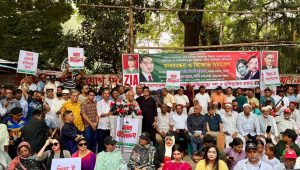
Students have already staged protests at campuses including Khulna, Rangpur, Rajshahi, Cumilla, Barishal, Islamic University and Jahangirnagar University.
They say reducing written examination marks while increasing viva marks could make recruitment more vulnerable to recommendations and political or personal influence.
Students raised slogans including “Quota or merit”, “Viva against quota, direct action”, “No uncle-aunt recommendations” and “Stop politicisation in the name of viva”.
Rayhan Hasan Rabbi, who joined a protest at Jahangirnagar University, told TIMES, “The greatest scope for irregularities in recruitment examinations is created during viva.”
The Dhaka University Central Students’ Union has described the initiative as a “new form of quota”.
Professor Sadik Hasan of the Department of Public Administration at the University of Dhaka said the students’ concerns were not unfounded.
“In awarding viva marks, there have often been instances where objective methods were not followed, with some candidates receiving favour while others faced bias. Past experiences show that there is scope for manipulation in viva examinations,” he told TIMES.
Former secretary and former rector of Bangladesh Public Administration Training Centre AKM Abdul Awal Majumdar also criticised the proposal to increase viva marks.
“This will bring disrepute to the government, expand corruption, obstruct good governance and harm the state. Such rules may increase irregularities and arbitrariness in recruitment,” he told TIMES.
Former additional secretary Mohammad Firoz Mia warned that greater weight on viva could allow recruitment decisions to depend heavily on the preferences of interview committee members.
“Since there is no record of the oral examination, someone with low written marks can be selected by giving them higher viva marks, while a candidate with high written marks can be eliminated through lower viva marks,” he said.
Former secretary Anwar Faruk also said, “The proposed structure will not be appropriate. There is a risk that unqualified people could enter the administration based on political considerations.”
Minister-led panel raises PSC questions
The concern over recruitment neutrality extends beyond the proposed viva changes.
The government has formed a four-member committee to expedite recruitment for vacant posts of sub-assistant agriculture officers.
State Minister for Public Administration Md Abdul Bari has been made the convener, with the cabinet secretary, principal secretary to the prime minister, and public administration secretary as members.
The PSC previously conducted examinations and recommended appointments for these posts.
There are 14,100 posts of sub-assistant agriculture officers, of which the agriculture ministry has sought recruitment for 3,751 vacant positions through the PSC.
The government notification says the committee will take necessary steps to speed up the recruitment process and may add new members if required.
It remains unclear, however, how the committee will accelerate a recruitment process handled by the PSC.
Experts say the move raises questions about the role of the ministry in a recruitment process that has traditionally been conducted by the PSC, particularly when considered alongside the proposed changes to viva marks.
Professor Muhammad Sayadur Rahman of the Department of Public Administration at Jahangirnagar University said the government may have legitimate concerns about the time taken by the PSC, but the proposed mechanism could create questions over institutional independence.
“One reason could be that PSC recruitment takes comparatively more time. But this would increase the scope for ministry authority or control. The main concern is the transparency and neutrality of the recruitment process,” he told TIMES.