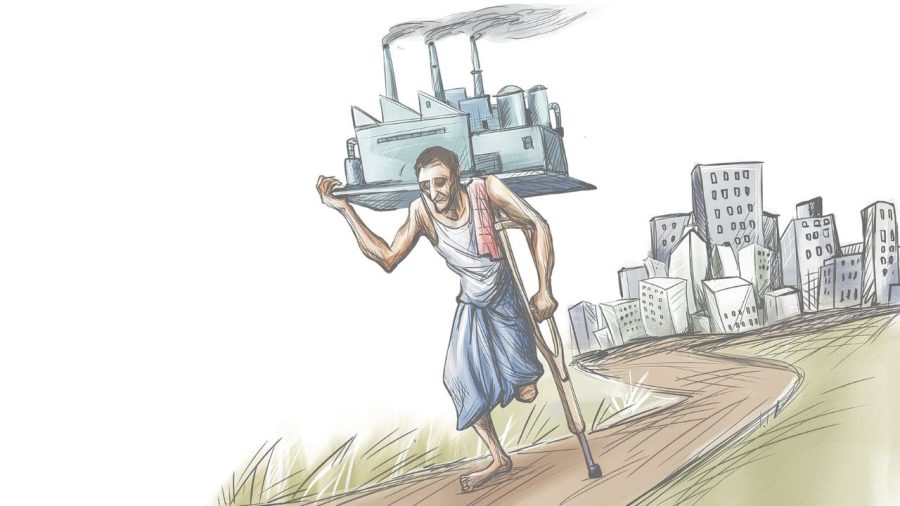

A well-dressed man walked into a private bank and asked for help filling out his cheque, surprising those around him when they discovered he could not write.
The incident reflects a broader reality in Bangladesh, where millions still lack the reading, writing and basic calculation skills needed in everyday life despite years of government claims of achieving universal primary school enrolment.
Government statistics show that nearly 70 million people in the country remain “functionally illiterate”, accounting for 37 per cent of the nearly 180 million population.
The figure raises questions over Bangladesh’s readiness for Industry 5.0, which aims to combine technology with human capabilities for social, environmental and economic development.
Former caretaker government adviser Rasheda K Chowdhury told TIMES, “It is not possible to achieve the government’s target of a trillion-dollar economy by keeping such a large number of people illiterate.”
According to the latest 2025 report of the Bangladesh Bureau of Statistics (BBS), the country’s literacy rate stands at 77.9 per cent. However, a functional literacy assessment survey conducted by the same organisation found that only 62.92 per cent of people could read, write, understand and perform calculations required in practical life.
This means a significant number of people officially counted as literate have not achieved functional literacy.
“According to the definition of Unesco, this is actually literacy. A person must be able to read, write and perform mathematical calculations to be considered literate,” Rasheda said.

Despite the scale of the problem, functional literacy has received limited policy attention. While political parties in the 1990s spoke about building an illiteracy-free country, the issue has largely disappeared from election manifestos and political programmes. The education ministry also has no specific initiative addressing it.
Government data shows the literacy rate is rising by around one percentage point annually. At that pace, Bangladesh would require nearly four decades to achieve full literacy.
Educationists say universal literacy is essential for vocational education, skilled workforce development and sustainable economic growth, as technical training cannot effectively reach people who lack basic literacy skills.
They say Bangladesh remains behind in developing skilled human resources, while transforming its population into human capital remains largely a slogan.
As Bangladesh discusses participation in Industry 5.0, experts say the country must shift focus from literacy figures to practical skills.
Mohammad Mostafizur Rahaman, deputy director of the Campaign for Popular Education, told TIMES, “Digital service use, understanding medicine instructions, banking or financial transactions, filling out government forms and following written instructions at workplaces – all these are now parts of functional literacy.”



“While welcoming the numerical progress in literacy, our next goal should be moving from literacy to functional literacy,” he said.
He said the first step should be a reliable assessment of where literacy gaps exist among different age groups and communities.
Based on such data, he suggested introducing region- and community-specific programmes instead of applying a single approach nationwide.
Basic literacy generally refers to the ability to write one’s name or read simple text. Functional literacy measures whether a person can understand information used in daily life, communicate effectively and perform calculations.
A functional literacy assessment survey conducted between 1 January 2021 and 30 June 2023 collected data from all districts among people aged seven years and above.
The survey found functional literacy among those aged seven to 14 years at 72.97 per cent, while the rate among people above 15 years was 60.77 per cent.
A 2011 functional literacy survey among people aged 11 to 45 years found the rate at 53.70 per cent.
In comparison, literacy measured only by the ability to write one’s name stood at 16.8 per cent in 1971, when Bangladesh gained independence. It rose to 25.9 per cent in 1974.
The rate increased to 35.3 per cent in 1991, 47.9 per cent in 2001, 59.82 per cent in 2010 and 77.9 per cent in 2025.
Mohammad Mojibur Rahman, chairman of the Department of Non-formal and Lifelong Education at the Institute of Education and Research of the University of Dhaka, told TIMES, “The foundation of lifelong learning is literacy. If the relationship between literacy and people’s work can be connected, it creates skilled manpower.”
“The impact on the economy is huge. If achieved, GDP, GNP and remittance all increase,” he said.
“The Philippines has been able to do this. That is why they can export skilled manpower. But we export workers. That is why our earnings are lower. Due to the high rate of illiteracy, social disorder is also higher,” Mojibur said.
An analysis of political parties’ election manifestos during the 2026 national election found that no party promised to make Bangladesh fully literate.
The 2008 election manifesto of the Awami League included a commitment to eliminate illiteracy. However, despite remaining in power for 15 years, the party failed to achieve the target.
Professor Mojibur said, “Instead of creating smart teachers and smart manpower, we focus more on digital classrooms and smart boards. Because there are procurement issues, financial connections and opportunities for corruption.”
“But achieving 100 per cent literacy is possible by using the existing structure. It only requires political will and proper management,” he said.
He suggested involving students under teachers’ supervision to help make community members literate.
“The government can announce a crash programme where educated people from different sections of society can participate through the ‘each one, teach one’ model,” he said.
Previous governments tried to improve literacy through the Bureau of Non-Formal Education with support from various non-governmental organisations. However, progress fell short as the programmes were long-term and many organisations lacked the required capacity.
Professor Mojibur said a government-led crash programme could achieve full literacy within two to three years if treated as a priority campaign. He cited Cuba’s literacy initiative as an example.
Rasheda K Chowdhury said, “The literacy eradication programme has been delayed due to a lack of political will and administrative opacity.”
“Again, it cannot be done through administration alone. Local communities must be involved. Needs differ from one place to another. Projects should be designed considering those differences. The same strategy will not work everywhere,” she said.