



The agriculture and livestock sectors in Chattogram are yet to recover from the devastating impact of recent heavy monsoon floods. The extensive damage to crops, vegetables, fish, poultry, and cattle continues to severely impact local commodity markets.
With local production heavily hit, the region’s markets are increasingly dependent on supplies brought in from other districts.
Although supply has recorded a slight increase over the last few days, daily commodity prices remain far from comfortable levels.
Amidst this vulnerability, consumers and traders are now expressing deep anxieties that the government’s decision to increase the salaries and allowances of public servants could trigger fresh inflationary pressure on the market.
They fear that if increased demand and commodity prices rise before the region can recover from the flood losses, private sector employees, the lower-middle class, and general working-class people will bear the heaviest brunt.
A visit to Bahaddarhat, one of the largest kitchen markets in Chattogram city, on Friday revealed these widespread concerns among shoppers.
Rasheda Begum, a private sector employee residing in Cosmopolitan Residential Area, said she had no objection to public servants receiving pay hikes. However, she warned of its wider market implications.
“The government is only thinking about public employees and raising their salaries and allowances, which we do not object to,” she said.
“But the resulting impact on the market touches people of all classes and professions, and private sector employees and ordinary working-class people suffer the most,” she added.
Another consumer, Masud Alam, pointed out that while the impact of salary hike might not be felt immediately, it could gradually influence the prices of daily essentials over time.

He urged the government to focus on maintaining the purchasing power of the general public alongside raising public sector salaries.
Aman Ullah, a grocer at Bahaddarhat, said a salary hike announcement typically creates apprehensions of price hikes in the market.
“The announcement has only just been made, and we have not yet seen a major impact on the retail market of rice, lentils, and other daily essentials,” he said.
He added that retail prices would only increase if wholesale prices went up. “The big question now is how the government will control this,” he mentioned.
Lingering scars of the flood
The recent devastating floods, triggered by heavy rainfall, caused widespread havoc across Chattogram’s agriculture and livestock sectors, damaging crops, vegetables, fish, poultry, and livestock.
Affected farmers and farm owners are still struggling to rebuild their livelihoods.
This decline in local production has forced Chattogram to rely heavily on products sourced from outside the district, altering the supply chain and driving up the prices of daily necessities.



Nonetheless, some minor signs of relief are appearing.
Firoz Alam, a vegetable retailer at Aturar Depo kitchen market, mentioned that prices had spiked suddenly after the floods.
“Now, supply is increasing, and the prices of some commodities have started to fall,” he said. “However, they are not decreasing at the same rate they rose,” he added.
A market survey showed that while the supply of some vegetables has improved, prices remain high.
Pointed gourd, cucumbers, okra, luffa, and ash gourd are retailing between Tk60 and Tk80 per kg. Papaya is priced at Tk30 to Tk40 per kg, aubergine at Tk80 per kg, and beans at Tk180 per kg.
Fish and meat prices remain high
The fish market also offers little respite.
Tilapia is selling for Tk220 to Tk250 per kg, pangas for Tk200 to Tk250 per kg, rui and katla for Tk350 to Tk400 per kg, and pabda for Tk350 to Tk400 per kg.
Large-sized rui is retailing at Tk450 to Tk500 per kg. Mrigel is priced at Tk250 to Tk280 per kg, poya at Tk260 to Tk280 per kg, baim at Tk600 to Tk800 per kg, and native koi at Tk700 to Tk800 per kg.
Cultured koi is selling for approximately Tk300 per kg, while cultured shing fish is retailing between Tk300 and Tk450 per kg depending on the size.
Prawns are priced between Tk1,000 and Tk1,300 per kg depending on size.
Hilsa prices also remain steep. Hilsa weighing 500 grams is selling at Tk900 per kg. Hilsa weighing 700 to 800 grams is retailing at Tk1,100 to Tk1,200 per kg.
A 1 kg hilsa is selling for Tk1,800 to Tk2,000, while larger specimens weighing 1 to 1.5 kg or more are priced between Tk2,500 and Tk3,000 per kg.
The poultry market offers no relief either. Broiler chicken is retailing at Tk180 to Tk190 per kg, while Sonali chicken is priced between Tk340 and Tk360 per kg depending on the market.
Prices vary by Tk20 to Tk30 between different markets and shops.
Rice prices on the rise
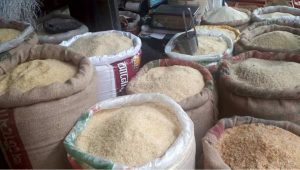
Both the retail and wholesale markets are witnessing an upward trend in rice prices.
Among coarse varieties, Swarna rice, which previously retailed at Tk51 to Tk52 per kg, is now selling at Tk56 to Tk60 per kg.
Medium-quality Pyjam and BR-28 rice are being sold at Tk70 to Tk72 per kg.
Among fine varieties, Nazirshail is retailing at Tk82 to Tk85 per kg, and Miniket is priced between Tk80 and Tk85 per kg.
Medium-quality BR-28 and BR-29 rice are selling at Tk62 to Tk65 per kg, while coarse varieties such as Guti and China IRI are priced at Tk58 to Tk60 per kg.
New anxieties replace relief
Although the gradual normalisation of the supply chain post-flood has begun to lower the prices of certain vegetables, the overall market is yet to fully stabilise.
The question of whether the new salary and allowance hikes will further impact the market remains a major concern.
Traders argue that price determination does not follow a simple equation of salary hikes.
Instead, retail prices are shaped by a combination of factors, including production, supply, transportation costs, wholesale rates, and consumer demand.
However, if demand rises while supply fails to grow at a normal pace, it could create additional pressure on the market.
This is precisely what consumers dread. The high cost of living caused by the floods has already strained household budgets. If commodity prices rise further, the situation will become increasingly difficult for people with limited incomes.
The current market situation in Chattogram highlights a dual necessity: accelerating recovery from flood losses to normalise local production and supply, and strengthening market monitoring to prevent abnormal price hikes.
If a new wave of price hikes hits before the scars of the flood have healed, the ultimate burden will be borne not just by public servants, but by the entire consumer society.