The National Curriculum and Textbook Board (NCTB) is currently working on reforming the education curriculum from pre-primary to higher secondary levels.
To prepare a modern and practical curriculum, the ‘framework’ is now being finalised. Based on this framework, the next political government will prepare the new education curriculum.
Political parties have their own philosophies, and they represent the people in the parliament and so, the new education curriculum will be prepared following their advice once a government is formed, said NCTB officials.
The entire curriculum—including textbook content, teaching methods, and assessment systems—is determined based on the framework, and its finalization is the most crucial step for the curriculum development, education experts said.
“Research is ongoing to reform the curriculum. The framework may be finalised early next year,” Professor Shah Shamim Ahmed of the Institute of Education and Research at Dhaka University told TIMES of Bangladesh.

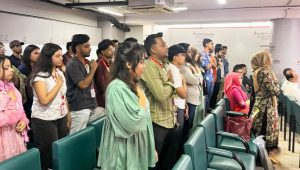
NCTB is preparing a research design to finalise the new curriculum framework. For this purpose, the organisation held a three-day workshop in October, where Professor Shah Shamim Ahmed was present.
“Work is underway to provide textbooks for Grade 1 in primary and Grade 6 in secondary for experimental implementation in 2027,” he said.
The new curriculum to see 20–25% changes
In textbooks, horizontal alignment ensures continuity between chapters within the same book, while vertical alignment maintains consistency between grades. This creates a continuous learning progression from pre-primary to higher secondary, which is an essential part of any curriculum.



Experts note that curriculum changes are highly sensitive; textbook content cannot be altered arbitrarily. Alignment must be maintained. This time, the content outline of the new curriculum may see up to 20–25% changes.
However, the textbooks being published for the 2026 academic year for primary schools will not see major changes. But secondary and higher secondary syllabuses, content, and assessment methods will undergo significant transformation.
Professor Shoaib Zibran of Bangladesh Open University, who was involved in refining the primary curriculum, said, “The demand for knowledge constantly evolves. Therefore, students’ skills need to be updated regularly. To keep pace with the world, logical changes should be made in the curriculum at least once every five years.”
Earlier, the first education curriculum in Bangladesh was formulated in 1977 based on the recommendations of the Kudrat-e-Khuda Education Commission of 1972. Afterwards, the curriculum was reformed, refined, and changed six times—in 1986, 1992, 1995, 2002, 2012, and 2022.
Priority areas in the framework
The new curriculum framework is being constructed with emphasis on three types of literacy– linguistic literacy, mathematical literacy and scientific and technological literacy.
In forming the framework outline, four issues are being prioritized — determining what students should learn, deciding content outlines based on those needs, setting teaching methods and establishing assessment methods.
Additionally, based on the country’s economic needs, the curriculum will determine what new content should be added to textbooks to enhance students’ skills and competencies. Global trends will be considered, but the education system will be updated by aligning international perspectives with Bangladesh’s own context.
Researchers who participated in the NCTB workshop said instead of fully copying foreign curricula, only what is essential for developing Bangladesh’s human resources will be adopted.
For example, life skills such as “making mashed potatoes” or “harvesting paddy”—included earlier from Western curricula—are naturally learned within Bangladeshi households. In Western societies, where parents are busy and cooking is less common at home, children need to learn such skills at school. But Bangladesh’s cultural and social context is different.
How the new curriculum framework is being prepared
Research work for preparing the new education curriculum is nearly organised. The effectiveness of the 2012 and 2022 curricula has been evaluated—how they functioned in education settings and how effective they were. The current education curricula of 16 countries across Europe, America, and Asia have also been analysed to prepare a report.
The ‘research design’ and ‘needs assessment’ are now under development through workshops. At this stage, information is being collected from stakeholders about societal needs and future requirements.
A survey questionnaire has been created and is being sent to teachers, students, parents, education administrators, academics, and researchers. Based on the survey results, the new curriculum framework will be finalised. The future shape of the education curriculum depends entirely on this framework.