


For a student of Shibpur Pilot Girls High School in Narsingdi, classroom teaching was not enough to prepare for examinations. To keep up with lessons, she had to take private tuition from the same teachers who taught her at school.
“What was taught in class was not enough. In many cases, teachers would deliberately teach less and end the class. That is why I had to take private tuition,” said the student, who passed the SSC examination from the school.
She alleged that students who did not take private lessons from teachers sometimes received lower marks and faced unfavourable treatment in classrooms.
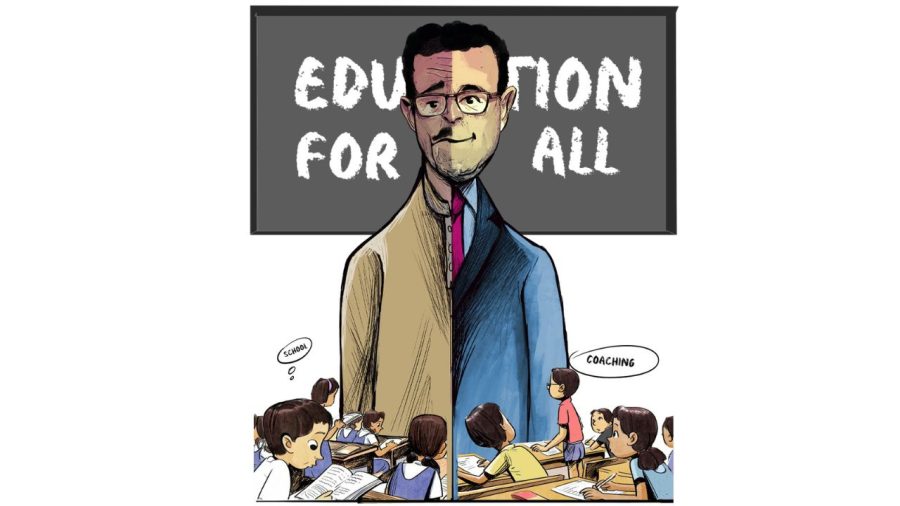
Her experience reflects a wider concern in Bangladesh’s education system: as classroom teaching falls short of students’ needs, private tuition and coaching have emerged as a parallel academic system, often involving the same teachers responsible for regular lessons.
For many parents, paying school fees is no longer enough. They spend several times more on private tuition and coaching to ensure their children complete the syllabus and perform well in examinations.
At some schools, private tuition costs several times more than monthly fees. Parents of SSC candidates say they spend Tk20,000-30,000 a month on private lessons and coaching.
The trend is not limited to Bangla-medium schools. Parents of students at reputed English-medium institutions, despite paying higher fees, say they still rely on private tutors because classroom teaching alone is often considered insufficient.
The practice has also spread beyond traditional subjects such as English, mathematics, science and accounting, with Bengali, social science and history increasingly becoming part of the private tuition market.
In some cases, students take lessons from the same teachers who teach them in classrooms, raising concerns over whether private tuition affects classroom attention and academic assessment.
A parent of a sixth-grade student at Shaheed Police Smrity College in Mirpur said, “We pay Tk1,950 a month as school fees, but we have to pay up to Tk5,000 for coaching by teachers of the same school.”

Another parent of a second-grade student at the same institution said, “The school fee is Tk1,650, but we pay around Tk3,000 for coaching after classes.”
Parents say they often have little choice as they fear their children will fall behind without additional lessons.
The dependence on private tuition is also visible in reputed institutions such as Rajuk Uttara Model College.
“There are many shortcomings at school,” a parent of a sixth-grade student told TIMES.
Coaching centres replacing classrooms
The growing demand for private tuition has created coaching hubs around several educational institutions.
Around Viqarunnisa Noon School and College’s Bailey Road branch and Shaheed Police Smrity College in Mirpur, coaching activities have expanded significantly. Many teachers living nearby run multiple batches before and after school hours.
Coaching often begins early in the morning before classes and continues until late at night.



Several parents of Shaheed Police Smrity College students said many teachers spend considerable time on coaching outside classrooms, reducing their focus on regular teaching.
A science teacher at Viqarunnisa Noon School and College’s Bailey Road branch said teachers do not conduct private tuition inside the institution’s classrooms.
“Many students from the same institution take lessons from us outside school hours, while students from other institutions also attend. No one is forced to take private tuition. Growing competition has made parents seek additional lessons for their children,” the teacher said.
A former English teacher of Rajuk Uttara Model College said students and parents were the main reasons teachers continued private tuition.
“Students want to study and parents are also interested. I wanted to stop private tuition but could not. I eventually rented a room in Uttara and taught there. I earned several times more from tuition than from my salary,” she said.
She acknowledged that classroom teaching does not always cover the entire syllabus.
“It is true that, for various reasons, completing 100% of lessons in classrooms is not always possible. This is a problem with the education system, not any particular institution,” she said.
She said low salaries were a major reason behind the continuation of private tuition.
“Private tuition allows many teachers to maintain a better standard of living. Without it, surviving in Dhaka would have been difficult,” she said.
She said the government needed to increase the number of teachers, reduce the student-teacher ratio and raise salaries.
“Unless these issues are addressed, private tuition and coaching will continue. Teachers face financial pressures, while demand from financially capable parents also makes it difficult to stop the practice,” she said.
Both teachers said they had never submitted a list of up to 10 private students to their institution heads, despite a government policy requiring such disclosure. They said teachers generally do not provide such lists.
Attempts were made several times to contact Kazi Md Fazlul Karim, chairman of the governing body of Shaheed Police Smrity College and additional inspector general of police, for comments, but he did not respond.
Policy fails to curb practice
The government has repeatedly taken measures to prevent teachers from providing private tuition to their own students and forcing students into coaching. However, the practice remains widespread.
A 2012 government policy prohibits teachers from providing private tuition or coaching to students of their own institutions. It also bars teachers from being directly or indirectly involved with commercial coaching centres.
Education officials, however, acknowledge that enforcement remains weak.
Officials at the Ministry of Education said the policy had existed for nearly one and a half decades but had never been effectively implemented.
Director General of the Directorate of Secondary and Higher Education Professor Khan Moinuddin Al Mahmud Sohel told TIMES that pushing students towards private tuition by neglecting classroom teaching was unacceptable.
“If anything is found to be contrary to government policy and complaints are received from parents, action should certainly be taken,” he said.
He said schools could arrange additional classes for weaker students with government-approved fees, but students should not be forced to attend them.
Education inequality deepens
Educationists say the growth of private tuition is widening inequality as students from wealthier families can afford additional academic support while others cannot.
Professor Manzoor Ahmed, head of two advisory committees formed by the interim government to improve primary and secondary education, said private tuition and coaching were creating unequal opportunities.
“Those who can afford private tuition and coaching have one kind of preparation for examinations. Those who cannot afford these expenses fall behind,” he said.
He suggested that schools provide additional classes for weaker students at affordable costs, with teachers receiving incentives.
Professor Mohammad Mojibur Rahman of the Institute of Education and Research at the University of Dhaka said improving classroom teaching was the key to reducing dependence on private tuition.
“It is essential to appoint quality teachers to ensure lessons are properly covered at school,” he said.
He added that policy alone would not solve the problem unless classroom teaching improved and teachers received proper training and incentives.