Bangladesh Jamaat-e-Islami has expressed interest in becoming part of a future BNP-led government, should the party secure a majority in the upcoming parliamentary election.
Senior Jamaat leaders say they want to continue the political cooperation they previously had with BNP, adding that the party led by Tarique Rahman has not publicly opposed the idea so far.
According to Jamaat leaders, if BNP forms the next government, the party plans to formally propose the formation of a “national unity government”, arguing that such an arrangement would help ensure political stability for at least five years and restore a tolerant political environment in the country.
Jamaat was a partner in BNP-led four-party alliance government between 2001 and 2006, during which two Jamaat leaders served as cabinet ministers. The party says it is willing to work again with a BNP government if the party returns to power.
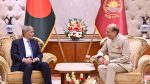
The issue was discussed recently during a meeting between BNP chief Tarique Rahman and Jamaat Ameer Shafiqur Rahman. While Jamaat leaders confirmed raising the matter, BNP leaders have said no final decision has been taken.

BNP leaders say the party remains committed to sustainable democracy and wants to work with all political forces in the interest of peace, order and stability.
Party sources say discussions around the implementation of the “July Charter”, proposed by National Consensus Commission, have added importance to the post-election government structure. Jamaat leaders fear that if BNP forms a government only with its current electoral allies, implementing the charter could become difficult, prompting their push for a broader national government.
The meeting between the two leaders took place on Thursday evening at the BNP chairperson’s office in Gulshan, where the upcoming election, government formation and the post-election political situation were discussed, according to party sources.



Jamaat leaders have repeatedly spoken at public meetings and discussions about their interest in a national unity government. They believe that after being absent from electoral politics for 17 years, Jamaat could emerge as the second-largest party after BNP in terms of vote share, strengthening their case for political accommodation.
BNP Standing Committee member Nazrul Islam Khan told TIMES of Bangladesh that Jamaat leaders, including its ameer, visited the BNP office to offer condolences following the death of party chairperson Khaleda Zia, and signed the condolence book. He said Jamaat leaders also mentioned their political interests during the interaction, but stressed that no decisions had been made.
A senior BNP leader, speaking on condition of anonymity, said Jamaat understands that BNP is likely to secure a majority if the election is held in a free and fair manner. He also pointed out that Jamaat had opposed BNP at various times by aligning with Awami League, although over the past 17 years both parties, along with student groups, jointly protested against the government of Sheikh Hasina.
Ahsanul Mahboob Zubair, Jamaat assistant secretary general and head of its media wing, says the party wants to continue working with BNP, as it did in the past, but insists this does not automatically mean forming a national unity government.
“There is no alternative to moving forward together if the country is to remain stable and free from fascism,” he told TIMES, adding that it was in this broader context that some political actors were raising the idea of a national government.
Following the mass uprising on 5 August 2024, an interim government led by Muhammad Yunus was formed. During this period, Jamaat’s political positions were not always aligned with BNP, a reality that remains part of the broader political context.
Sources say a referendum is scheduled to be held on the same day as the parliamentary election, on 12 February. Jamaat leaders have urged BNP to consider the implications, arguing that a favourable referendum outcome would make it easier to implement the July Charter.
Another BNP policymaker cautioned that Jamaat’s political stance has shifted multiple times in the past, saying the party’s proposals should be assessed carefully in light of experiences from the 1991 and 2001 elections.
Sources also say Jamaat has already reached an electoral understanding with National Citizen Party, a youth-led party that emerged from last year’s anti-discrimination movement, including discussions on securing victories in several constituencies.
After the meeting, Jamaat Ameer Shafiqur Rahman said the party had expressed condolences to the BNP leadership and reiterated its interest in working together in the national interest. He added that discussions also covered ensuring a free, fair and credible election, given that both the parliamentary election and the referendum are scheduled to take place on the same day.