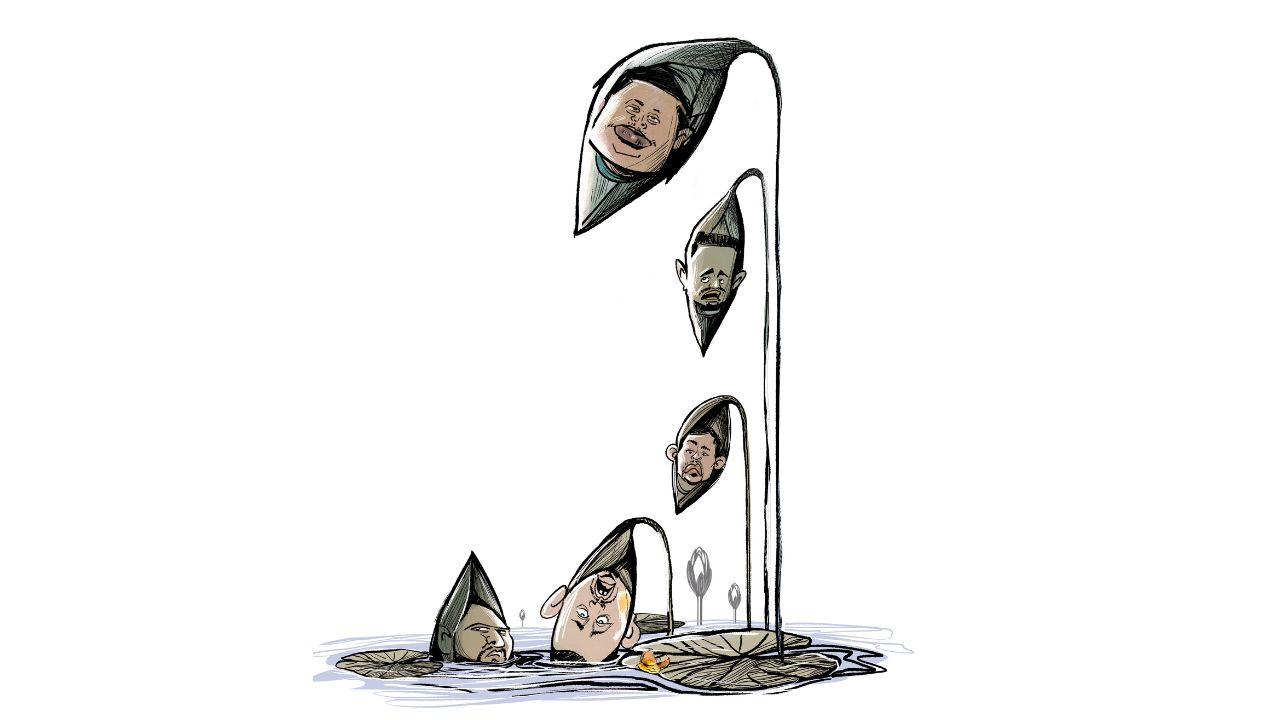
What’s changed in the past 48 hours is that the war is no longer being sold as a discrete strike. It is being narrated — by its architects — as a campaign with an open horizon.
If this war has a familiar danger, it’s not in the first wave of strikes. It’s in the assumption that removing a leader produces a solution.
Khamenei’s death makes Iran’s internal power struggle and regional retaliation the new battlefield — and it puts allies in the position of managing escalation without owning the strategy.
Iraq is the warning not because Iran is Iraq, but because “what comes next” is where American wars have repeatedly failed.
Reuters reports Israeli Prime Minister Benjamin Netanyahu now saying the war against Iran may take “some time,” though “not years,” while also suggesting it could produce regime change without naming it as the objective.
That matters because it matches what the operation already looks like after the killing of Iran’s supreme leader, Ayatollah Ali Khamenei: the most consequential act wasn’t simply hitting facilities or weapons systems, but removing the political apex of the Iranian state.
This is the familiar trap. Washington can insist it is acting to curb nuclear and missile threats, and Israel can insist it is acting to remove an existential danger. But once you kill a country’s paramount leader and begin speaking in timelines rather than endpoints, you are no longer in the realm of deterrence.

You are shaping succession politics inside a heavily securitized system, and you are gambling that escalation will stay bounded even as you alter the regime’s internal logic of survival. Reuters has also reported US officials themselves expressing skepticism about any quick, clean “regime change” outcome.
The civilian dimension is not secondary to that analysis; it is central. The reported strike on a girls’ school in Minab has become a defining reference point because it collapses the moral language of “precision” into an image most people can understand immediately.
ABC News Australia reported Iranian authorities saying more than 100 children were killed and described emerging footage of people searching rubble; it also notes the constraints on independent verification.
Whatever the eventual verified toll, this kind of incident is strategically catalytic: it hardens public attitudes, narrows diplomatic space, and makes retaliation easier to justify.


All of this is already colliding with alliance politics. Starmer has now put Britain’s position into an explicit doctrine: the UK will not join offensive strikes and rejects “regime change from the skies.” The UK government’s own published statement to Parliament reinforces the same frame: legality, restraint, and avoiding an Iraq-style slide into open-ended war.
But in the same breath, Britain is still permitting US use of UK bases for “defensive” action tied to Iranian missile threats.
In practice, “defensive” can become operational entanglement quickly — especially after reports of attacks hitting or threatening allied facilities, including RAF Akrotiri in Cyprus, which is seen as the wider escalation environment.
Meanwhile, the escalation has moved directly into the global economy. Iran has declared the Strait of Hormuz closed and threatened to attack vessels attempting passage, Reuters reports, underscoring that roughly a fifth of the world’s oil consumption moves through that chokepoint.
Reuters also reported a fuel tanker burning in the strait after a drone strike, according to Iran’s Revolutionary Guards, with vessel tracking corroborating the ship’s presence in the area. This is how regional wars become systemic risks: not only through battlefield spillover, but through energy flows, shipping insurance, and the pressure those shocks put on politics everywhere else.
In Canada and Australia, you can see the alliance reflex kick in: statements emphasizing the need to prevent Iran from acquiring a nuclear weapon, paired with caution about escalation, but little clarity on what political outcome is being pursued or how this ends.
Canada’s official statement urges Canadians to shelter and signals support for US efforts to prevent a nuclear-armed Iran. In Australia, the government has defended swift backing for the strikes, including harsh language about Khamenei; domestic debate has followed about how far that support should extend.
And then there’s the domestic American context — not because public opinion determines morality, but because it shapes endurance.
A Reuters/Ipsos poll conducted after the strikes found more Americans disapprove than approve of the US strikes (43% disapprove, 27% approve), with a large share unsure. That’s the political backdrop to an administration that appears to be widening the rationale even as the consequences multiply.
This is why the Iraq comparison keeps returning, and not as a cheap analogy. The recurring failure of modern American war-making isn’t that force never achieves an effect; it’s that leaders treat the effect as the end of the story.
In Afghanistan, Iraq, Libya, Yemen — and in political ruptures across the region, including Egypt and Sudan — the destabilising phase is often the easiest thing to trigger and the hardest thing to stop, because collapse doesn’t produce a tidy successor; it produces a vacuum that armed actors rush to fill. That’s why the idea that killing Khamenei equals regime change is so dangerously incomplete.
As American foreign policy think-tank Council on Foreign Relations (CFR) senior fellow Linda Robinson put it: “Taking out Iranian Supreme Leader Ayatollah Ali Khamenei is not the same as regime change. The Islamic Revolutionary Guard Corps (IRGC) is the regime.”
Right now, the most urgent concern is not simply whether the strikes were “successful” in the narrow operational sense.
It is that the logic of this war is drifting toward a familiar place: a campaign whose political meaning is bigger than its stated aims, whose civilian toll is already warping the terrain for any diplomacy, and whose economic spillover is turning escalation into a global problem.
Netanyahu’s comment that this may take “some time” should be read plainly: this is not being treated as a moment. It is being treated as a phase.
The writer is an independent international journalist based in Dhaka, reporting for several leading global outlets.