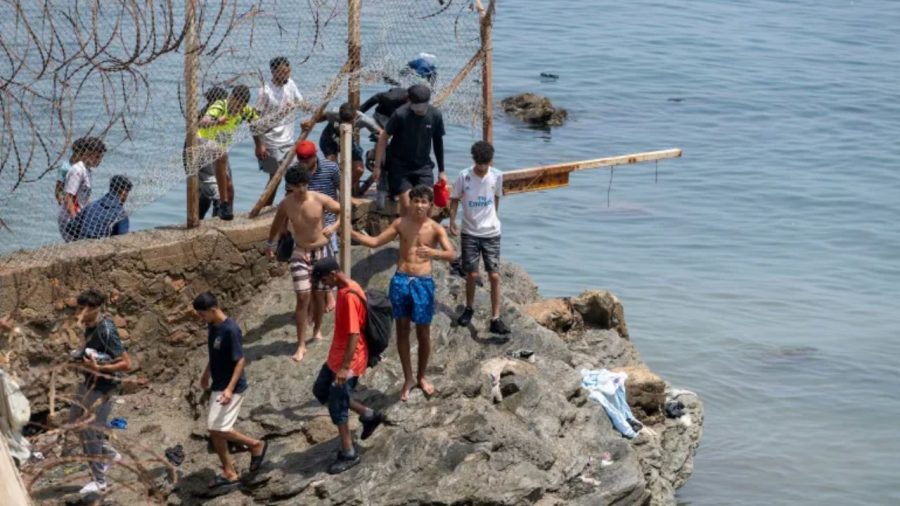

Declassified documents have revealed that Spain’s intelligence services warned of potential mass crossings by migrants and asylum seekers into Ceuta shortly before tens of thousands of people arrived in the Spanish enclave in late July.
The release of the 40-document trove on Wednesday comes amid near-daily protests in Ceuta over the Spanish government’s handling of the crisis and questions surrounding neighbouring Morocco’s role in the events, reports Al Jazeera.
The records show that on 29 July, a day before more than 72,000 people began entering Ceuta from Morocco, Spain’s National Intelligence Center (CNI) sent a WhatsApp alert to the Spanish government’s delegation in the city.
The alert highlighted social media calls “for an assault on the fence and by sea tomorrow at 8pm”.
Referring to social media groups, the declassified message stated: “There are two different groups with a total of 180,000 followers… just to give you an idea of its scale”.

On the same day, the CNI also warned Moroccan intelligence agencies DGST and DGED about plans by migrants to enter Ceuta by climbing the border fence or swimming around it. The warning noted that the attempt could take advantage of Morocco’s national Throne Day, which is celebrated on 30 July.
However, Spanish Prime Minister Pedro Sanchez on Wednesday rejected the claim that the declassified files showed prior warning of a border crisis on the scale of what took place between 30 and 31 July.
Writing on X, Sanchez said: “The existence of this campaign was known to other institutions and was being monitored, but in no way did it constitute or could it be interpreted as an indicator of the scale, nature, or probability of what happened afterward”.



Sanchez had previously said there was no evidence of Moroccan involvement in the crisis, despite a leaked police report in July alleging “total permissiveness” from Moroccan police during the border rush.
Morocco offered no immediate official comment.
A declassified CNI document issued at midday on 30 July stated that it was “highly likely that the Moroccan authorities are not actively encouraging the migratory wave, but have so far acted in a negligent and passive manner”.
The assessment said that “at the operational level, no proactive response from Moroccan authorities was observed regarding the loss of control over the situation, beyond the deployment of a few riot control units”.
It added that many people on the night of 29 July were already “waiting to jump into the water to reach Ceuta”, while an increased presence of Moroccan police and gendarmes proved insufficient to control the crowd.
Several hundred migrants swam across that night.
More than a month after the mass crossing, the Spanish government says about 5,000 migrants and asylum seekers, including 1,200 minors, remain in Ceuta. Local officials, however, cite a higher figure of up to 10,000 people.
The population of Cuba is about 84,000 people.
Madrid has pledged $357 million in aid as some individuals remain unhoused in the small city.
Meanwhile, parliamentary opposition parties have accused the government of failing to act despite receiving warnings.
Ester Munoz, spokeswoman for the right-wing Popular Party in parliament, told reporters: “The government knew everything that was happening… They had the information. They are directly responsible for the invasion of Ceuta”.