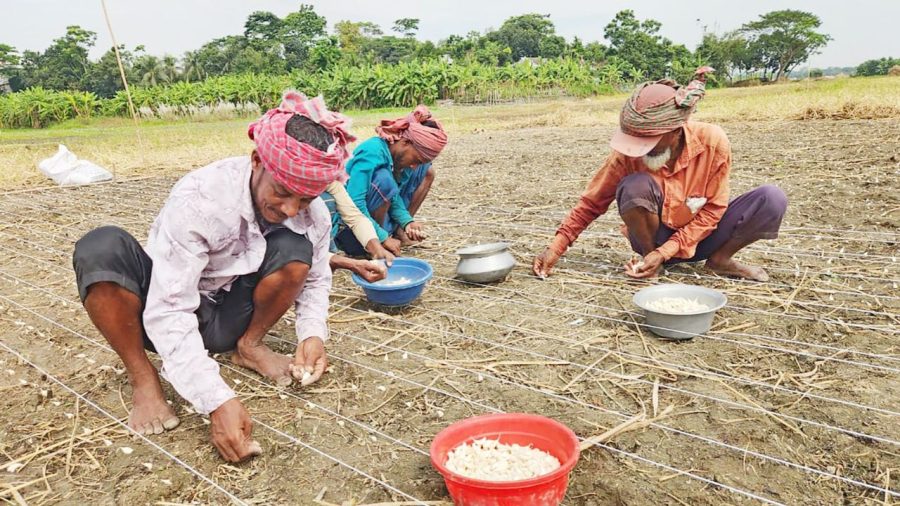



Agricultural workers from several districts are sustaining year-round farming in Shibchar upazila of Madaripur, where a shortage of local labour has left farmers dependent on seasonal workers from other parts of Bangladesh.
As the Aman rice harvest draws to a close, labourers are clearing fields and preparing land for garlic, onions and other winter crops. Many have been returning to the same villages for more than a decade, earning Tk800 to Tk1,000 for a full day’s work.
Farmers say the workers are essential to maintaining agricultural production, although rising wages are putting pressure on their earnings.
A recent visit to Kutubpur found workers harvesting Aman paddy while others prepared fields for winter cultivation.
Local farmers said they cultivate jute, Aman rice and winter crops in succession. After harvesting jute, they plant Aman rice, which grows in waterlogged fields. Once the water recedes, they harvest the paddy and prepare the land for garlic and onions. Some also grow mustard alongside onions.
This continuous cultivation creates demand for workers from Naogaon, Netrakona, Kushtia, Sunamganj and Sylhet.

Farmers said labourers generally receive Tk800 to Tk1,000 for a full day and Tk400 to Tk500 for half a day. Many arrive in groups, share rented accommodation and return home after completing their seasonal assignments.
Md Azad, an agricultural worker from Sunamganj, said he first came to Shibchar four or five years ago through the labour market in Faridpur.
“We have labour markets in Faridpur, Bhanga and Tekerhat. I first found work through the Faridpur market and have been returning here regularly ever since,” he said.



Azad said a labour market also operates daily at Kutubpur Bazar, where workers gather around midday to find employment.
“We work for half a day, collect our wages and return to the market for another job. Eight to ten of us rent a house together, cook our meals and return home when the work ends,” Azad added.
For some, Shibchar has been a familiar workplace for more than a decade.
Md Monir Mia from Netrakona first arrived in 2012 and has continued working on local farms. He supports his wife and two children with his earnings, while saving income from crops grown on his own land back home.
“I cannot sit idle. I enjoy agricultural work and have developed good relationships with many landowners here,” he said.
Jiabur from Naogaon, who has worked in Shibchar for 13 to 14 years, said local labour shortages created opportunities for workers from other districts.
“Many local people live abroad but still own farmland. Earlier, workers came through labour markets. Now farmers contact us by mobile phone, and we arrive when the season begins,” he said.

Altaf Hossain, a farmer from Taher Fakirer Kandi in Kutubpur, said he had harvested Aman rice from his 18-katha plot and was preparing to plant garlic.
“The paddy yield was good. Six or seven workers help cultivate my land, and many have been coming here for years,” he said.
However, he expressed concern over rising labour costs.
“Finding local agricultural workers is difficult. Wages keep increasing, but crop prices are not rising at the same rate,” he said.
Another farmer, Abul Kashem, said several workers had been returning to his fields for 10 to 12 years, developing close relationships with him.
As one harvest ends and another planting season begins, hundreds of migrant workers continue working in Shibchar’s fields, sustaining local agriculture while earning a livelihood for their families.