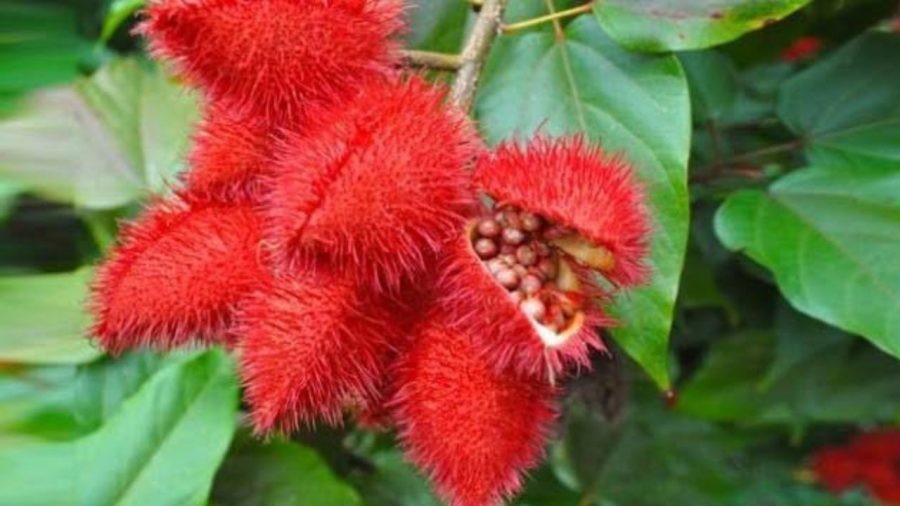



The rich, reddish-orange colour that makes yoghurt so appealing can come from an unlikely source – the seeds of a tree.
Known locally as doigota, or the yoghurt-colouring tree, it produces a natural pigment used in food, cosmetics and other products. But an agricultural scientist has cautioned against consuming preparations made from the plant without proper testing.
Scientifically known as Bixa orellana, the plant is commonly called the lipstick tree in English. It has several local names, including doigota, lotkongota, ronggota, sinduri and sindur phul.
Some also call it the saffron flower, although officials from the Wildlife Management and Nature Conservation Department say it is not saffron.
One such tree stands on the premises of the department’s Sylhet divisional office, beside Barshijora Ecopark on the outskirts of Moulvibazar town.

The tree is currently bearing pale pinkish-white flowers alongside reddish fruits. The fruits are covered with numerous soft spines, giving them a hairy appearance from a distance. Flowers, buds and ripe fruits can be seen on different parts of the same branches.
A nameplate at the foot of the tree identifies it as a “rare species” and gives its local name as sindur or lotka.
Native to the Americas, the plant spread to Southeast Asia through the Spanish around the 17th century. It is a perennial evergreen shrub that generally grows four to five metres tall. Its main flowering season runs from autumn to early winter.
Wildlife and Biodiversity Conservation Officer Mirza Mehdi Sarwar said the plant was commonly known as the sindur tree.


“Its colour is used in yoghurt, which is why people also call it doigota,” he said.
“The tree has been on our office premises for around 10 to 12 years. It produces flowers and fruits almost every year,” he added.
Sylhet Agricultural University Dean of the Faculty of Agriculture and Chairman of the Department of Horticulture Md Shahidul Islam said the plant was primarily a source of natural dye.
He said it was used to colour fabrics and yarn in South Africa and other parts of the world, adding that the plant itself was neither harmful nor poisonous.
However, he warned against confusing it with saffron.
“Some people try to pass it off or sell it as saffron, but it is not genuine saffron,” he said.

The plant, also known in Bangla as rong dana, belongs to the Bixaceae family.
According to Islam, the tree is relatively uncommon in Sylhet but grows naturally in considerable numbers in parts of the Chattogram Hill Tracts, particularly along roads leading to Chimbuk Hill in Bandarban.
He said the absence of commercial cultivation and the fact that the plant often grows naturally without care have led some people to describe it as a rare species.
Despite its use as a natural colourant, Islam advised caution over its consumption.
“Without specific testing, it would not be advisable to recommend its consumption as a natural colouring agent in foods such as biryani and yoghurt,” he said.
He added that it was necessary to establish whether any research had been conducted on the plant by food and nutrition science departments.