In the middle of Dhaka’s concrete rhythm, something quietly extraordinary unfolded inside the halls of Bishwo Shahitto Kendro. The Dhaka Pen Show, organised by the Bangladesh Pen Club, was a two-day-long celebration (December 5-6) of an object slowly fading from modern life- the simple, enduring beauty of ink on paper. Collectors, students, writers, calligraphers and curious visitors gathered under one roof, drawn by nostalgia and an appreciation for this craftsmanship.
The exhibition felt like a reunion of forgotten things. There were stalls of every kind- pens, inks, reed pens, calligraphy tools and books tracing the history of writing instruments. Nazmul Haque Montu’s Collection and Ink Pot Home displayed an impressive range of vintage ink pots, glass bottles and decades-old pens. These were not just mere instruments of writing; they carried our history within them.
One of the organisers, Iftiqhar Husain of the Bangladesh Pen Club, captured the sentiment in simple words. “This event is a reminder of the lost beauty of putting ink on paper,” he said. “Computers and ballpens have taken over. Ballpens create plastic waste, and they don’t last long. And on digital platforms, you never truly write the way you want to. It fails to express you.”

For him, the movement is both cultural and environmental. “We want to revive the fountain pen,” Iftiqhar added. “It’s hard to bring something back once the world has rejected it. But beats a fountain pen. When someone writes, as opposed to tapping their keyboards in the computer, they can communicate their thoughts with clarity as they build a connection with the handwritten scripts. Letters have been replaced with emails though at one time letters were written with a lot of passion. So, we want to refine the technology and bring it back. We want people to start writing with fountain pens again. This is our movement.”
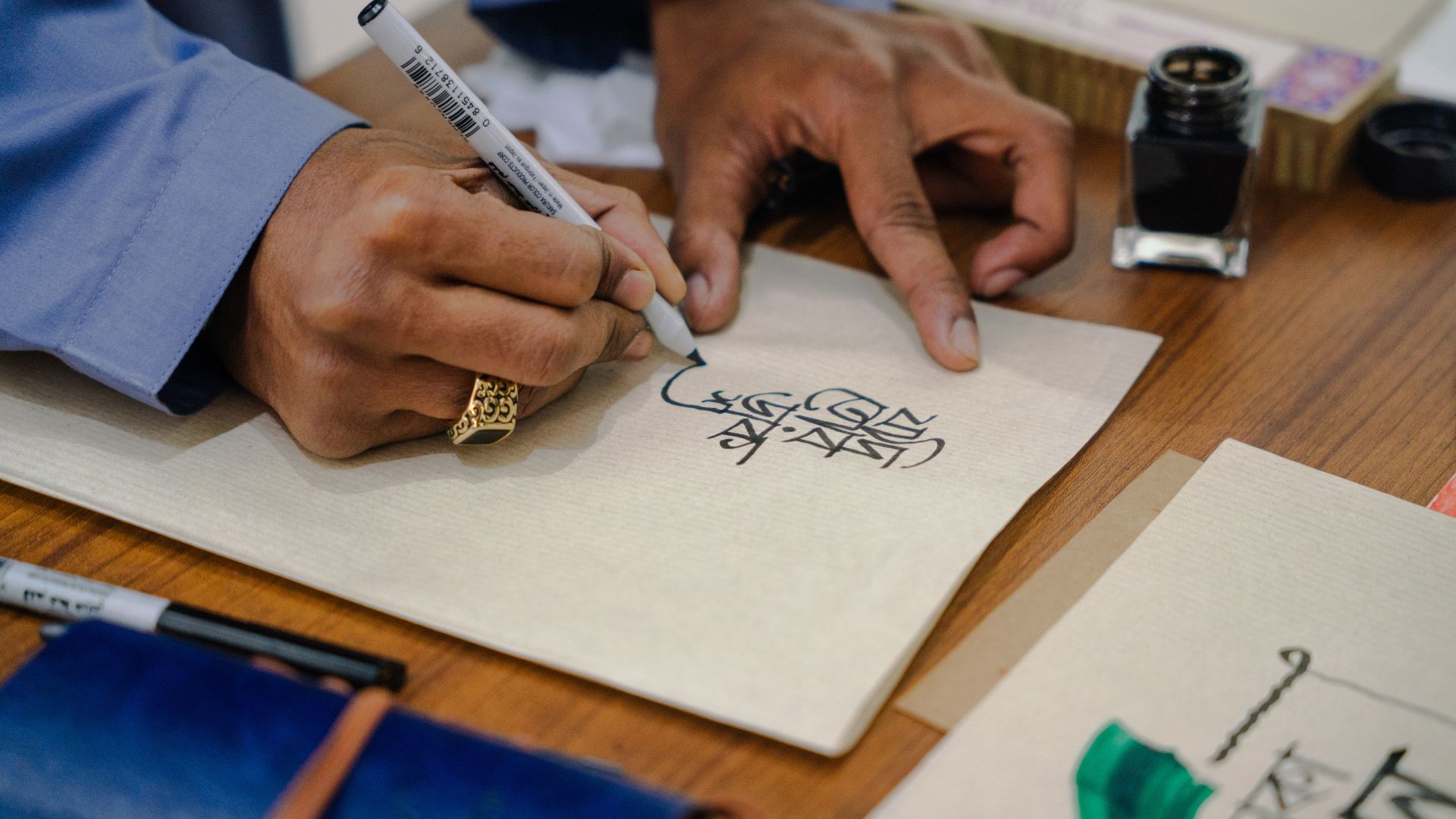
Other stalls, like Sun Trading House and Pen Bazar BD, bridged past and present, showcasing both vintage models and modern stationery. Quotes and Koffee and Faaeem’s Collection added an artistic flair with live calligraphy and demonstrations of traditional scripts. The atmosphere remained festive throughout, with the halls buzzing with enthusiasm and soft ink-scented curiosity.




The Bangladesh Pen Club’s own desk stood as a quiet centrepiece: a curated timeline of writing instruments, from ancient reed pens to early fountain pen giants like Parker and Sheaffer. Rare pieces, catalogues and books charting the evolution of writing culture reminded visitors how deeply the act of writing is woven into our heritage.
Iftiqhar also touched on a deeper cultural urgency. “We are sentimental about our language, but we don’t take real action to preserve it,” he said. “There is so much more to develop, our language, our writing practices. This work is part of that movement too.”
For an exhibition celebrating what many consider a relic, the Dhaka Pen Show felt remarkably fresh. It wasn’t only about pens or inks or nostalgia. It was about memory, craft and the quiet insistence that handwriting still matters. The slow glide of a nib over paper carries a kind of truth no screen can replicate.
If the organisers’ hopes take hold, this gathering may one day be remembered not just as an exhibition, but as the beginning of a revival and return to the intimate, expressive art of writing by hand. For these two December days, that revival felt alive, vibrant and surprisingly full of hope.