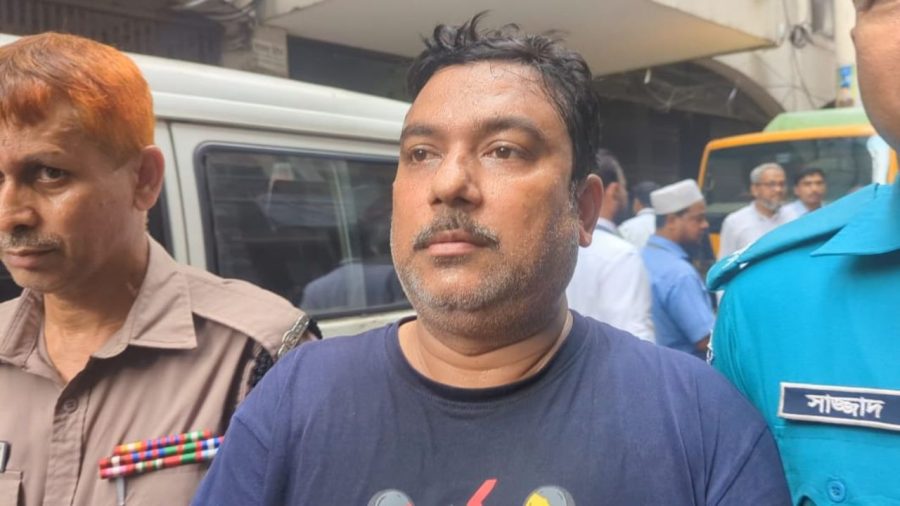



A Dhaka court on Thursday placed Indian national Rabiul Islam on a seven-day remand for a third term in connection with a case filed over alleged espionage and activities detrimental to state security and national interests.
Dhaka Additional Chief Metropolitan Magistrate Md Sefatullah passed the order following a hearing on Thursday. State prosecutor Samsuddoha Suman confirmed the court ruling.
The order came after the investigating officer produced Rabiul before the court and petitioned for a 10-day remand for further interrogation in the new case. After the hearing, the court granted a seven-day remand.
Prior to this, Rabiul had been interrogated on an eight-day remand across two phases following his initial arrest under Section 54 of the Code of Criminal Procedure (CrPC).

According to the case documents, Rabiul is a resident of Gouribhoj village under Matia Police Station in North 24 Parganas district of West Bengal, India.
He entered Bangladesh through Bhomra land port in Satkhira on 14 September and subsequently stayed in Dhaka from 15 to 22 September.




Acting on secret information, police detained Rabiul around 12:30am on 22 September from in front of House 60, Road 13, Sector 11 under Uttara West Police Station.
During his detention, he identified himself as an Indian citizen and presented his passport.
Police said discrepancies were found in the dates of birth recorded across his passport, national identity card (NID), and driving licence. Moreover, his passport specifies his birthplace as Riyadh, Saudi Arabia.
The investigating officer noted that although Rabiul had travelled to Bangladesh on multiple previous occasions, he failed to provide a specific reason for his current visit, raising suspicion over his movements.
During initial interrogation, Rabiul disclosed that he had been travelling to Bangladesh intermittently over the past 10 to 12 years, entering on tourist and business visas.
Police alleged that under the guise of commercial activities, Rabiul was engaged in espionage and leaking sensitive information to foreign intelligence agencies.
He is also accused of attempting to send photographs of key government installations and restricted areas, official documents, and confidential data to foreign intelligence agencies, as well as assisting their agents while residing in Bangladesh.
Following these allegations, a case was formally registered against him under Sections 3, 3A, 4, 5, and 9 of The Official Secrets Act, 1923.