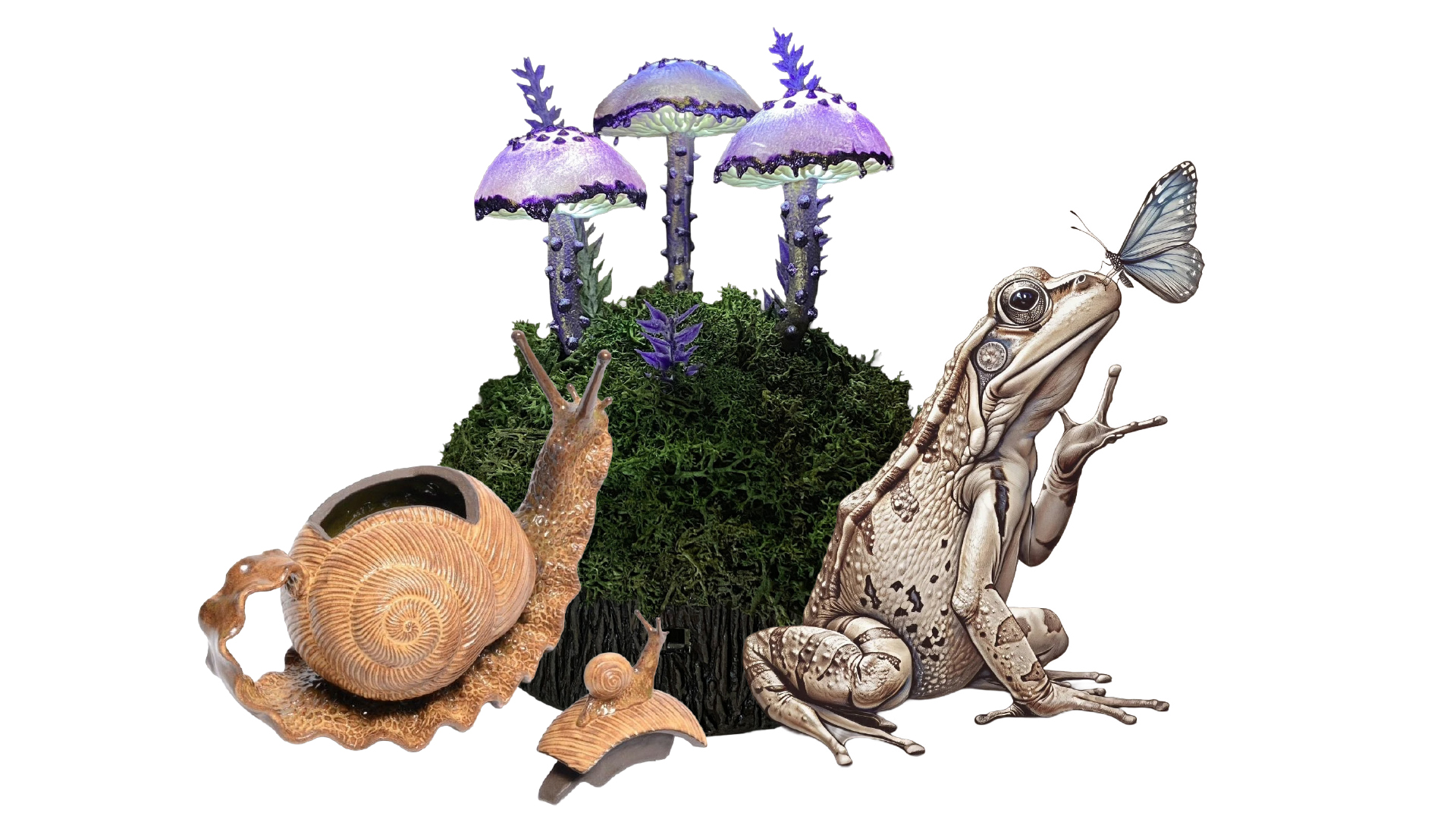

While the “clean girl” aesthetic and the hyper-feminine “cottagecore” have long dominated social media feeds with their white linen and curated tea parties, a messier, more feral cousin has crawled out of the damp undergrowth of the internet. Known as Goblincore, this subculture celebrates the least appreciated corners of the natural world: mud, mushrooms, snails and moss.
Goblincore is more than a fashion aesthetic; its followers describe it as a romanticisation of the lesser-appreciated parts of the natural world. Its adherents, often called “gobbies,” find joy in collecting “shinies” – random trinkets such as pretty stones, snail shells and old buttons – and speak of a “cosy, feral satisfaction” in bringing bits of the outdoors inside.
Unlike cottagecore’s stylised, agrarian fantasy, Goblincore is rough around the edges, built on chaos, dirt and mud, where a dress isn’t just worn but left stained with moss after an afternoon spent watching slugs move through the wildflowers. The look runs on what devotees call “practical whimsy” – oversized button-downs, worn flannels, overalls and earth tones that look lived-in rather than styled.
The aesthetic first surfaced on Tumblr in the late 2010s, part of a wave of internet “-core” identities that included cottagecore and, later, weirdcore. Amanda Brennan, Tumblr’s former head of editorial, has traced its trajectory precisely: The tag started picking up in spring 2019 and hit full steam in 2020, as people stuck at home during Covid-19 lockdowns stumbled onto it while looking for something to romanticise about the outdoors they could no longer freely enjoy.

Cut off from restaurants, malls and curated public life, many found themselves paying attention, often for the first time, to the mushrooms sprouting after rain or the snail trails on a garden wall – and Goblincore gave that attention a name and an aesthetic.
The subculture also absorbed influences from adjacent internet communities. Its overlap with “Witchtok,” TikTok’s witchcraft-adjacent corner, comes through a shared reverence for the darker, spirit-inhabited parts of nature. Its overlap with tabletop role-playing communities is more literal: Dungeons & Dragons players already called their favourite dice “shinies,” and Goblincore borrowed both the term and the delight in hoarding small treasures. European folklore, in which goblins are typically grotto-dwellers, may explain why frogs, slugs and snails recur as visual motifs more than any single fashion reference does.




What began as a niche tag has grown in fairly measurable bursts. Goblincore’s Reddit community had roughly 19,000 members by July 2021, a 395 per cent jump from the year before; by early 2023, that number had climbed past 68,000. Etsy, a frequent barometer for aesthetic subcultures, reported a 695 per cent increase in Goblincore-related searches in June 2021 alone – a surge that repeated itself in 2023, when searches for mushroom-themed home décor rose 900 per cent and related item searches climbed 652 per cent year-on-year. Each spike suggests less a single viral moment than a subculture that keeps finding new waves of converts.
Retailers noticed. Mainstream chains including Target, Walmart and Urban Outfitters now stock mushroom-shaped lamps, moss-green blankets and frog-print apparel, folding what was once a fringe Tumblr tag into ordinary seasonal merchandising. Independent creators have ridden the same wave: One widely shared TikTok video from a ceramicist working under the handle TheWondersmith, showing off a hand-thrown snail-shaped teapot and matching cups, drew hundreds of thousands of likes and helped cement snails and slugs as recognisable Goblincore iconography in their own right, well beyond the moss and mushrooms that first defined the look. As one industry observer put it, subcultures don’t stay underground anymore – they climb out, covered in moss, and ask for your credit card.
For a generation that grew up inside curated feeds and algorithmic pressure to look put-together effortlessly, Goblincore functions as something close to relief. It offers a version of aspiration that doesn’t require a spotless kitchen or a colour-coordinated wardrobe – a windowsill of mossy rocks and mismatched thrift-store mugs becomes the aesthetic goal instead of the thing to hide. Amid rising conversations around climate anxiety and burnout, several commentators have noted that finding beauty in the overlooked – a slug, a puddle, a rotting log – reads as a quiet rebellion against the pressure to be flawless online.
The subculture has also built a reputation for inclusivity, particularly among LGBTQ+ and non-binary communities. Its refusal of tidy categories extends to its choice of mascots: Fungi, which can have thousands of mating types rather than a simple binary, have become an unlikely emblem for a community that prizes existing outside a mould. “It’s just about vibing and existing, not fitting into a mould,” as one trends expert has put it.
Even as it grows, Goblincore carries an internal disagreement over its own name. The word “goblin” has a documented history of antisemitic caricature, including its use in propaganda imagery and in stereotyped depictions such as the greedy bank-managing goblins of the Harry Potter franchise. Some in the community are working to reclaim the word on their own terms; others have shifted to alternative labels – Mosscore, Dirtcore, Mushroomcore – specifically to sidestep those associations while keeping the aesthetic intact.
The aesthetic tends to surge further each autumn, when consumers lean into “spooky and cosy” seasonal rituals that suit Goblincore’s earth-toned, slightly unkempt sensibility better than any other time of year. What the trend ultimately demonstrates is that even the internet’s “ugliest” aesthetic can be turned into a billion-view, multi-retailer phenomenon -proof, as one observer summed it up, that imperfection isn’t just a mood. Increasingly, it’s a market.