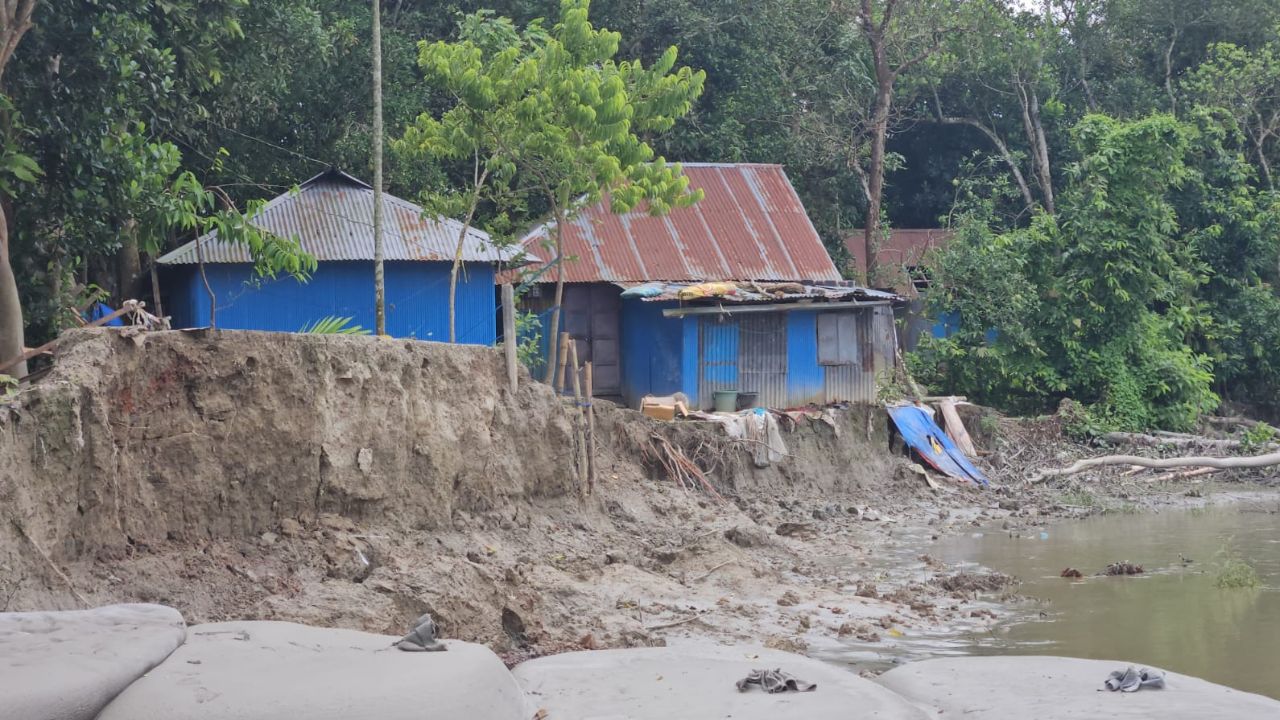



For more than a year, Abul Kashem has watched his home disappear into the Chhoto Feni River in Char Gopalgaon of Sonagazi.
The man in his sixties has lost his homestead three times and now lives with his wife and three children under a makeshift shelter, fearing that it too could vanish into the river any day.
“Three times my homestead has been taken by the river. Everything is gone. Will the little that remains survive?” he said.
His neighbour Rokeya Begum’s loss is even more painful. The grave of her husband, located in the family courtyard, was also swallowed by the river along with their home. Her children no longer have a place to stand beside their father’s grave and offer prayers.
“The river has left me floating with my children. This cannot be called a life,” she said in a grief-stricken voice.
Continuous rainfall during the ongoing monsoon and the pressure of upstream water have intensified river erosion in several parts of Feni. Homes, croplands and roads along the banks of the Little Feni, Feni and Kalidas Pahalia rivers are disappearing every day.
Thousands of people in vulnerable areas of Sonagazi, Daganbhuiyan and Feni Sadar upazilas, as well as riverbank communities in Noakhali’s Companiganj Upazila, are facing growing risks from the erosion.

The Water Development Board (WDB) said emergency measures have been taken to tackle the situation. However, locals said there would be no permanent solution without rebuilding the Musapur Closure, which was damaged during the 2024 floods.
Sonagazi shrinking as erosion continues
Surrounded by rivers on three sides, Sonagazi Upazila is gradually losing land due to relentless erosion.
Along the Chhoto Feni River, several villages under Char Majlishpur Union, including Char Badarpur, Kutirhat, Katakhila and Kalimandir, are facing threats. Areas under Char Darbesh Union, including South Char Darbesh, Adarsha Gram, West Char Darbesh, Kazirhat sluice gate, Aurar Khil fishing community, Alampur, Tellarghat, Italy Market and Dhanipara, are also at risk.




Residents of Bagerhat, Ramanandapur, Salam Nagar, Jelepara, Taltali and Karimpur areas under Matubhuiyan Union in Daganbhuiyan are also living in fear of erosion.
During a visit to the Kazirhat area of Sonagazi, this correspondent found that places that once had homes and settlements have now disappeared into the river. People have lost houses, tube wells and roads, leaving them helpless.
“Nothing is left. Everything has gone into the river. Now I live at someone else’s house,” said local resident Kabir Ahmed.
River erosion has been most severe in Char Majlishpur, Char Darbesh, Char Chandia and other char areas of Sonagazi, Matubhuiyan of Daganbhuiyan, Baligaon Union of Feni Sadar and Musapur Union of Noakhali.
More than 20 kilometres of riverbank areas in Feni and nearly 15 kilometres in Noakhali are currently affected by erosion. More than 300 homes have been lost to the rivers over the past two years.
Locals demand permanent solution
Residents alleged that the Water Development Board usually takes action after erosion has already occurred instead of taking preventive measures.
They said temporary measures such as dumping geo-bags cannot provide a permanent solution and demanded immediate reconstruction of the Musapur Closure.
“Musapur Closure was damaged during the 2024 floods. Two years have passed, but there is still no sign of reconstruction. Restoring it could protect the lives and property of people across a vast area,” said local resident Monir Ahmed.
The Water Development Board said geo-bags are being placed at vulnerable points to prevent erosion. A Tk49.59 crore project is currently underway to protect around three kilometres of the banks of the Chhoto Feni and Feni rivers.
Under the World Bank-funded B-STRONG project, tender procedures are ongoing for erosion control work covering nearly six kilometres of the two rivers at an estimated cost of Tk77 crore.
Feni Water Development Board Executive Engineer Mohammad Monirul Islam said the government is also considering reconstruction of the Musapur Closure.
“The proposal for rebuilding the Musapur regulator is awaiting approval from the Planning Commission. Necessary progress has been made regarding the project,” he said.
Locals said the Musapur regulator, built in the 2006-07 fiscal year at a cost of Tk33 crore, was washed away during the devastating floods on 26 August last year.
Following the collapse of the regulator, tidal water carrying saltwater has been entering local areas directly at high tide, rising by 8 to 10 feet, while strong currents during low tide have accelerated erosion along the riverbanks.
For people living beside the rivers, promises are no longer enough. They want immediate action, saying every tide and ebb is taking away new homes, farmland and years of their lives.