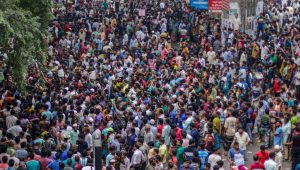
As the summer heat increases, so does the suffering of the people.
While the power situation in Dhaka has been relatively stable, the situation across the country is not as favourable. However, for those in the labour force, it makes hardly any difference.
Rickshaw pullers, day labourers, and construction workers are forced to work under the scorching sun. Moreover, when the heat becomes unbearable, people tend to stay indoors more, which results in fewer passengers for rickshaw drivers.
Raton Mia, a 60-year-old rickshaw puller from the Karwan Bazar area in Dhaka, says, “Due to the heat, there are fewer passengers. Earnings are not as good. At night, the heat makes it difficult to sleep properly at home.”
Sajjad Hossain, a resident of Kalabagan, says, “When the power goes out in this intense heat, life becomes unbearable.”

The Meteorological Department states that a mild to moderate heatwave is sweeping through Dhaka, Faridpur, Madaripur, Rajshahi, Pabna, Sirajganj, Feni, Lakshmipur, Rangamati, Bandarban, Patuakhali, and ten other districts of Khulna Division.
However, the temperature readings from the department’s thermometer do not align with the heat felt by the people. For instance, according to the department, the maximum temperature in Dhaka on Friday was 36.8°C. But according to various technology companies like Google and AccuWeather, the “feels like” temperature in Tejgaon at 5pm was around 41°C.
Meteorologists suggest that factors such as pollution and lack of greenery can cause the perceived temperature to be higher than the recorded temperature.




According to the department’s records, the highest temperature in the country at 5pm on Friday was 38°C in Jessore.
Farmers in distress
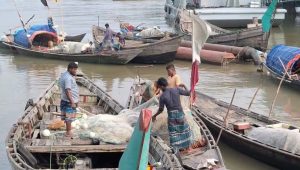
Farmers are also facing a different kind of stress in this intense heat. There has been no monsoon rain yet, and the Boro paddy fields are in dire need of water. But the situation is far from easy for the farmers.
Due to power load-shedding, electric irrigation pumps are constantly being turned on and off. As an alternative, using diesel-powered pumps is difficult, as fuel is still not available in sufficient quantities.
Shafiqul Islam, a farmer from Char No 5 in Melandah Upazila, Jamalpur, who has cultivated Boro rice on five bighas of land, uses a diesel pump for irrigation. However, for the past two months, due to a fuel shortage, he has been unable to supply adequate water to his fields.
“Fuel is not available consistently. One day I get it, the next day I don’t. It has become extremely difficult to carry out farming like this,” Shafiqul told TIMES of Bangladesh.
A glimmer of relief
However, the Met office’s forecast might offer some relief for these farmers’ worries.
Senior meteorologist Mohammad Abul Kalam Mallick told TIMES: “Currently, a heatwave is passing over 21 districts of the country, but the intensity of this heatwave will decrease in the next one to two days. With the increase in thunderstorms and rainfall, temperatures will begin to drop.”
The Met office reported that a low-pressure area, extending from West Bengal to the North Bay of Bengal, is affecting the country’s weather. As a result, there may be gusty winds, thunderstorms, and hail in parts of Rangpur, Rajshahi, Mymensingh, and Sylhet divisions, while the weather in other areas of the country will generally remain dry.
According to the forecast, rainfall will increase starting Saturday. There will be light to moderate rain in parts of Rangpur, Mymensingh, and Sylhet divisions, with some areas experiencing moderate to heavy rainfall. From Monday, rainfall is expected to spread across more areas of the country, and there could be moderate to very heavy rainfall in parts of Rangpur, Rajshahi, Dhaka, Mymensingh, Chattogram, and Sylhet divisions.
On Tuesday and Wednesday, heavy rainfall is likely, particularly in the northern and northeastern regions. As a result, temperatures will gradually decrease.
Mallick also mentioned that heavy rainfall warnings have been issued for the next 96 hours, with the rain possibly lasting more than four days, especially in the northern regions of the country.