Even in exile, fallen autocrat Sheikh Hasina is orchestrating anti-state activities from Indian soil, inciting her remaining followers in Bangladesh to create instability, often with the perceived tacit consent of Indian authorities.
This persistent interference has cast a shadow over the interim government’s efforts to restore the rule of law and prepare for the 13th parliamentary election, scheduled for 12 February, according to the Annual Human Rights Report 2025 released by Odhikar.
The report, published on Wednesday, added that 2025 has been a pivotal period for Bangladesh, defined by a rigorous attempt to dismantle the remnants of Sheikh Hasina’s fifteen-and-a-half-year authoritarian rule and transition towards a democratic future.
Following the historic July mass uprising of 2024, which forced the then prime minister to flee to India on 5 August, the interim government formed on 8 August was tasked with the monumental challenge of institutional reform and ensuring justice for decades of state-sponsored atrocities.
Throughout her tenure, Hasina’s administration was characterised by the systematic destruction of state institutions, farcical elections, and a brutal campaign of enforced disappearances and extrajudicial killings.
Judicial reckoning, quest for accountability
The pursuit of justice for the crimes committed during the Hasina regime reached a landmark moment on 17 November 2025.
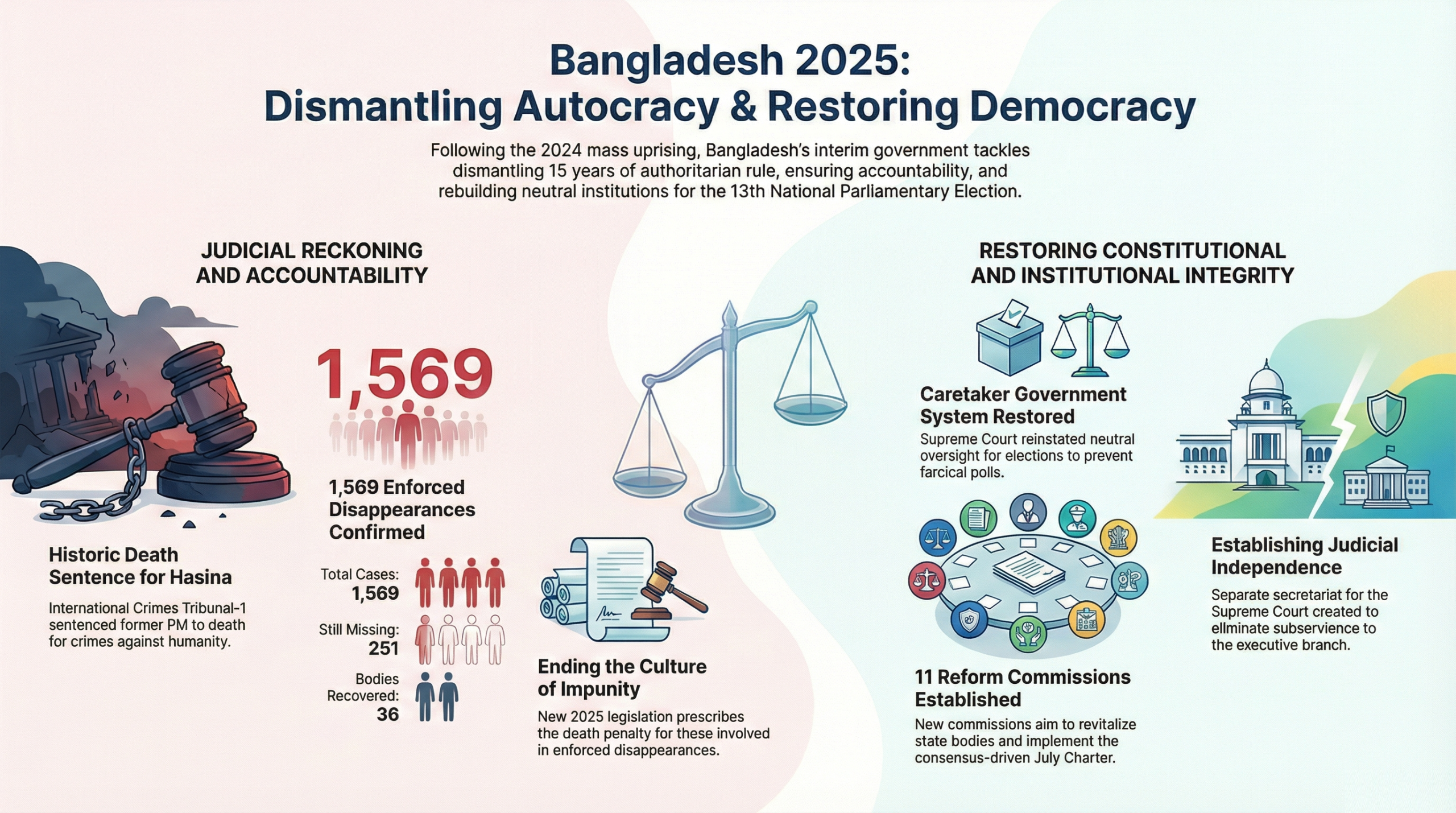
The International Crimes Tribunal-1 (ICT-1) delivered a historic verdict, sentencing Sheikh Hasina and her former minister, Asaduzzaman Khan Kamal, to death by hanging for their roles in orchestrating the massacre during the July uprising and other crimes against humanity.
This tribunal has also been actively pursuing cases against military officials, police officers, and political figures loyal to the previous administration who were involved in decades of repression.
However, the legal process has faced scrutiny from victims’ families and human rights activists, who have raised concerns over the “special facilities” provided to accused military officers.

These individuals are being held in special sub-jails within the cantonment and transported to court in air-conditioned vans, a practice criticised as discriminatory compared to the treatment of other defendants facing similar charges of crimes against humanity.
Beyond the tribunal, the sheer scale of the previous government’s malice was further exposed by the Commission of Inquiry on Enforced Disappearances.
In its final report, the commission confirmed a staggering 1,569 cases of enforced disappearances during Hasina’s reign, with 251 individuals still missing and 36 bodies recovered.
To ensure such horrors are never repeated, the President issued the “Enforced Disappearance Prevention and Redress Ordinance 2025” on 1 December, which prescribes the death penalty as the maximum punishment for those involved in such crimes.
This legislative action, alongside the government’s approval of the Optional Protocol to the Convention Against Torture on 17 July 2025, represents a significant step towards ending the culture of impunity that Hasina cultivated for over a decade.
Restoring constitutional order, institutional integrity
A central pillar of the transition has been the reversal of constitutional amendments that Hasina used to consolidate her power. On 20 November 2025, the Supreme Court Appellate Division delivered a seminal ruling restoring the caretaker government system.



This system, which ensures neutral oversight during national elections, was unilaterally abolished by the Hasina government in 2011 through its parliamentary majority and influence over the judiciary.
The restoration of this system is seen as essential for the integrity of the upcoming 13th National Parliamentary Election, as every poll held under Hasina’s direct control was widely condemned as a farce.
Furthermore, the interim government established 11 reform commissions to revitalise state bodies that had been rendered ineffective and subservient to the executive.
This process led to the creation of the “July Charter,” a national document reflecting the consensus of political parties and the spirit of the 2024 uprising.
However, the path to institutional independence has not been without hurdles.
While the establishment of a separate secretariat for the Supreme Court was hailed as a “revolutionary step” for judicial independence, other reforms have met with resistance.
For instance, the government faced criticism for failing to adopt all recommendations regarding the Anti-Corruption Commission (ACC), which has left the body still vulnerable to political interference.
Similarly, the National Human Rights Commission Ordinance 2025 was criticised for including the Cabinet Secretary in the selection committee for the commission, a move that activists argue maintains government control over an institution that should be fiercely independent.
Additionally, the legal system continues to struggle with the legacy of “ghost cases” and mass litigations; some post-uprising murder cases have named as many as 735 defendants, leading to allegations that complainants and law enforcement members are using these investigations to harass non-political individuals, businesspeople, and professionals for financial gain or to settle personal scores.
Political volatility, struggle for civil stability
Despite the change in government, the political landscape in 2025 has remained fraught with the same “criminal culture” of violence, extortion, and internal strife that the public hoped would disappear with the old regime.
Clashes have frequently erupted between BNP, Jamaat-e-Islami, Anti-Discrimination Student Movement, and NCP.
Allegations of extortion have been levelled against members of the BNP, Jamaat, and even student coordinators. The prohibited Awami League has also remained a source of instability, with its members reportedly attacking NCP rallies and inciting conflict within other political organisations.
The gravity of this volatility was underscored by the assassination of election candidate Shariff Osman Hadi, who was shot shortly after the election schedule was announced and died during treatment in Singapore on 18 December 2025.
His attackers are alleged to have fled to India, further straining bilateral relations. Relations with India have reached a low point due to the continued refuge provided to Hasina and the aggressive actions of the Indian Border Security Force (BSF).
In 2025, the BSF’s use of torture and oppression was described as exceeding all limits, culminating in the illegal “push-in” of over 2,500 people into Bangladesh, including Indian citizens and Rohingya refugees.
Internally, the government is also grappling with social unrest in the Readymade Garment (RMG) sector, where workers have staged massive protests and roadblocks over unpaid wages and layoffs.
The human cost of this economic instability has been tragic, with two workers committing suicide due to the “unjust and inhumane” treatment by factory authorities, and another dying from illness while protesting for arrears.
Human rights concerns, rise of mob justice
The transitional period has also seen a worrying rise in “mob justice” and extrajudicial violence. Unruly crowds have frequently taken the law into their own hands, leading to numerous lynchings, primarily targeting those suspected of theft.
These incidents have not spared the mentally disabled or minors, highlighting a significant breakdown in public order.
Furthermore, the prison system remains in a state of crisis, with facilities housing inmates far beyond their capacity and providing substandard food, leading to widespread illness and malnutrition.
The lack of specialised facilities for drug-addicted prisoners has further exacerbated the health crisis within the penal system. In the Chittagong Hill Tracts, ethnic tensions escalated throughout the year.
A clash between the JSS and UPDF in Dighinala on 27 July resulted in four deaths, while an alleged rape of a Marma girl in Khagrachhari on 23 September sparked mass protests and attacks on security force convoys.
While citizens currently enjoy greater freedom of expression than under the Hasina administration, the digital sphere has become a battlefield for misinformation.
Pro-Awami League elements and extremist religious groups have been accused of spreading false and defamatory content online, often targeting women.
As the nation moves towards the 2026 referendum and election, the interim government’s ability to curb this cycle of violence and misinformation while ensuring the fair implementation of the “July Charter” will be the ultimate test of the 2024 uprising’s success.