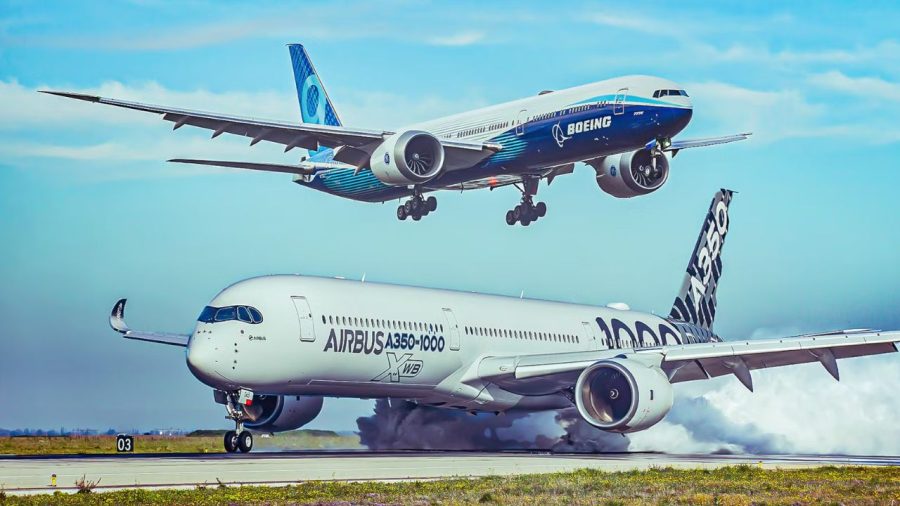



Biman Bangladesh Airlines is moving towards building a mixed fleet with 25 Boeing aircraft from the United States and 10 Airbus aircraft from Europe, as the government seeks to expand capacity while navigating diplomatic concerns surrounding the purchases.
Days after signing a deal to purchase Boeing aircraft from the United States, the government has decided to sign an agreement to buy 10 aircraft from European manufacturer Airbus.
The move comes a week after French Ambassador to Bangladesh Jean-Marc Séré-Charlet said Bangladesh and the European Union want to build a long-term partnership in civil aviation, with the proposed Airbus deal.
Civil Aviation and Tourism Minister M Rashiduzzaman Millat said at a press conference at the Secretariat on Tuesday that the Airbus deal could be signed in October.
The minister said the decision had no geopolitical considerations behind it, adding that the government was working to build a sustainable mixed fleet.

The Awami League government, ousted on 5 August 2024 during a mass uprising, had nearly finalised an agreement to add Airbus aircraft to Biman’s fleet. At the time, then BNP Secretary General Mirza Fakhrul Islam Alamgir, now president of the country, had backed Boeing purchases. After BNP came to power, the government signed deals to buy 25 Boeing aircraft in two phases.
On 22 September, French Ambassador Jean-Marc said, “For many logical and technical reasons, Biman Bangladesh Airlines had chosen Airbus, not for any political reasons. Discussions on purchasing Airbus aircraft are still ongoing. We are also not concerned about the new Bangladesh-US agreement on purchasing Boeing. However, Europe expects a level playing field for Airbus.”
Speaking at a programme in the capital, the ambassador said France did not want a partnership with Bangladesh based on political pressure. However, he added that the future of relations with the European Union would depend on Dhaka.



The aviation minister said Biman currently has 19 aircraft in its fleet, but two are close to being grounded. In practice, the airline is operating with around 17 active aircraft. Several aircraft in the existing fleet will become outdated within the next few years, making new purchases part of a long-term fleet plan.
On 23 September, Biman signed a supplementary agreement with Boeing in New York to purchase 11 aircraft. Earlier, it signed a final agreement on 30 April to buy 14 Boeing aircraft. On both occasions, the agreements were disclosed by US government officials.
The minister said Boeing would deliver the first aircraft in November 2031 and the remaining aircraft by 2035 under the agreement. However, Bangladesh has requested Boeing to deliver at least one aircraft by 2028.
Questions have already been raised over the rationale behind purchasing such a large number of aircraft. The minister, however, said the government was following the model of Ethiopian Airlines.
“Ethiopia has transformed from a small traditional airline into an airline with a fleet of 167 aircraft. Our Biman has only 19 aircraft,” he said.
Biman’s current fleet can meet just over 20 per cent of the country’s total passenger demand, while foreign airlines carry the remaining 80 per cent, the minister said.
He said the government considers fleet expansion a timely step to address Biman’s capacity shortage.
Explaining the purchase plan, the minister said it was based on Biman’s financial capacity, revenue from different routes and future growth projections. He claimed the purchases would not directly put pressure on the government budget.
The number of wide-body and narrow-body aircraft was determined based on Biman’s network and fleet plans, he said. Factors including aircraft range, seating capacity, potential passengers on each flight and weekly flight frequency were considered.
The press conference said wide-body aircraft would be deployed on high-demand Middle Eastern routes as well as long-haul routes to Europe and North America. Narrow-body aircraft would operate on regional and short-haul routes.
The minister said Biman, as a public limited company, would pay for the aircraft through its own income and suitable financing arrangements. As deliveries would be made in phases, payments would also be made gradually.