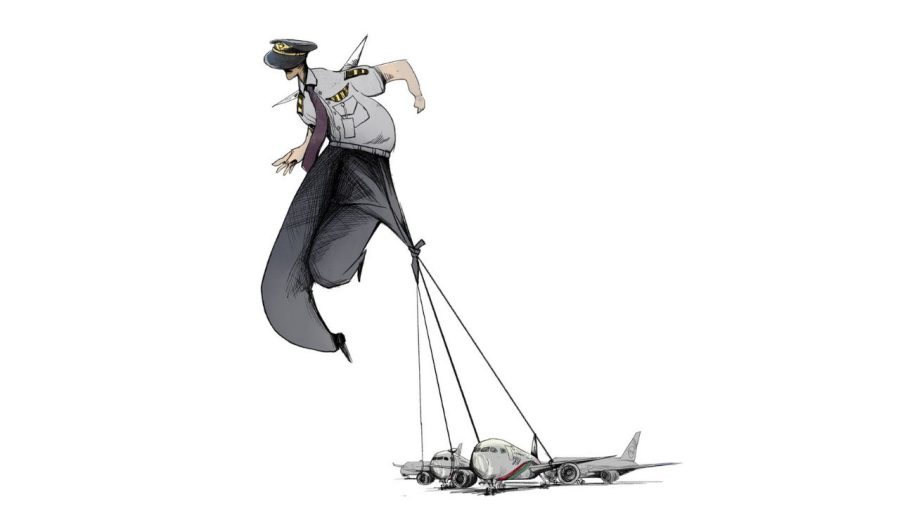



The aviation sector is facing a looming pilot shortage, with airlines needing at least 500 pilots to operate 56 additional aircraft, far more than the country can currently produce.
National flag carrier Biman Bangladesh Airlines is already struggling to fill its pilot positions, with only 179 pilots against 206 previously approved posts. Its highest policy-making body has since raised the approved strength to 382 to support expanded operations, leaving 203 positions vacant.
The country’s airlines plan to add 56 aircraft to their fleets over the next decade, including 35 for Biman and 21 for private carrier US-Bangla Airlines. At least 500 pilots will be needed within the next two years to operate the additional aircraft.
Biman plans to recruit 203 pilots by 2028, while US-Bangla aims to add 21 aircraft by next year. Announcing the expansion plan in June, the private carrier said it would need around 300 pilots to operate the aircraft. Novoair and Air Astra are also planning to acquire additional aircraft, further increasing demand.
However, the country’s pilot training capacity is falling far short of requirements, raising concerns about whether airlines can recruit enough qualified pilots within the stipulated timeframe. Aviation stakeholders warn that the shortage could disrupt expansion plans.
Galaxy, one of the country’s pilot training centres, produces only around 10 pilots a year. NXT Air Academy has recently started operations, but its first batch is not expected to graduate until January next year.
Meanwhile, Bangladesh Flying Academy, a 78-year-old institution that trained hundreds of pilots, closed on June 26 this year. Most of Biman’s senior pilots received their training there. The once-popular Arirang Flying Academy has also admitted no new students in the past two years.

As a result, the country’s training institutions are unable to produce even half the number of pilots needed, according to sector stakeholders.
The recruitment difficulties are already evident. A private airline recently advertised 10 pilot positions but managed to recruit only six.
“If pilots cannot be found even now, what will happen when a large number are needed at the same time?” a Biman pilot said, speaking on condition of anonymity.
Biman recruited 48 pilots in 2025, but more than 200 positions remain vacant at the state-owned airline.
The shortage is particularly acute for long-haul operations involving Boeing 787 Dreamliners and Boeing 777-300ER aircraft, a senior Biman pilot said. The airline needs 84 pilots to operate its six Dreamliners, but only 65 are currently assigned to them. For its four Boeing 777s, it needs 56 pilots but has only 44.



Another Biman pilot, speaking on condition of anonymity, said most of the newly recruited pilots would operate Dash 8-400 aircraft, leaving the shortage of pilots for the airline’s Boeing Dreamliners and 777s unresolved.
The Dash 8-400 is a turboprop aircraft, while the Dreamliner and 777 are wide-body jets requiring separate aircraft-specific qualifications.
The shortage is also putting pressure on existing crews. A pilot is not supposed to fly more than 75 hours a month, but Biman pilots often exceed 100 hours, the pilot said. During the Hajj season, monthly flying-hour limits are also not maintained, he added.
Following the closure of Bangladesh Flying Academy, a committee was formed under the leadership of Captain Abdullah Al Faruque, a former Biman pilot, to try to revive the institution.
Abdullah, the academy’s general secretary, told TIMES that a global pilot shortage was also emerging as experienced pilots gradually retired.
Under international rules, pilots can operate passenger aircraft until the age of 65, he said.
“Experience cannot be bought; it has to be acquired. Therefore, pilot recruitment must begin now to allow them to gain experience,” he said.
He added that efforts were under way in the United States to raise the pilot retirement age from 65 to 67.
Abdullah said domestic flying academies needed restructuring and greater capacity to enrol and train more students. Pilots must complete several courses and medical examinations to remain eligible to fly, making it important to recruit and train new pilots well in advance, he added.

Captain Mohammad Rajib Uddin, chief flight instructor at NXT Air Academy, told TIMES that the country was not producing enough pilots to meet demand. He called on the government and the Civil Aviation Authority of Bangladesh (Caab) to take initiatives to address the shortage.
Amid the shortage, US-Bangla Airlines has launched an initiative to train new pilots.
Kamrul Islam, the airline’s general manager (public relations), told TIMES that it was funding the training of 200 Bangladeshi pilots in Florida, the United States. They will join the airline after completing their training and obtaining the necessary licences.
Kazi Wahidul Alam, an aviation expert and former board member of Biman Bangladesh Airlines, said a lack of planning had undermined many initiatives in the country, with the pilot shortage being another example.
“Fifty-six aircraft are coming. Where will the pilots needed to operate these aircraft come from? If there is no advance planning on such matters, there will be a disaster,” he said.
Biman plans to increase its pilot strength across different aircraft types to support its expanded fleet.
For Boeing 787 Dreamliners, it plans to increase the number of captains from 28 to 84 and first officers from 24 to 28.
For Boeing 777ER aircraft, the number of captains is expected to rise from 28 to 38 and first officers from 24 to 38.
For Boeing 737 aircraft, Biman plans to increase captains from 31 to 42 and first officers from 32 to 42. For Dash 8 aircraft, it aims to increase captains from 15 to 22 and first officers from 24 to 48.