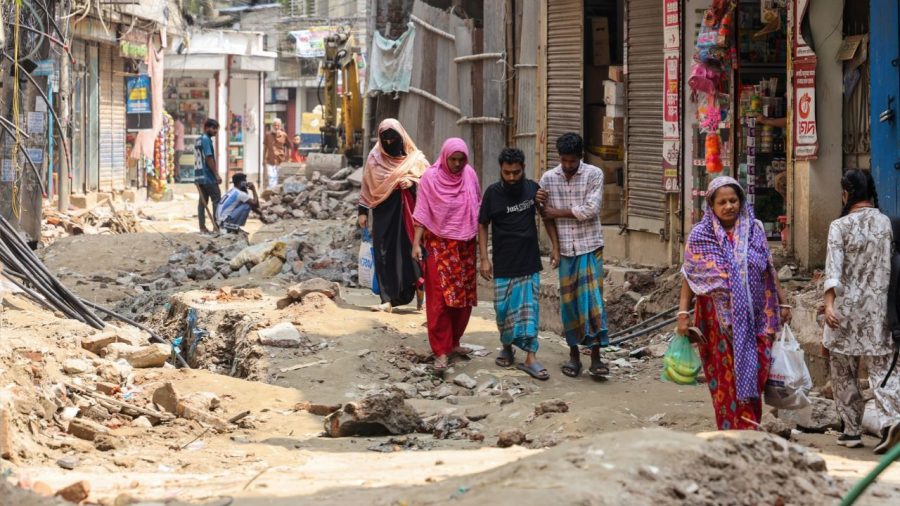



Khilbarirtek in Shahjadpur. Road improvement work began there in May 2025. Nearly a year and a half later, there is still no sign of completion.
The area falls under the jurisdiction of Dhaka North City Corporation (DNCC). Asked why the road work has taken so long, a DNCC official admitted that it should not have taken this much time.
Another official from Dhaka South City Corporation (DSCC) said funding shortages often delay projects. However, why work was started without ensuring funds were available remains difficult to answer.
This is not the only example of prolonged road development work and public suffering in the capital. In Uttara, road improvement and adjacent drain construction have remained unfinished for seven months. In Bakshibazar in Old Dhaka, a road has been dug up and left for around four months, preventing residents of nearby houses from even taking out their motorcycles.
According to the Dhaka City Road Excavation Policy 2019, roads must be fully restored within 15 to 30 days, and all waste and soil must be removed within 24 hours of completion of work.
Although the policy requires traffic management plans, warning signs, barricades and safety measures before excavation begins, these measures are rarely implemented in practice.

DSCC Chief Engineer Nur Azizur Rahman told TIMES that the financing structure is a major reason why roads dug up for drainage infrastructure construction or renovation often remain unfinished for long periods.
He said projects funded under the Annual Development Programme (ADP) remain active as contractors receive payments regularly. But in projects financed through city corporation revenue funds, contractors often do not receive bills on time. As a result, they complete part of the work, leave the site and projects remain stalled for years.
Dhaka University Public Administration Department professor and governance expert Sadik Hasan believes the prolonged road digging is not merely a result of poor planning but also a business strategy.
“The main objective is to ensure that the allocated budget is never returned. Public suffering is ignored to serve the interests of vested groups,” he said.


Road damaged for one and a half years
In DNCC Ward-39, Khilbarirtek, the condition of the Shahjadpur-Khilbarirtek road has deteriorated so badly over the past one and a half years that vehicles can hardly move through it. Battery-powered rickshaws carrying passengers frequently fall into potholes. The suffering becomes worse during rainfall.
Local resident Raihan Islam said, “Whenever it rains, waterlogging occurs here. The stagnant water serves as breeding ground for mosquitoes. There is no peace even during the day. My younger son has contracted dengue.”
Umm-e-Ratna, a Class Five student of Khilbarirtek Islamia High School, said the damaged road forces her to take a longer route on foot to reach school every day. It takes more time and causes additional hardship.
Rony Mia, a resident of nearby Nurer Chala, told TIMES that the road was dug up for drain construction but was never properly repaired.
He said a small road in his own area had also taken a year to be repaired.
Asked why a single road repair project was taking so long, DNCC Executive Engineer (Civil) Md Saifuddin Manik could not provide an explanation.
At Uttara Sector-1, work to resolve waterlogging and construct a master drainage line in front of Scholastica School began in February 2026. After seven months, mosquito larvae have started breeding in the pits left on the dug-up road.
Rickshaw puller Md Yusuf said, “There are large pits beside the road. They are difficult to see at night. If a wheel falls into a hole, there is a risk of the rickshaw overturning with passengers.”
Driver Md Ismail said uneven slabs and potholes were damaging vehicles from underneath.
Children, elderly people and students are being forced to walk on the risky main road due to the poor condition of the area.
DNCC Zone-1 Regional Executive Officer Mohammad Kamal Hossain said he was unaware of the public suffering. After being informed about the situation, he assured that water would be drained from the pits quickly and barricades would be installed in dangerous areas.
In Tejpata Goli of Bakshibazar in Old Dhaka, the road has also remained excavated for nearly three months for drainage system renovation. Soil dumped on both sides of the road has disrupted normal movement.
Local resident Rakib Hossain said, “The work is progressing very slowly. Nobody knows when this suffering will end.”
Transparency International Bangladesh (TIB) Executive Director Iftekharuzzaman said, “A persistent lack of long-term vision in our country often causes delays in project implementation. If budget allocation and fund distribution had been managed efficiently and according to priorities from the beginning, there would have been no need for this reckless rush to exhaust funds at the end of the year.”