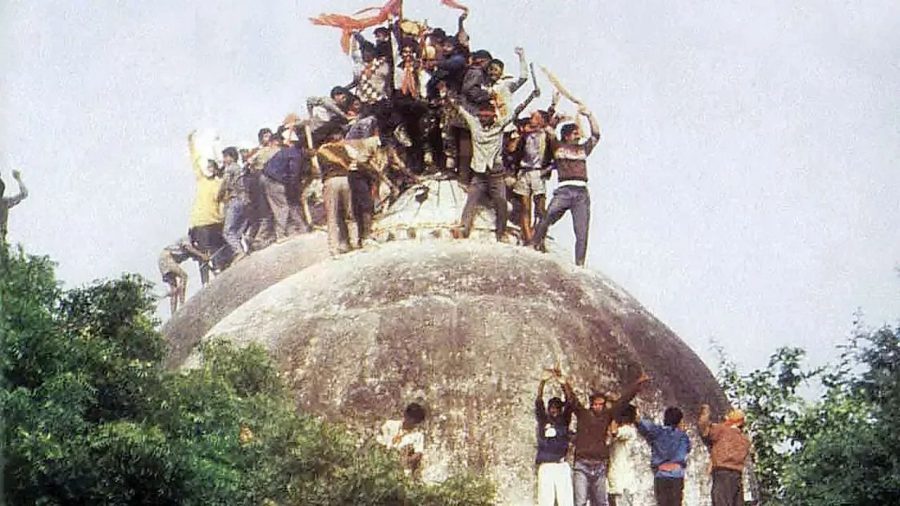



In the 1990s, the historic Babri Masjid in the Indian subcontinent was demolished amid the mobilisation and violence surrounding the Ram Janmabhoomi movement.
Decades later, a similar controversy appears to be emerging in a different form.
This time, the demolition of Muslim places of worship is being carried out through administrative action and bulldozers under BJP-ruled governments.
Although the Constitution provides for the protection of religious freedom and places of worship, questions are increasingly being raised over how these protections are being implemented in practice.
The recent demolition of a portion of the historic Shahi Masjid in Ujjain, Madhya Pradesh, has once again highlighted concerns among members of the Muslim community. Those protesting to protect the religious site have faced allegations of police action, including lathi-charge, tear gas, and criminal cases.

The demolition work at Ujjain’s historic Shahi Masjid has continued for four consecutive days under heavy police deployment and behind barricades. The administration has justified the action as part of preparations to widen roads ahead of the 2028 Kumbh Mela.
Although the district administration and the mosque committee reportedly reached an agreement regarding the demolition of a specific portion of the mosque, local Muslims had strongly opposed the move. In an effort to protect the historic mosque, they had been staging a sit-in inside the premises for more than two weeks.
However, on Monday, a portion of the mosque’s projecting slab was demolished, after which bulldozers moved towards the minaret.




Under the reported agreement between the local administration and the mosque committee, only a designated portion of the mosque was to be removed. However, during the demolition of the minaret on Thursday, a significant portion of the mosque’s dome and first floor was damaged.
The administration described the damage as an accident, saying that the machinery malfunctioned during the operation. Local Muslims, however, have rejected the explanation. They allege that the damage occurred because the demolition work was carried out hastily.
According to local residents, members of the Muslim community had initially been carrying out the demolition of the designated portion themselves and were also cooperating with the administration.
They allege that the administration subsequently decided to use machinery to demolish the minaret, citing pressure from higher authorities. They claim that this decision resulted in the damage. Some residents have also raised concerns that the incident may have been pre-planned.
The situation became even more tragic after Arshad Rahmani, a former president of the mosque committee, reportedly died of a heart attack after hearing about the demolition of the mosque.
The administration has appealed to people not to spread rumours. District Magistrate Roshan Kumar Singh said that the work was proceeding peacefully and that representatives of all communities were present at the site. He also warned that strict action would be taken against anyone spreading rumours.
For security reasons, photography and videography have been prohibited within a 500-metre radius of the mosque. The area remains tense amid a heavy police presence.
Meanwhile, in West Bengal, preparations have reportedly begun to demolish a more than century-old mosque located inside Netaji Subhas Chandra Bose International Airport in Kolkata, although the mosque is situated some distance away from the runway. The airport authorities have cited security concerns as the reason for the proposed action.
The matter is currently before the Calcutta High Court, with the next hearing scheduled for October 7.
Questions have been raised over why the mosque, which has existed at the site for decades without reportedly causing security problems, is now being targeted on security grounds.
The developments have generated anger among sections of the Muslim community in West Bengal, with questions being raised over why the community repeatedly has to face such controversies concerning its places of worship.