


Muslim voters have traditionally played an important role in West Bengal politics. In the 2021 Assembly elections, a large section of the community voted for the Trinamool Congress.
However, the political equation changed significantly after the 2026 Assembly elections. The Trinamool Congress’s tally fell from 215 seats to 80, while the BJP won 207 seats and formed the government. The division of opposition support among Muslim voters has therefore emerged as an important issue in the state’s current political landscape.
According to the 2021 figures cited in the analysis, around 75 per cent of Muslim voters supported the Trinamool Congress. The figure was 70 per cent in 2019 and 51 per cent in 2016. In Muslim-dominated areas such as Murshidabad, Malda, Uttar Dinajpur, South 24 Parganas and Birbhum, this support played an important role in the Trinamool’s electoral performance.
In the 2026 election, however, that consolidated support fragmented. The Trinamool’s vote share declined significantly in Murshidabad, Malda and Uttar Dinajpur. The Beldanga result has been cited as one example of this shift. Muslims account for around 63 per cent of the population in the constituency. While the Trinamool secured more than 55 per cent of the vote in 2021, its share fell to 26.1 per cent in 2026. AJUP secured 20.4 per cent, the Congress 17.5 per cent and the BJP 31.9 per cent.

A similar fragmentation was visible in Rejinagar and Nowda in Murshidabad, where AJUP pushed the Trinamool behind and won both seats. The Congress won Farakka and Raninagar, while the CPI(M) won Domkal. In Jalangi, the Trinamool’s winning margin fell from more than 79,000 votes in 2021 to around 21,500 in 2026.
Against this backdrop, Nandigram and Rejinagar are scheduled to vote on 6 October. Nandigram is regarded as a political stronghold of the Adhikari family, while Muslims account for more than 65 per cent of the population in Rejinagar. The division of opposition votes could therefore be an important factor in both constituencies.
The political situation in Nandigram has also become contentious around Congress candidate Milan Pradhan.




After Trinamool faction candidate Sanchita Pradhan Dey withdrew from the contest, Mamata Banerjee’s faction announced its support for the Congress candidate.
Pradhan was subsequently arrested in connection with pending cases dating back to the 2007 Nandigram land agitation and was sent to judicial custody until 3 October. Police have said the arrest was based on pending non-bailable warrants involving serious charges. Opposition parties have questioned the timing, while the BJP has rejected allegations of political pressure.
The equation in Rejinagar is somewhat different. Humayun Kabir won the constituency in the 2026 Assembly election, and his son Golam Nabi Azad is now contesting the bypoll as the AJUP candidate. The BJP, rival Trinamool factions, Congress and Left are also in the contest, making it a multi-cornered election.
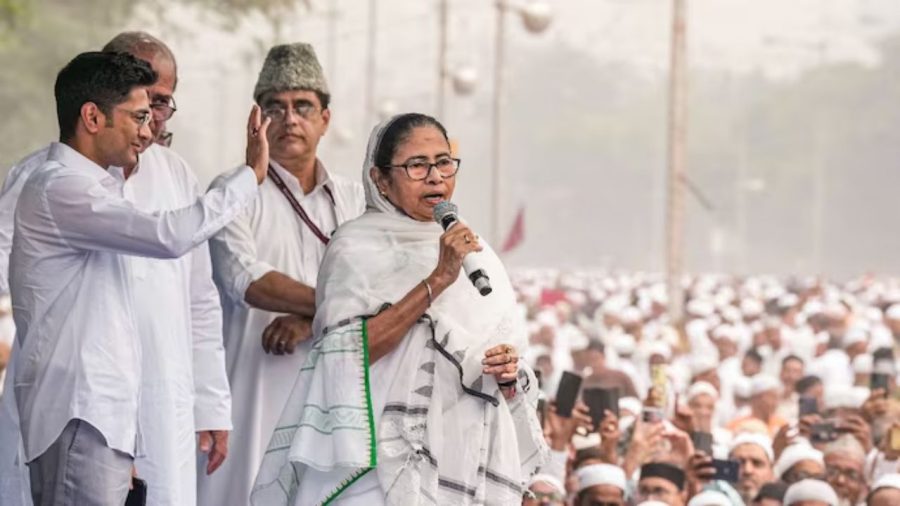
The Trinamool Congress has also undergone major organisational changes. Mamata Banerjee remains one of the most recognisable opposition faces in Bengal, but the party has split following the 2026 Assembly elections. More than 50 of the party’s 80 MLAs are currently with the faction led by Ritabrata Banerjee, while the Mamata Banerjee-led faction is attempting to retain its organisational network.
The Congress has also found renewed political space. The party has a long organisational presence in Murshidabad and Malda. Adhir Ranjan Chowdhury’s long political influence in Baharampur is one example of that legacy. However, the extent to which the Congress can rebuild its support among Muslim voters after the 2026 election remains uncertain.
The Left Front is also attempting to regain some of its traditional support among Muslim voters. Before 2011, the Left had governed West Bengal for 34 years and enjoyed significant support among the community. Its organisational base has weakened considerably since then. The CPI(M)’s victory in Domkal, however, shows that the Left can still make an impact in constituencies where opposition votes are divided.
Humayun Kabir’s AJUP and the Bhangar-based Indian Secular Front led by Naushad Siddiqui are also playing regional roles in the Muslim vote equation. However, their influence remains largely concentrated in specific areas, according to the analysis.
Overall, the Muslim vote in West Bengal is no longer as consolidated as it was in previous elections. Support is now divided among the Trinamool Congress, Congress, Left, AJUP, ISF and other political groups. The Nandigram and Rejinagar bypolls will provide a fresh indication of how this fragmented political landscape is evolving ahead of the next electoral contest.
Overall, the Muslim vote in West Bengal is no longer as consolidated as it was in previous elections. Support is now divided among the Trinamool Congress, Congress, Left, AJUP, ISF and other political groups. The Nandigram and Rejinagar bypolls will provide a fresh indication of how this fragmented political landscape is evolving ahead of the next electoral contest.