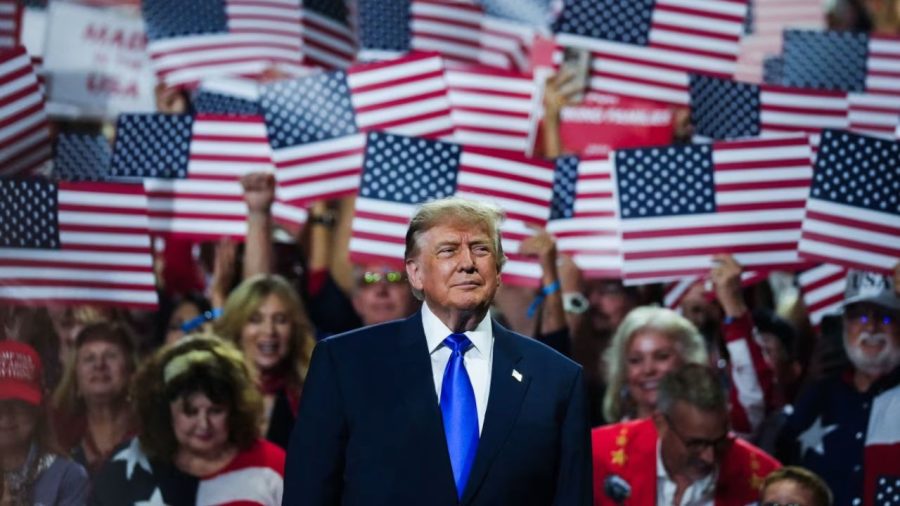



America is approaching an election in which Donald Trump is not on the ballot, but the power of his presidency could be dramatically affected.
On November 3, voters will choose all 435 members of the House of Representatives and decide a series of crucial Senate races.
At stake is control of Congress and with it, President Trump’s ability to advance his agenda during the remaining two years of his term.
Five weeks before Election Day, Democrats hold an advantage in several national measures of voter preference.
But the political map remains far more complicated than a single national poll can capture.
The emerging contest is being shaped by economic anxiety, dissatisfaction with Washington, immigration, healthcare, Trump’s approval rating and, perhaps most importantly, turnout.
Trump is not on the ballot but he is everywhere
Midterm elections traditionally become a judgment on the sitting president, and 2026 appears to be following that pattern.
Recent Reuters & Ipsos polling found registered voters favouring Democratic congressional candidates over Republicans.
Other national polling has also shown Democrats ahead on the generic congressional ballot.
At the same time, Trump’s approval rating has become an important part of the political environment, with recent polling showing particular voter dissatisfaction over the cost of living.
That may explain why the economy is becoming the common language of this election.
For many Americans, the debate is not primarily about Washington ideology.
It is about what they pay at the supermarket, how much rent or mortgage costs, healthcare bills and whether household income is keeping pace with everyday expenses.

For Republicans, the challenge is to persuade voters that the administration’s broader economic agenda will ultimately improve their finances.
For Democrats, the strategy is almost the reverse: turn frustration over household costs into votes that could change control of Congress.
The battle for the House
The House of Representatives may provide the clearest test of the national political mood.
Democrats do not need to transform the entire electoral map. Control could turn on a relatively small collection of competitive districts.
The nonpartisan Cook Political Report recently shifted its assessment of a number of House races in the Democrats’ direction.
Many of the most competitive seats are currently held by Republicans, making suburban and swing districts especially important.
Those assessments are not predictions.
They do, however, illustrate why both parties are concentrating enormous resources on a comparatively small number of races.
Republicans argue that national polling does not fully reflect what is happening locally.
Candidate quality, fundraising, advertising and campaign organisation can make an enormous difference in individual districts.




America, after all, does not elect the House through one national popular vote. It elects 435 individual representatives.
The Senate is a different battle
The Senate presents an even more complicated picture.
Only about one-third of Senate seats are contested in a regular election cycle, meaning political conditions in a relatively small number of states can determine control of the chamber.
Democrats need a net gain of four seats to take control.
North Carolina and Maine are among the states attracting particularly close attention, while competitive races elsewhere are forcing both parties to invest heavily.
The national political environment may influence those contests, but ultimately each Senate race will be decided by voters within that state.
That means November could potentially send different political signals through the House and Senate.
What American voters are saying
Beyond the national polls and Washington strategy, conversations with ordinary voters suggest that the election is increasingly being viewed through everyday concerns.
In conversations with the TIMES of Bangladesh, several American voters expressed a mix of concern and uncertainty over the direction of the country, with the cost of living, immigration and political division repeatedly emerging as key issues ahead of the November midterms.
Some voters said household expenses were more important to them than the political battles dominating national television, while others pointed to immigration, public safety and the increasingly polarised political environment.
Their views reflect a broader reality of this election: national political arguments may dominate the headlines, but voters often make their decisions based on issues much closer to home.
Independent voters could therefore become particularly important.
Recent polling has shown significant movement among independents, a group capable of deciding close elections in competitive states and suburban congressional districts.
But polling support does not automatically translate into votes.
Midterm elections are often decided by turnout.
Campaign organisation, early voting and each party’s ability to motivate supporters may prove just as important as national approval ratings.
Immigration remains powerful
Immigration remains one of Trump’s signature political issues and continues to generate strong support among Republican voters.
Nationally, however, public opinion is more divided.
For immigrant communities, immigration policy is not merely an election slogan.
Enforcement policies, visa rules, citizenship questions and the treatment of immigrant communities can have direct consequences for families and businesses.
That gives the issue particular relevance in states such as New York, New Jersey, Pennsylvania, Michigan, Texas and Georgia, where immigrant populations including Bangladeshi-Americans play increasingly visible roles in civic and economic life.
For many immigrant voters, immigration also intersects with the same concerns affecting other Americans: jobs, small businesses, education, healthcare, public safety and the cost of living.
What November could change
The significance of this election extends well beyond which party wins more seats.
If Democrats gain control of either chamber, the balance of power in Washington would change.
Congress determines legislation and federal spending, but it also possesses substantial investigative and oversight authority.
Control of congressional committees influences which investigations receive hearings, which administration officials are called to testify and which legislation moves forward.
If Republicans retain congressional control, Trump would face a very different political environment during the second half of his term.
That is why the November election is increasingly becoming a test not only of the two political parties, but also of the reach of presidential power.
The final stretch
For now, the numbers tell only part of the story.
Democrats have advantages in several national polls.
Trump’s approval ratings present challenges for Republicans, while independent voters and several competitive House districts deserve particularly close attention.
But none of those factors determines the outcome.
The decisive votes will not be cast in a national opinion poll.
They will be cast across hundreds of congressional districts and a relatively small number of crucial Senate states.
Economic developments, international events, candidate controversies and voter turnout could still reshape individual contests before November 3.
Donald Trump will not appear on the ballot.
But in political terms, his power will be.
And when Americans vote in November, they will decide not only who controls Capitol Hill, but how much room the president will have to govern during the final two years of his current term.