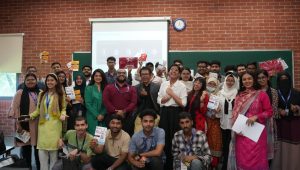
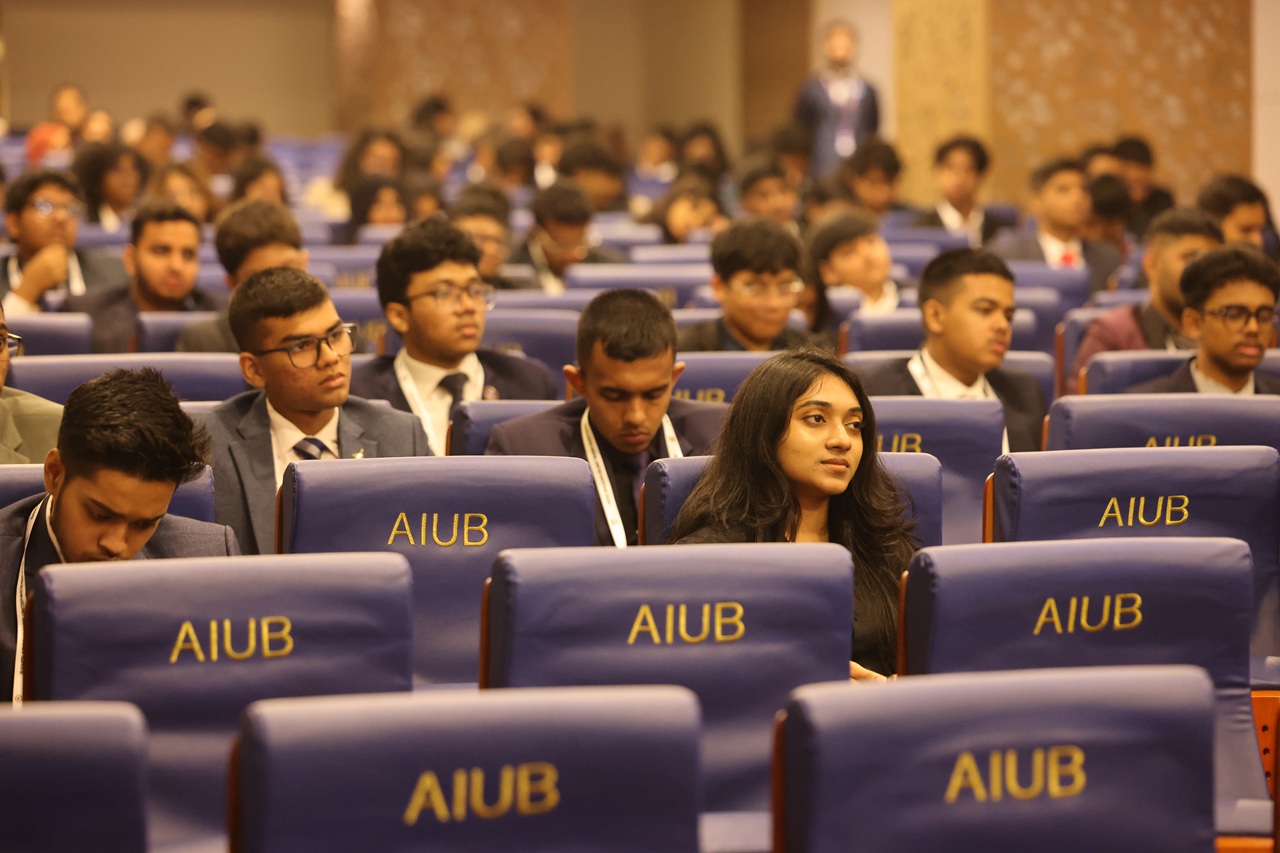
The Bangladesh Model United Nations (BANMUN) 2025 has opened at the American International University–Bangladesh (AIUB) with a restrained yet pointed message that global diplomacy today demands moral clarity as much as technical solutions.
Held under the theme Just Energy Transition, the opening ceremony held on Friday morning brought together senior government officials, academics, policymakers and student delegates to reflect on power, equity and responsibility in a world facing overlapping crises.
More than a ceremonial gathering, the event framed youth engagement as a serious political exercise. One rooted in justice rather than symbolism at a time when climate vulnerability, geopolitical instability and inequality are no longer theoretical concerns for countries like Bangladesh.
In his address, Chief Guest Asad Alam Siam, secretary of the Ministry of Foreign Affairs, described BANMUN as a platform that prepares young people for the complexity of real-world diplomacy.

He argued that climate action must move beyond technology and finance to address its human consequences. “A just transition is not only about shifting from fossil fuels to renewables; it is a moral dimension centered on people, equity and shared responsibility,” he said.
Highlighting Bangladesh’s role in global climate negotiations, Siam noted that despite contributing less than 0.5% of global greenhouse gas emissions, the country continues to push for climate justice on international platforms.

He cautioned delegates against seeking one-size-fits-all solutions, emphasizing that energy transition pathways must reflect national realities. Diplomacy, he added, depends not on competition but on mediation, restraint and collaboration.
The ceremony opened with a welcome address by Dr Sayed Md Saikh Imtiaz, professor of Women and Gender Studies at the University of Dhaka and Chairman of the Trustee Board of United Nations Youth and Students Association of Bangladesh (UNYSAB), who challenged conventional ideas of debate culture.
Describing Model United Nations as a philosophical practice rather than a competitive sport, he urged delegates to treat disagreement as a space for understanding rather than domination.
“Winning or losing does not take you anywhere unless you understand that the people who are losing also have a point,” he said.




Reflecting on UNYSAB’s early struggles to introduce MUN culture in Bangladesh, Dr Imtiaz recalled a time when structured diplomatic simulation was largely unfamiliar.
He acknowledged the role played by officials from the Ministry of Foreign Affairs in mentoring young organizers through real diplomatic experience.
Addressing the delegates, he asked them to envision the Bangladesh they wish to help shape over the next 25 years and announced plans to expand MUN culture beyond Dhaka, with the goal of establishing MUN clubs in educational institutions nationwide.
Presiding over the event, Dr Gazi Md Saifuzzaman, director general of the Department of Youth Development under the Ministry of Youth and Sports, placed the discussion within Bangladesh’s demographic context.
Nearly one-third of the population, he noted, falls within the youth age bracket of 18 to 35, many of whom remain outside education, training and employment.
He outlined ongoing government training programs aimed at skill development and self-employment, expressing hope that platforms like BANMUN could bridge academic learning with national development initiatives.
Guest of Honor Md Mashud Razzaq, Publisher of The Times of Bangladesh, described the newspaper’s partnership with BANMUN as its first major collaboration since launch.
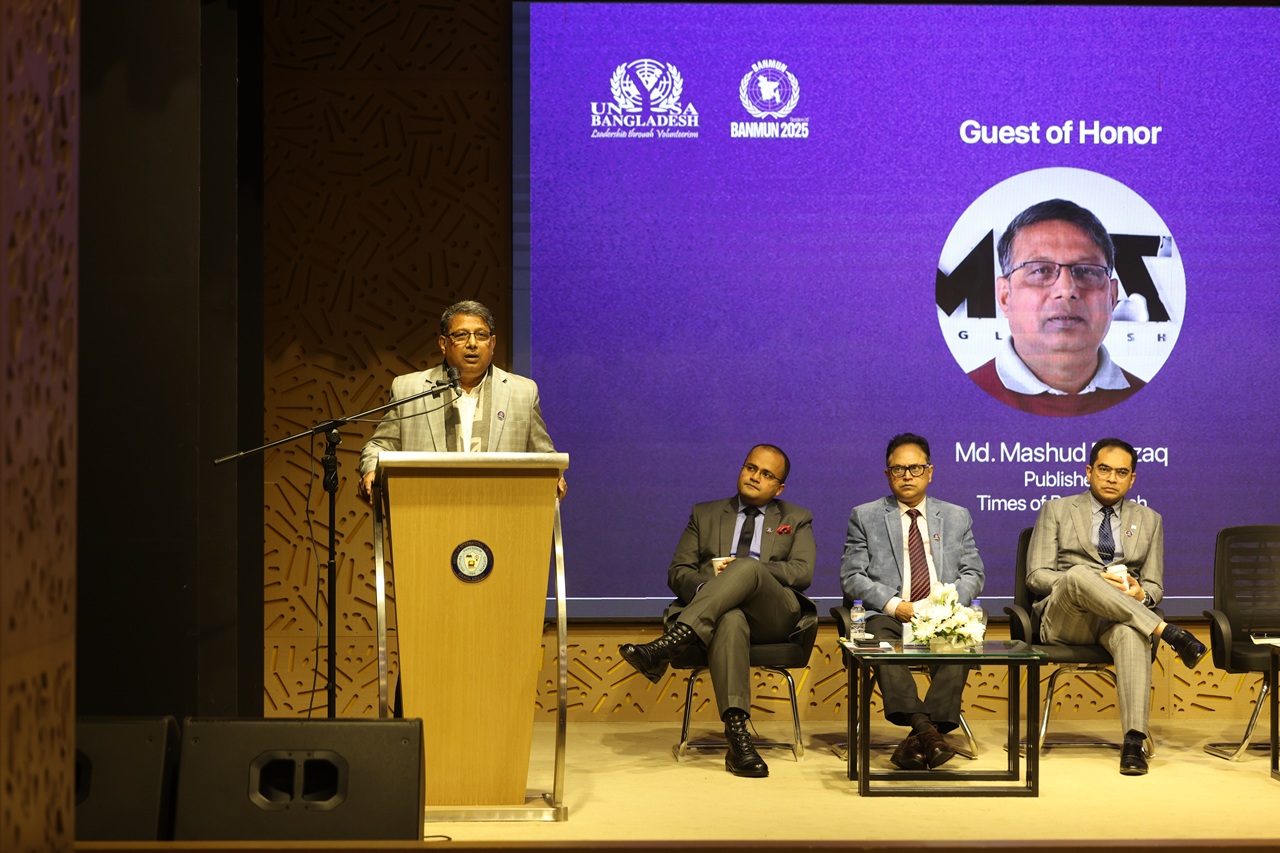
Emphasising editorial responsibility and national interest, he linked the conference theme directly to the delegates. “To me, you are the energy, the future,” he said, underscoring youth as both subject and stakeholder in the transition debate.
M Abul Kalam Azad, Editor, Special Affairs, and Sheikh Shahariar Zaman, Special Correspondent of TIMES were also present at the ceremony.
Special guest Dr Taufique Joarder, Associate Professor at the National University of Singapore and former president of UNYSAB, traced BANMUN’s origins to the early 2000s, recalling an era when limited access to information demanded deeper reading and mentorship.
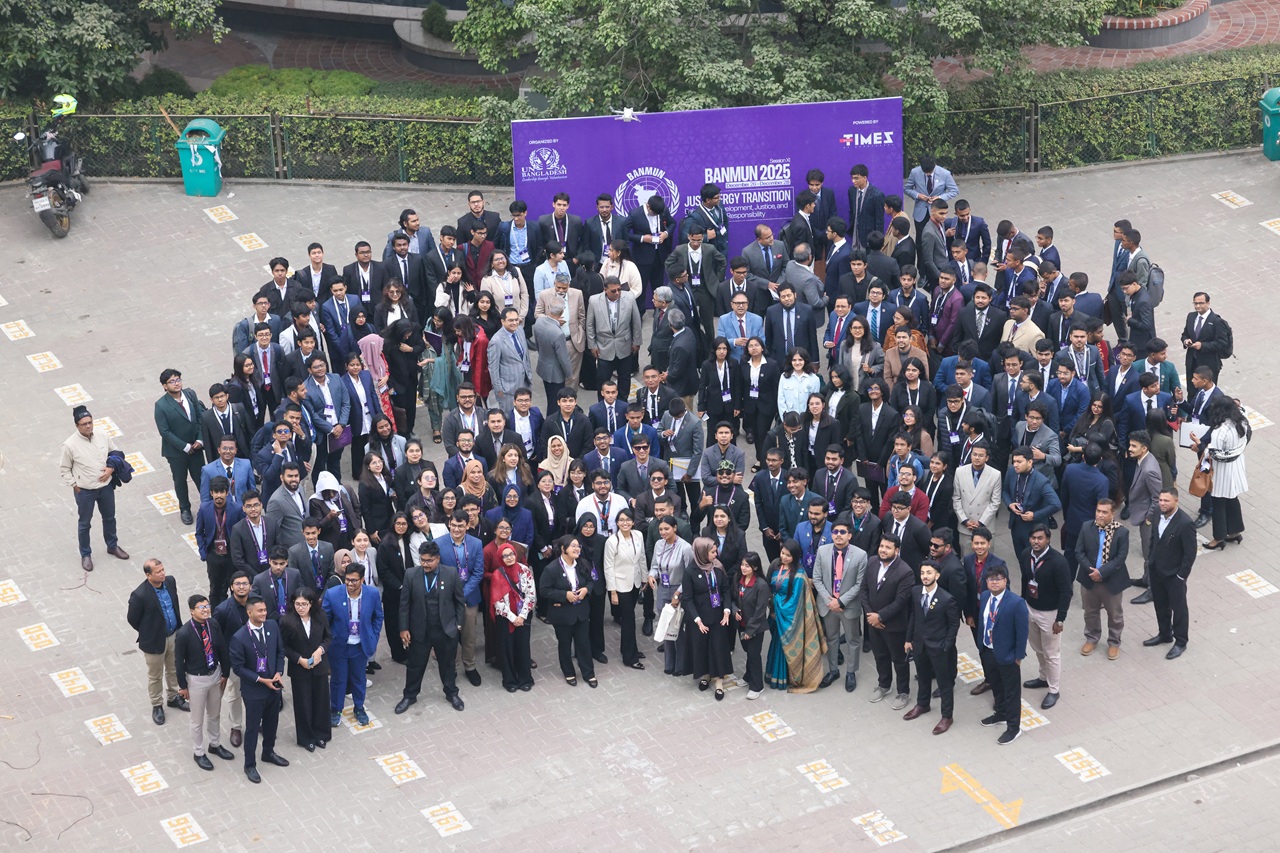
While acknowledging the growth of MUN culture, he warned against reducing it to spectacle and advocated for its integration into formal education.
Another special guest, Dr Syed Muntasir Mamun, Director General at the Ministry of Foreign Affairs, grounded his remarks in Bangladesh’s peacekeeping history, describing the United Nations as an institution built on sacrifice rather than abstraction.
He cautioned that global institutions risk losing relevance if they fail to reflect the realities of a generation that now constitutes the majority of the world’s population.
Linking artificial intelligence, energy transition and global governance, he urged delegates to examine policy through the lenses of justice and national interest.
As BANMUN 2025 begins its committee sessions, the opening ceremony set a clear tone: that diplomacy is not merely about resolutions and rhetoric, but about ethical choices in an increasingly unequal world and that the responsibility to confront those choices is already shifting to a younger generation.
After several sessions of discussion across eight groups over three days, this shadow United Nations assembly will adopt a consolidated resolution on the third day.