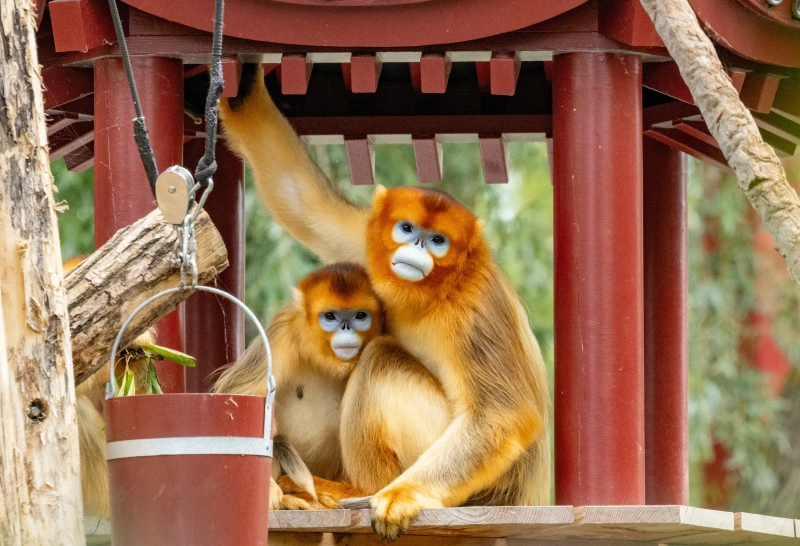

China’s rare golden snub-nosed monkeys have made their first public appearance at European zoos, marking a new chapter in the country’s wildlife diplomacy and possibly succeeding the long-running “panda diplomacy” program.
With bright orange fur, blue-tinted faces, and thick coats adapted to China’s icy mountains, these endangered primates are now serving as animal ambassadors in France and Belgium. The monkeys, loaned for a decade under the supervision of the China Wildlife Conservation Association, were transferred to Europe earlier this year as part of official cultural exchanges.
In April, three golden monkeys arrived at France’s Beauval Zoo in Saint-Aignan, coinciding with the 60th anniversary of China-France diplomatic relations. Another group reached Belgium’s Pairi Daiza Zoo in Hainaut in May, where visitors waved Chinese and Belgian flags to welcome them. After a month in quarantine, both groups are reportedly healthy and adjusting well to their new environments.

At Pairi Daiza, the trio—Liu Yun, Lu Lu, and Juan Juan—live in a specially designed habitat featuring traditional Chinese gazebos with red pillars and gray-tiled roofs. “We aim to establish long-term research and conservation collaboration with China, similar to our panda programs,” said Anaïs Maury, communications director at Beauval Zoo.




Both pandas and golden monkeys are classified as endangered and require approval from China’s central government before being moved abroad, said environmental historian Elena Songster of St. Mary’s College of California. Unlike pandas, however, golden monkeys have deep cultural roots in Chinese art and mythology, often depicted in paintings and literature, including the legendary Monkey King from the 16th-century novel Journey to the West.
China’s tradition of using animals as diplomatic envoys dates back decades. The first pair of pandas, Ping Ping and Qi Qi, were sent to the Soviet Union in 1957, followed by a historic panda exchange with the United States after President Nixon’s 1972 visit. Since 1984, China has shifted from gifting to long-term leasing of such animals, with partner zoos required to contribute to habitat protection and species research.
However, concerns persist about the welfare of animals transported long distances and required to return offspring to China. “These arrangements may benefit conservation but can also impose severe stress on individual animals,” said Jeff Sebo, an environmental and bioethics researcher at New York University.
At home, China’s conservation efforts have shown results. In Hubei’s Shennongjia National Park, protection programs launched in the 1980s have tripled the golden monkey population to around 1,600, according to Yang Jingyuan, president of the park’s Academy of Sciences.
While the diplomatic success of these “furry envoys” remains to be seen, China’s golden monkeys are already attracting global attention — and possibly heralding a new era in animal diplomacy.