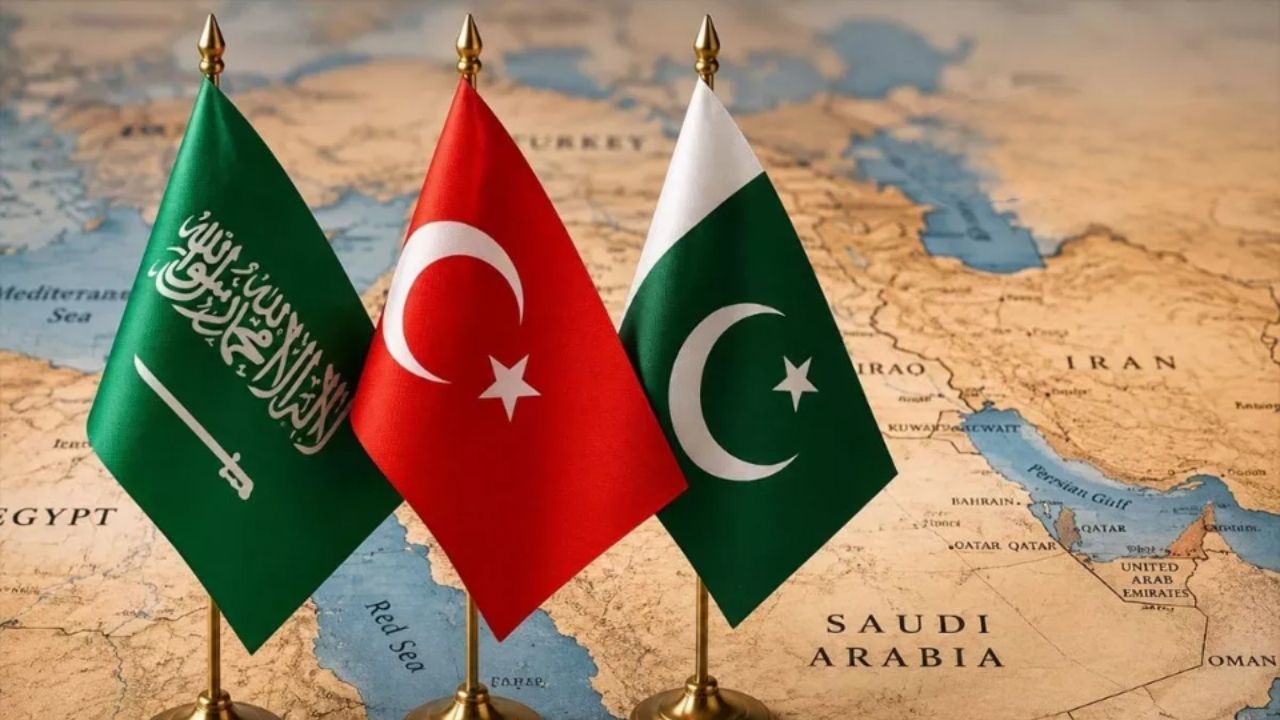
Bangladesh is once again part of Asian politics with the vision of the China–Myanmar–Bangladesh Economic Corridor (CMBC). During his recent visit to China, Bangladeshi Prime Minister Tarique Rahman again expressed China’s eagerness to develop an economic corridor between Kunming and Bangladesh via Myanmar.
The plan has been designed to improve regional connectivity, develop trade, and increase economic integration, but it also carries complex regional security challenges, great-power rivalry, and Bangladesh’s foreign policy issues.
The CMBC is not a stand-alone infrastructure project. It is actually an agenda for connectivity development between South Asian and Southeast Asian nations, which are part of China’s larger initiative, the Belt and Road Initiative (BRI).
The proposal offers tremendous economic potential for Bangladesh, but the avenues to implement it will depend on resolving the various geopolitical issues.
This concept is not unheard of. The Bangladesh-China-India-Myanmar (BCIM) Economic Corridor was first proposed by China over 10 years ago, envisioning a transport and trade corridor linking the Chinese city of Kunming with Kolkata via Myanmar and Bangladesh.
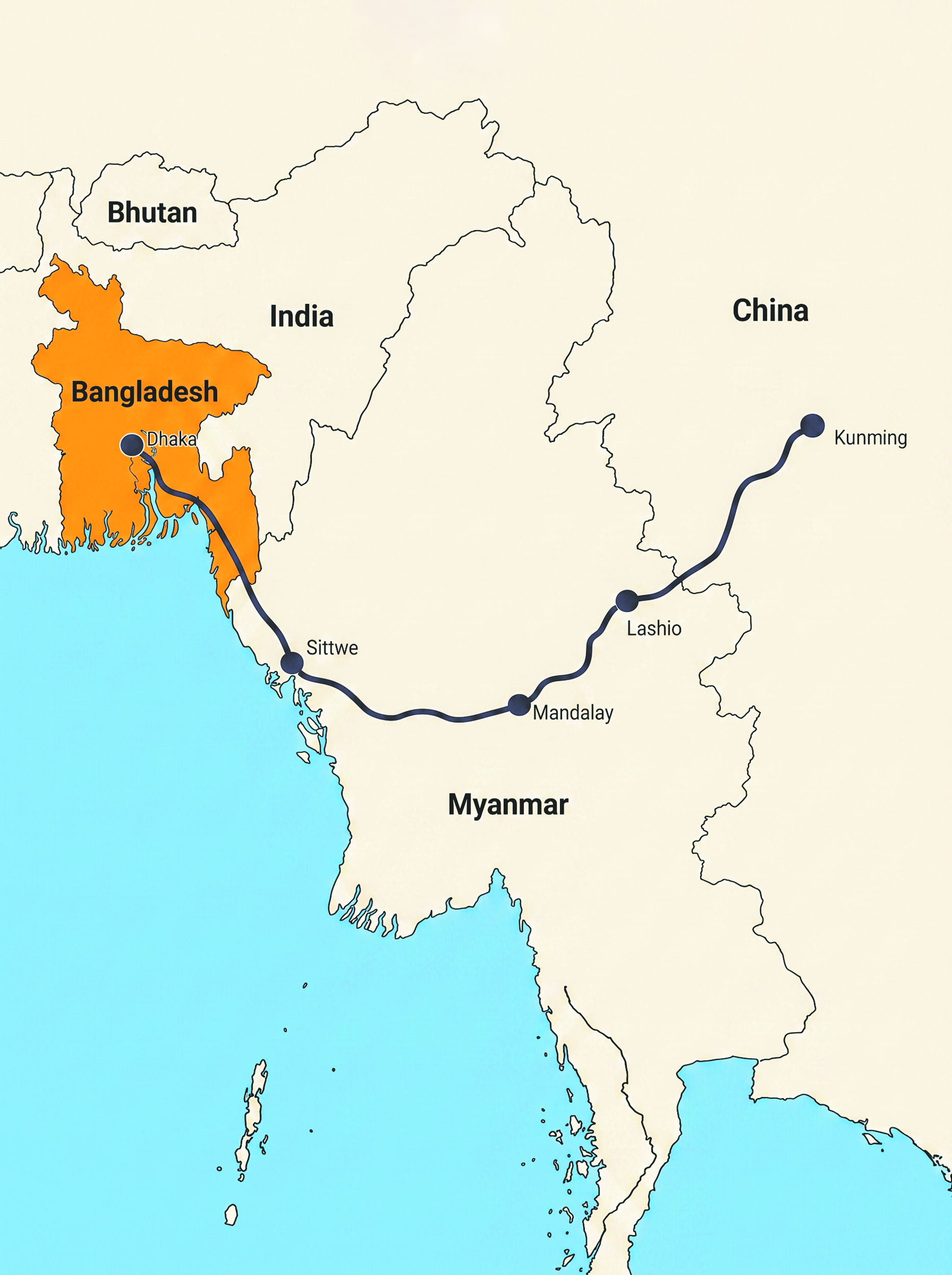
While the project is an economic proposition, it has not gained momentum because it is a strategic issue for India amid China’s rise under the BRI. Now that India has left, Beijing is looking at an alternate route through Myanmar and Bangladesh, and the door is open to India in the years ahead.
The new approach is geared towards the new geopolitical realities. China is not trying to get the four countries to agree, but to push regional connectivity with willing partners. Bangladesh is strategically situated at the northern limit of the Bay of Bengal and, naturally, is at a crossroads in this new arrangement.
The proposed route has great economic potential. The path would go from Kunming to Mandalay, then to Yangon and into Myanmar’s strategically significant Kyaukphyu Deep Sea Port.
It would then be transported from there to connect with Cox’s Bazar and Chattogram by road and rail, respectively, making Bangladesh the hub of a regional logistics network between the Indian Ocean and China.
If implemented successfully, the corridor is expected to greatly reduce transportation costs and delivery times between western China, Bangladesh, and Southeast Asian countries.
The magnitude of Chinese investment in Bangladesh’s SEZs can be increased, the manufacturing value chain diversified, and better access to Bangladesh’s exports to the Chinese and ASEAN markets can be achieved. This connectivity will help to make Bangladesh a logistics and manufacturing hub in the region.
Moreover, the corridor is in coherence with Bangladesh’s overall development policy. Regional connectivity and export markets are now prioritised in light of the country’s aspiration to become a Least Developed Country (LDC). With improved connectivity, opportunities for industrial investment and trade with neighbouring countries would improve, making Bangladesh even more competitive in the global value chain.
The corridor is also symbolic of other areas of cooperation between Bangladesh and China, which are strengthening. Beijing has been eager to help manage rivers, including the long-delayed Teesta River Comprehensive Management Project.
With improved management of the river, food security and livelihoods of the people in the region would also improve, as river water is vital for crop cultivation in northern Bangladesh. This broader development cooperation indicates China’s desire to do more than just invest in infrastructure.
However, the biggest challenges to the emergence of the CMBC are geopolitical. Myanmar is the weak link in the envisioned corridor. Since the 2021 military coup, between the military junta and various ethnic armed groups, the country has been experiencing a protracted civil conflict.
The Arakan Army has gained significant power in parts of Rakhine State where substantial sections of the proposed corridor lie. Stability, security of transportation systems, the predictability of governance, and investors’ confidence are critical conditions for infrastructure corridors. These prerequisites exist largely at present.




Security concerns would be significant during construction, logistics, and maintenance.
The pending Rohingya crisis only adds to the woes. For months, if not years, Bangladesh has been accommodating more than one million Rohingya refugees from Myanmar.
However, without any progress in voluntary, safe, and dignified repatriation, political confidence between Dhaka and Naypyidaw will continue to be hampered. This is a humanitarian issue that will continue to be part of any large-scale connectivity project that cuts through Rakhine State.
The role of the Chinese government is becoming even more important in this place. Beijing has significant sway over Myanmar’s military officials and has been in touch with several players there.
The political environment for corridor implementation might drastically turn for the better if China can take an active role in the conflict management process in Rakhine State, and also if concrete measures are taken for Rohingya repatriation.
Hence, there should be simultaneous economic connectivity and conflict resolution, not separate ones.
China’s connectivity initiatives in South Asia have been viewed as a form of competition with India from time immemorial. The first BCIM deal has been unsuccessful because of New Delhi’s fears that Chinese development will give the Chinese city more political and economic weight in New Delhi’s neighbourhood.
Today, it’s a new geopolitical world. India and China have taken tentative steps to defuse their relations after years of frosty relations over the border issue. But there has always been some rivalry in their relationship.
The Bangladesh-China-Myanmar link inevitably affects regional trade patterns and also boosts China’s influence in the Bay of Bengal region.
Bangladesh has a unique geopolitical situation from India’s perspective. It connects South Asia with Southeast Asia, passing through the important sea lanes of the Bay of Bengal. The attention of the government of New Delhi is naturally drawn to major infrastructural or economic development by China in Bangladesh.
However, connectivity doesn’t need to be a zero-sum game. The corridor, if carefully managed and operating within an open economic framework, should coexist with, rather than compete with, regional integration.
Actually, the Chinese have said they’re willing to play if the political situation is conducive. This transparency could reduce the chances of the CMBC being used as a Geopolitical weapon.
The U.S. and other Western partners are also closely following events outside South Asia. Not a day goes by without China occupying Americans’ minds in the Indo-Pacific, and Washington increasingly views the region that way.
In terms of geopolitics, therefore, China’s mega infrastructure projects tend to be examined more closely than economic analysis.
As its cooperation with China continues to grow, Bangladesh will have to walk a tightrope between its growing economic, security, and trade relationships with the U.S., Japan, the European Union, and India. In this regard, the foreign policy motto of Dhaka over the years, ‘friendship to all, malice towards none,’ is more relevant.
As far as Bangladesh’s strategic autonomy is concerned, it should still be based on this principle. No compromise on building good relations with other great powers in the process of being part of the Chinese-led connectivity.
In the same way, even if one engages in trade with the West, one ought not to be prevented from using China for trade. Effective middle powers are more diversified than focused on strategic partnerships.
The Bay of Bengal has, in fact, emerged as one of the most highly militarised waters in the world. Competition is intensifying among Beijing, New Delhi, Washington, Tokyo, and other regional powers over sea lanes, energy security, infrastructure, and digital connectivity. Bangladesh is right at the centre of this transforming picture of the transforming geographies.
Bangladesh should not consider it a weakness; rather, it is a strength in geography. The country’s geostrategic location offers an opportunity to become the pivot between South Asia, Southeast Asia, and other island countries of the Indo-Pacific region. The potential for a CMBC to be a significant part of this vision is great if the project’s design and execution are done correctly.
But economics, not geopolitics, should be the developmental effect of all economic corridors. All implementation efforts should be based on transparency of the financing, environmental sustainability, job creation, debt sustainability, social inclusion, and national ownership.
The development of infrastructure should be geared towards national resilience and not strategic dependence.
The CMEC will have to rely on diplomacy rather than engineering to achieve its goals. Whether or not the proposal will be successful will depend on Myanmar’s security situation, the situation of the Rohingya, India’s diplomatic skill, shifting geopolitical interests, and perceptions of China’s regional interests.
Either passing up the connectivity opportunity or taking it without a plan in place may place the country in an unwarranted geopolitical trap and limit the range of additional economic opportunities. It’s not a choice between politics and economics, between China and the West. The problem is economic growth and equilibrium.
The main principles of Bangladesh’s foreign policy are independence, multi-layered policies, and pragmatism, particularly in the competitive world of great powers.
A delicate balance of economic ambitions and geopolitical skill could make the China-Myanmar-Bangladesh Economic Corridor (CMEC) a new symbol for cooperation, development, and mutual peace in the Bay of Bengal.
The author is a Professor of Department of International Relations, University of Chittagong, Bangladesh. Director, Hong Kong Research Centre for Asian Studies-Bangladesh Centre (RCASBC). Email: [email protected]