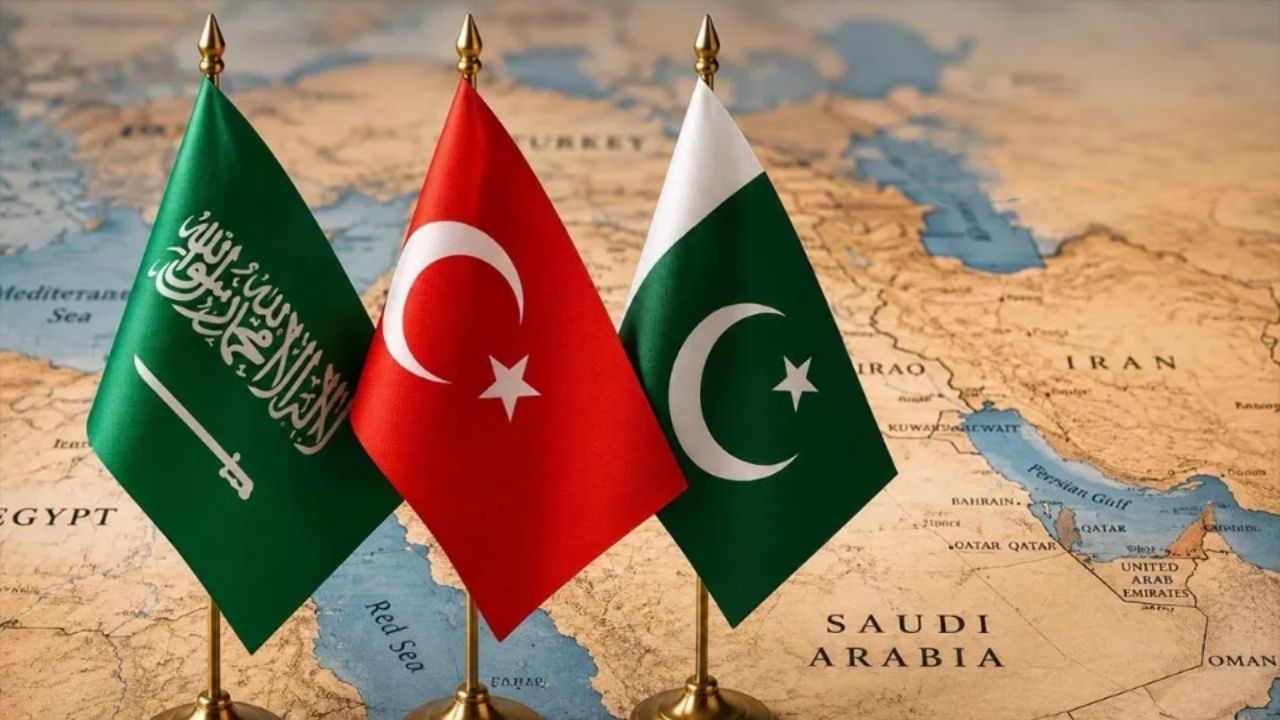



Joining the Mecca Pact could open crucial new doors for Bangladesh’s defence capabilities, military equipment supply, joint training, and intelligence sharing.
However, potential geopolitical fallout – including the India-Pakistan friction, US-China rivalry, the Israel issue, and regional geopolitics – could trigger serious national security risks.
Security and international relations experts have therefore warned the government to meticulously assess the treaty’s terms, costs, benefits, and long-term strategic implications before committing to the alliance.
These warnings were delivered on Monday at a roundtable discussion titled “Potential Accession of Bangladesh to the Mecca Defence Pact: Strategic National Security Calculus.”
Organised by Voice for Reform in collaboration with Adhipatyabad Birodhi Nagorik Samaj, the seminar was held at the BDBL Building in Karwan Bazar, Dhaka.
Panellists noted that while the Mecca Pact presents valuable defensive and diplomatic opportunities, any decision must carefully balance the alliance’s terms against the positions of key regional and global powers.

Strategic openings and Turkey’s tech edge
Major General (retd) Fazle Elahi Akbar argued that a defensive alliance like the Mecca Pact could prove highly supportive under Bangladesh’s current security realities. He highlighted its potential to boost defence supply chains, military capabilities, joint training, and intelligence sharing.
However, with the treaty’s specific details still under wraps, he cautioned that Dhaka must fully anticipate the geopolitical fallout, particularly regarding the India-Pakistan conflict.
Professor Shahab Enam Khan of the Department of International Relations at Jahangirnagar University agreed that the Mecca Pact could bolster Bangladesh’s security and diplomatic leverage.
He pointed out that rising instability in the Bay of Bengal, Myanmar, and adjacent areas poses immediate security threats to Bangladesh.



Since regional organisations have failed to guarantee collective security, Bangladesh must explore alternative security partnerships, though this will require meticulous diplomatic groundwork and national political consensus.
He also pointed to new avenues of security cooperation within the Muslim world, suggesting that if full membership is off the table, Bangladesh should consider joining as an observer.
Brigadier General (retd) Hasan Nasir, President of Nexus Defence and Justice, suggested that aligning with the Mecca Pact would enhance Bangladesh’s autonomy to make independent security and diplomatic decisions in its own national interest.
Beyond cooperation from Saudi Arabia, Bangladesh could also leverage Turkey’s advanced military technology. However, he warned that the Mecca Pact must not devolve into an “OIC-2.0”, pointing out that an oversized membership would only dilute the alliance’s ultimate operational teeth.
Scepticism over ‘shortcut solutions’ and regional ties
Taking a more sceptical view, former diplomat Sakib Ali questioned the government’s seemingly positive posture toward the pact. He argued that the treaty’s terms and its potential cost-benefit impacts have been kept hidden from the public and political stakeholders.
He warned against treating the Mecca Pact as a “shortcut solution” to all of Bangladesh’s security challenges instead of doing the hard work of building up self-reliant, domestic defence capabilities.
Monira Sharmin, Joint Convenor of the Jatiya Nagorik Party, strongly cautioned that the Mecca Pact must never be framed or projected as an anti-India alliance. Emphasising Bangladesh’s deep, long-term bilateral ties with India over shared borders and rivers, she stressed that joining any alliance should not drag Bangladesh into conflict with its neighbours.
No formal invitation yet, analysts urge caution
Chairing the seminar, Dr Dilara Choudhury, Head of the Convening Committee of Adhipatyabad Birodhi Nagorik Samaj, insisted that any decision on the Mecca Pact must be ruled by national interest, security, and geopolitical pragmatism, not emotion.
She advised against any rushed moves before the treaty’s precise terms, the positions of future members, and its long-term strategic impacts are fully laid bare.
Crucial dynamics – including the Shia-Sunni sectarian divide, the US stance, the Israel issue, and India’s inevitable reaction – must be weighed.
Crucially, Dr Choudhury revealed that Bangladesh has not even received an official invitation to join the pact yet. She maintained that Dhaka must first secure the invitation and examine the fine print before deciding whether the pact genuinely serves its national security and economic interests.
The delicate global balancing act
Brigadier General (retd) Shafaat Ahmed observed that Bangladesh has massive untapped opportunities for cooperation with Saudi Arabia, Turkey, and Pakistan across the defence, economic, and manpower sectors.
However, rather than rushing for full membership, he advised exploring alternative avenues such as observer or associate member status.
Given Bangladesh’s geographical reality – specifically its shared borders, rivers, and maritime proximity to India – he urged Dhaka to craft a strategy that secures the benefits of the pact without unnecessarily irritating its neighbour.
Jon F Danilowicz, former US diplomat and deputy chief of mission at the US Embassy in Dhaka, stated that while Washington has no direct objection to the Mecca Defence Pact, it does harbour deep concerns regarding its geopolitical ramifications.
He noted that the pact’s eventual impact on US-China relations and the security of Israel would be heavily scrutinised by Washington.