


When the United States invaded Iraq in 2003, Bangladesh came under pressure to contribute troops to the US-led military effort. Washington sought Dhaka’s cooperation at a time when bilateral relations were important, and the BNP-led government included Jamaat-e-Islami as a coalition partner.
The then US Secretary of State Colin Powell visited Dhaka in June 2003, followed a year later by US Secretary of Defence Donald Rumsfeld.
Against the backdrop of strong US pressure, Bangladesh publicly maintained that it would not participate in any military operation without a UN mandate. Dhaka later made its position more explicit, saying that even a UN mandate would have to be considered alongside the consent of the Iraqi people and public opinion in Iraq.
But what was happening behind the scenes? How did the government prepare diplomatically? How did the Foreign Ministry coordinate with the Prime Minister’s Office, the military and political parties? And how did Bangladesh resist US pressure without damaging its relationship with Washington?
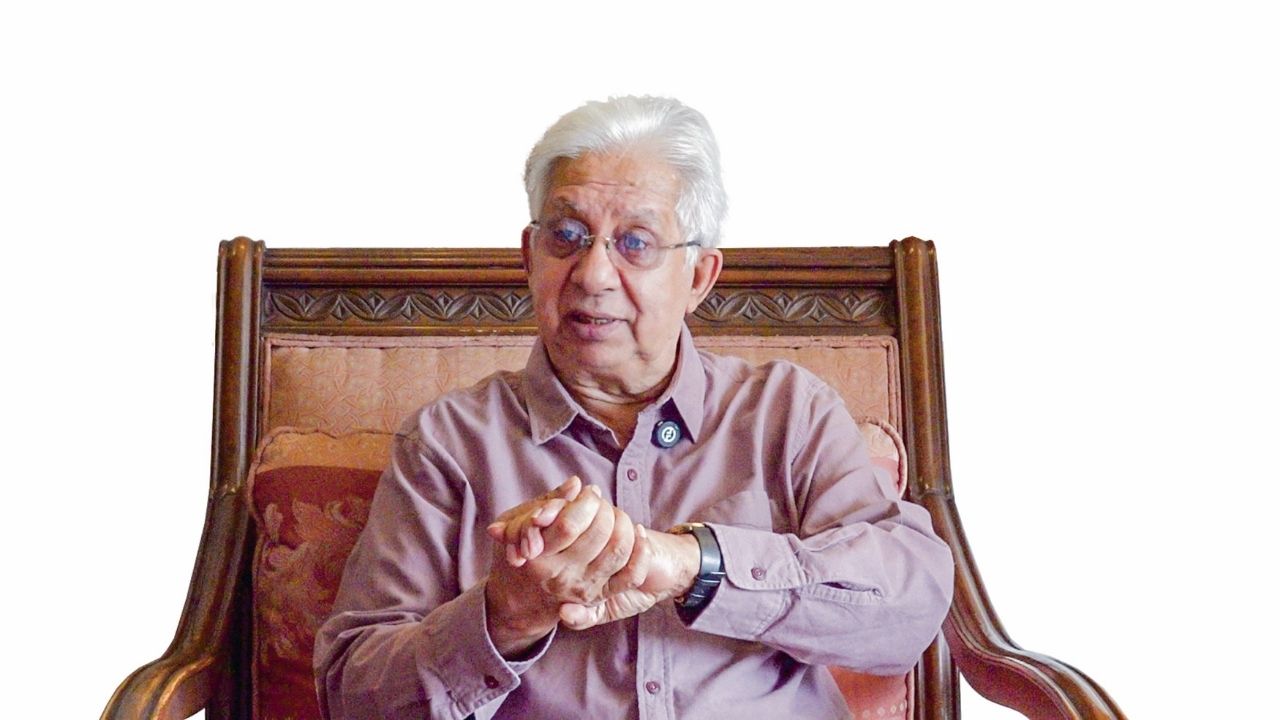
In this special interview, former Foreign Secretary Shamsher M Chowdhury, who was at the centre of the process, recalls how Bangladesh handled one of the most sensitive foreign-policy challenges of that period.
The story began soon after the BNP government came to power in 2001. At that time, Bangladesh attached great importance to its relations with the United States. Within a few weeks of the new government taking office, the then Foreign Minister Dr. AQM Badrudozza Chowdhury visited Washington at the invitation of Colin Powell.
I accompanied him, along with the then State Minister for Foreign Affairs, Amb. Reaz Rahman. We held a series of meetings at different levels with members of the Senate and Congress and officials of the State Department. In almost every meeting, one question came up: ‘Why is Jamaat in your alliance?’
In the meantime, Mr. Morshed Khan had been appointed Foreign Minister, replacing Dr. Badrudozza Chowdhury, who had been elected as President. The political atmosphere in the United States had changed significantly after 9/11, and there was strong anti-Islam sentiment in the country. From late 2001, we also began to understand that the United States was preparing for possible military action against Iraq. By 2002, we were monitoring the issue very closely.
Our fundamental question was: on what basis would the United States launch a military operation against an independent and sovereign country? The United States was arguing that Iraq possessed weapons of mass destruction and had links with terrorism. But the necessary support for military action was not forthcoming from the UN Security Council.
By late 2002, the Foreign Ministry proposed to the Prime Minister that the government should discuss this critical issue at the highest decision-making level within the government, determine Bangladesh’s position as the situation developed and consider all possible options.
A meeting was held under the leadership of the late Prime Minister Khaleda Zia. We presented the Foreign Ministry’s assessment and proposed position. We explained that if the United States took such a major military step, pressure would inevitably come on Bangladesh. Washington could seek political cooperation and perhaps even ask us to contribute troops. Therefore, we felt that Bangladesh needed to establish its position beforehand.

The government’s position was clear: Bangladesh would not participate in any military operation without UN approval. Bangladesh had a long tradition of sending its armed forces abroad for peacekeeping and other operations under a UN mandate. We felt that this principle should guide our policy on Iraq as well.
During the course of the discussions, Dr Khandaker Mosharraf Hossain made an important observation. He said that the United States might be able to enter Iraq and remove Saddam Hussein from power, but it would be much more difficult for them to manage the long-term fallout from the aftermath of such a major military action. One later saw how prescient that observation was.
The United States entered Iraq, but it took many years to withdraw, with enormous costs in terms of money and lives. At the same time, we would have to tactfully take a position that the US would understand and thereby avoid doing any serious harm to our bilateral relations.
One day, the US Ambassador in Dhaka, Mary Ann Peters, said she had some important news. She said that US Secretary of State Colin Powell would be coming to Dhaka on an official visit shortly. I immediately informed the Foreign Minister. We immediately went to the Prime Minister’s Office and briefed Prime Minister Khaleda Zia on this sudden development. At that point, we assumed that the Americans would raise the issue of the war in Iraq.
The Prime Minister’s instruction was very clear: “We will listen first. Let them tell us what they want. We will not say anything in advance.”
During his meeting, the US Secretary of State raised the possibility of Bangladesh playing a military or peacekeeping role in Iraq. The Prime Minister made it clear that Bangladesh could consider participating in any military action in a foreign land only when the UN has sanctioned such military action, and that too mainly for UN Peacekeeping operations.
Colin Powell chose not to pursue the matter further and instead emphasised on the importance of Bangladesh-US relations. Later, in September 2003, Foreign Minister Morshed Khan discussed the issue again with Colin Powell in New York. He reiterated that Bangladesh sends peacekeepers under the UN framework only.

At one point, when the pressure had increased considerably, I went to the Prime Minister’s residence and briefed her on the situation.
She said very calmly, “If Bangladesh sent soldiers to fight in Iraq and the body of a Bangladeshi soldier came back to the country, her government would be under tremendous pressure and face serious criticism at home.” That reflected her understanding of the political reality.
Once the war had started and Saddam Hussein had fallen, the question for the United States became: how could Bangladesh contribute to the reconstruction of Iraq?
The Prime Minister made it clear that Bangladesh would not participate militarily. However, if US soldiers required medical evacuation and needed to use Dhaka airport for that purpose, Bangladesh could consider it favourably. The Prime Minister was very clear: medical use, not military use. In other words, Bangladesh would not become part of the military operation.
US Ambassador Harry K Thomas informed me that after arriving at the airport, Rumsfeld would go directly to the cantonment and meet the chiefs of the three services before meeting the government officials. I told him this did not conform to our usual protocol.
It was made clear from our side that any meeting with the Military Service Chiefs would be part of the Defence Secretary’s overall interaction with the government, not separately. Prime Minister Khaleda Zia was very firm on this. Eventually, we agreed on a unified format.
The meeting would be led by the Foreign Minister, with the Prime Minister’s representative and the three service chiefs present. I told them that they would be present at the meeting, but would not get drawn into any diplomatic or military-related discussions. If there was a technical or military question, that could be addressed by the appropriate person.
It is not clear why the US Secretary of Defense wanted to meet the Service Chiefs separately. Among other things, this did not fit into any protocol practice anyway.
During Secretary Rumsfeld’s visit, Bangladesh reiterated that it would not send troops to Iraq in any combat role. The possibility of Bangladeshi peacekeepers going to Iraq was also discussed at the time.
It was not a balancing act in the conventional sense of balancing strategic relationships between two competing powers.
This one called for striking the right balance between a principled policy on one side and making it known to the most powerful country in the world on the other, and doing so without harming this very important relationship.
Our objective was simple: there could be disagreement, but the disagreement should not damage the strategic ties.
To achieve that, we took several steps. First, we needed to brief all Bangladeshi Ambassadors and High Commissioners abroad about the situation and the government’s position. We felt this was necessary as they would be asked by the respective host governments about the position taken by Bangladesh on this very issue.
Accordingly, we apprised them of the government’s position for the different stages of the crisis – what to say before the war started, what to say after the war began and how to respond as the situation evolved. The government’s position was ‘we call for peace and dialogue among all stakeholders, preferably under the auspices of the United Nations.’ The message had to be consistent everywhere.
The government’s position was straightforward: Bangladesh would not engage in military action without a UN decision. At the same time, we would appeal for peace and dialogue without publicly condemning the US action.
There was regular communication with the media. Both Foreign Minister Morshed Khan and I briefed journalists from time to time. At that time, relations between the media and the BNP government were also relatively good. There was criticism at times, and the government responded to it.
But there was a degree of mutual understanding. For us, it was important that the government’s position on such a sensitive international issue was properly understood and not misinterpreted.
The most important thing was a collective approach, with one decision-making process and one public face. Everyone could give their opinion. But the decision had to be collective, and one institution had to communicate the government’s position publicly – the Foreign Ministry.
The Prime Minister had clearly instructed that no ministry or department other than the Foreign Ministry should publicly speak on this issue. That was very effective. The coordination between the Prime Minister and the Foreign Ministry was very strong.
I was in diplomacy for 32 years. I believe that, for Bangladesh, diplomacy must be the first line of defence. If a problem can be resolved diplomatically, there is no need to resort to military power. Of course, a country must maintain the capability to defend itself. But diplomacy should always come first.
Our diplomats must be properly trained, and their role in national decision-making must be clearly defined. I have worked in China, where the scope for conducting foreign policy outside the Foreign Ministry is very limited. The Foreign Ministry plays a central role in matters relating to international relations.
In Bangladesh too, if the Foreign Ministry can be properly positioned as the central coordinating institution for foreign affairs, both decision-making and implementation will become easier.
The most important thing is clarity about who executes the government’s foreign policy. The answer is the Ministry of Foreign Affairs. However, the need for effective coordination between the Foreign Ministry and other relevant Ministries is equally important.
I have seen at different times that whenever coordination between the Prime Minister and the Foreign Ministry was strong, diplomats were able to work much more effectively.
Foreign policy requires consistency. Foreign governments need to know where decisions are being made and whom they should speak to.
Bangladesh said ‘no’ to the United States on military participation in Iraq, but it did not say ‘no’ to the relationship. During the Iraq war, Bangladesh had to navigate strong pressure from Washington while also taking into account domestic political realities and public opinion.
The core policy was clear: Bangladesh would not participate in military operations without a UN mandate, and it would not send troops to fight on behalf of any side. At the same time, we would not damage our relationship with the United States.
The policy worked because there was strong political leadership, close coordination between the Prime Minister and the Foreign Ministry, communication with the political parties, preparation of our missions abroad and, above all, a unified message. The final decision rests with the Prime Minister as Head of the Government. A well-coordinated process helps the Prime Minister make a well-informed and well-considered decision.
That was the key lesson: a country can disagree with a powerful partner without turning the disagreement into hostility.