


Ancient yoga texts use the image of a turtle withdrawing its limbs into its shell. This imagery represents a yoga practitioner’s capability of drawing back attention inwards rather than allowing every external impression to dictate where the mind goes.
The turtle isn’t running away when it senses danger, rather it is setting boundaries by retracting its senses.
This makes ‘pratyahara’ less about deprivation and more about discernment.
The Sanskrit word is described as withdrawal of senses. But it does not mean shutting oneself away from the world or deliberately refusing to see, hear or feel anything. Instead, it is the practice of becoming less automatically controlled by sensory stimulation.
This is where yoga becomes relevant to modern life.
A phone vibrates. We reach for it. A notification appears. We check it. A conversation becomes uncomfortable. We mentally rehearse our response. A thought about work arrives while we are eating. We follow it.
Much of the time, our attention is being directed by whatever happens to appear in front of us.

Pratyahara asks us to practise something different: noticing the stimulus without immediately surrendering our attention to it.
From ancient sutras to modern practice, yoga has long been concerned with something beyond flexibility: learning when to turn away from the noise.
Yoga today can look very different from the practice imagined thousands of years ago. There are studios, elaborate poses, flowing sequences, and carefully curated yoga playlists. There are classes designed for better sleep, stronger backs, greater flexibility and, increasingly, stress relief.
Beneath all these modern variations runs the age-old idea: yoga is not only about what the body can do. It is also about what happens to the mind. At the centre of this philosophy is a simple phrase: chitta vritti nirodha.
It is commonly translated as “yoga is the stilling of the fluctuations of the mind”.



The phrase describes something familiar to anyone who has finished a yoga class and noticed, perhaps for a few fleeting minutes, that the mind feels quieter. Thoughts have not necessarily disappeared. Rather, they no longer seem to pull attention in every direction.
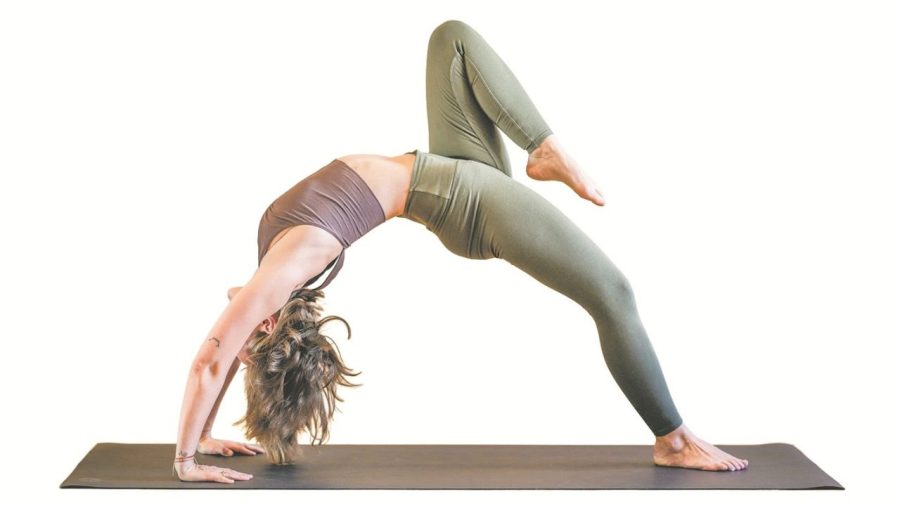
It is not necessary to close the eyes, block the ears or retreat to a cave. The practice can begin in something as ordinary as an asana.
During a posture, instead of worrying constantly about whether the body looks right, how much longer the pose will last or what comes next, attention can be brought deliberately to the breath, the sensations in a particular part of the body or a chosen point of focus.
If practising Cobra Pose, for example, a practitioner might notice the sensations around the spine and lower back, observe the movement of the breath and remain attentive to what the body is actually experiencing.
Child’s Pose can offer a similar inward quality, with the body folded and the visual field naturally restricted. Supported Legs-Up-the-Wall or Viparita Karani can create another quiet, restorative setting.
Seated postures such as Sukhasana or Padmasana provide a stable base for breath awareness and concentration.
Gaze can become another tool.
In beginner practice, the gaze may rest on a point such as the floor, a wall, the thumb or the big toe. With greater experience, some practitioners use more inward points of attention, such as the tip of the nose or the space between the eyebrows.
Ancient yoga sages describe five broad forms of mental movements: correct perception, mistaken perception, imagination, sleep, and memory. Some may be helpful; others may create disturbance.
The challenge is learning to recognise them rather than automatically identifying with every thought that arises.
Yoga, in this sense, is not an instruction to stop thinking. It is an invitation to notice thinking.
Trying to force the mind to become completely empty can itself become another source of frustration. The practice is instead about developing enough awareness to observe thoughts, sensations and emotions without being swept away by each one.
A practitioner learns to distinguish tension from compression, effort from strain, movement from stillness and changes in the breath. Over time, the same capacity for observation can be applied to the mind.
Consider Savasana, the familiar Corpse Pose at the end of a class. The body is still. The eyes are closed. There is little physical activity to occupy the mind. External stimulation is reduced, and attention can gradually settle on the breath and bodily sensations.
Savasana is therefore not merely a few minutes of lying down after the “real” yoga is finished. It can become an opportunity to practise withdrawing attention from the constant stream of external demands.
Listen to the teacher’s cues. Feel the breath. Notice the body. Keep the gaze steady. Resist the urge to evaluate every second of the practice. Am I doing this correctly? How long is left? Why can everyone else do this better?
The mind can generate an endless stream of questions. Pratyahara is the practice of recognising that stream without having to follow every current.
Perhaps yoga’s most enduring challenge is not whether we can touch our toes or balance on our heads. It is whether, for a few moments, we can choose where our attention goes.
Author is Senior sub-editor at TIMES of Bangladesh, founder of Prabhayoga, and yoga instructor at Arthy Ahmed Dance Academy.