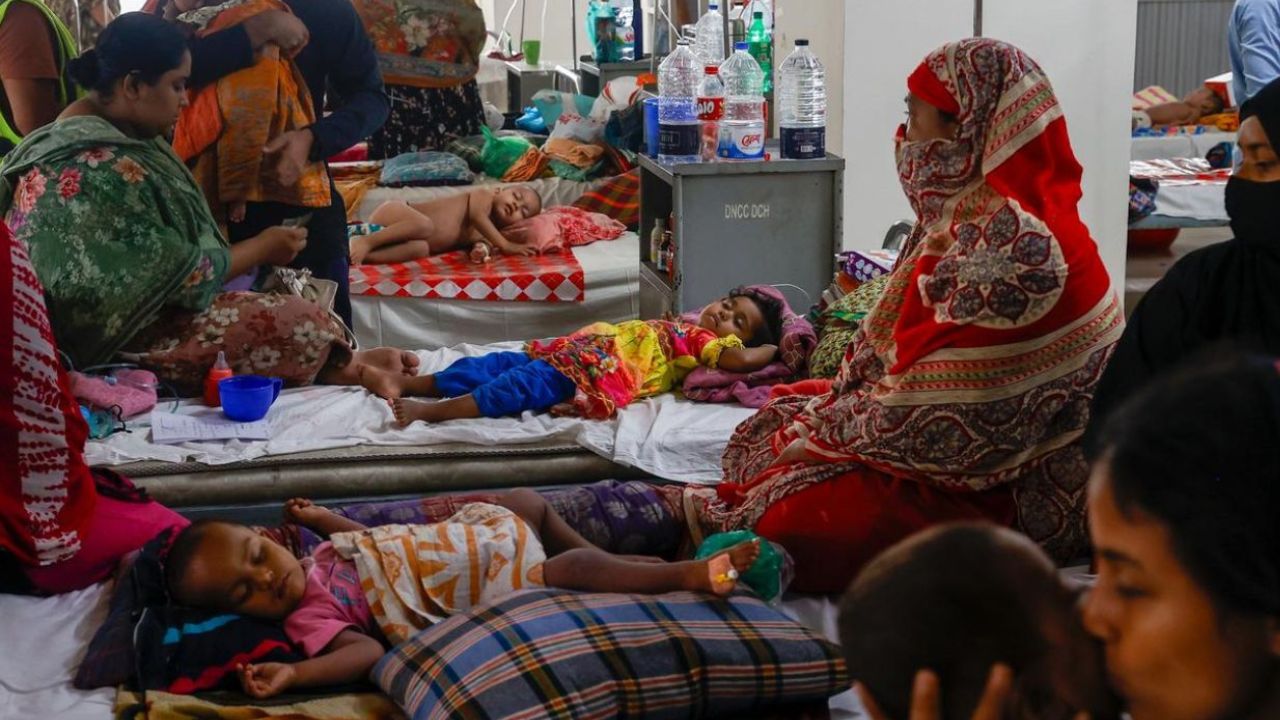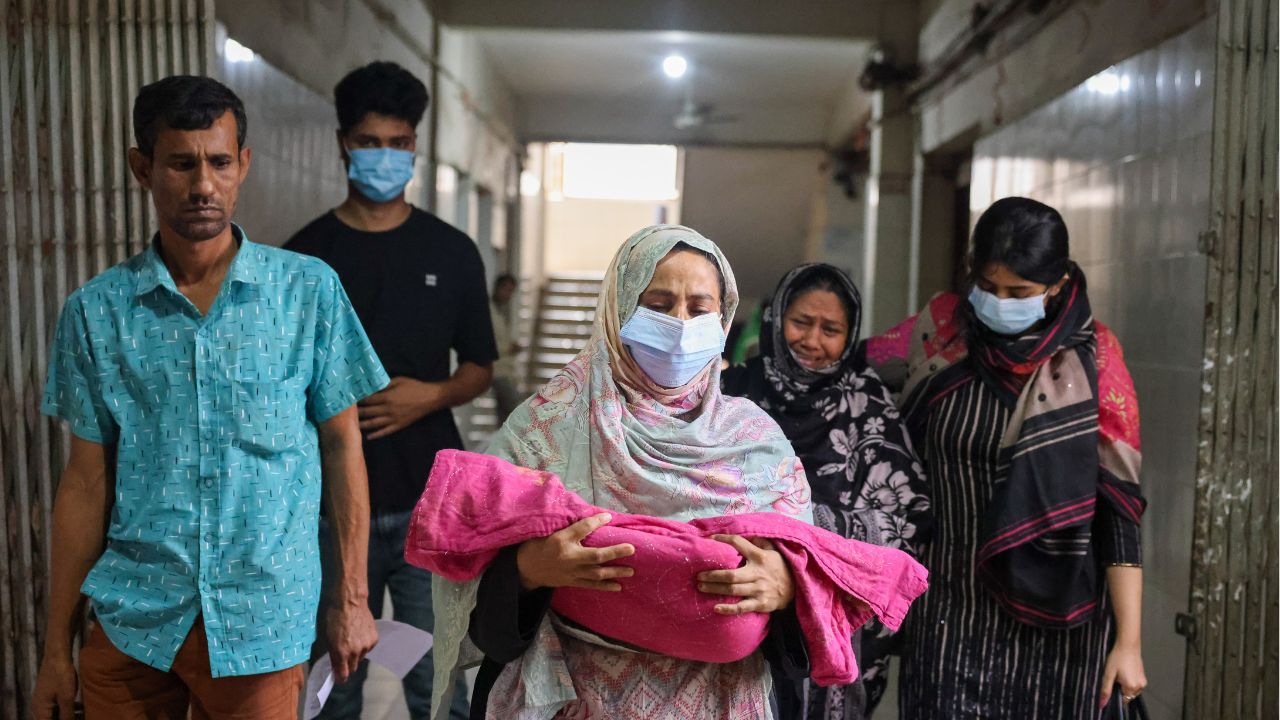



For many families battling measles, one child’s illness is only the beginning. Within days of returning home, infected children are often followed by siblings developing fever and rashes.
Doctors say measles is among the world’s most contagious diseases, making household transmission particularly difficult to prevent without effective isolation.
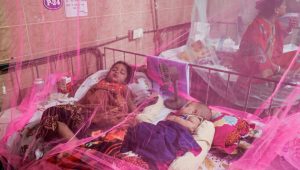
Seven-year-old Fahim lies in the measles isolation ward at Shaheed Shamsuddin Ahmed Hospital in Sylhet, with large reddish lesions covering almost his entire body except his face and head.
His father, Amir Uddin, sits beside him, wiping his body with a white vest every few minutes in an attempt to ease the burning sensation.
Fahim was admitted to the hospital on 8 July. Just two days earlier, his elder brother Minhaj had been discharged from the same ward after recovering from measles.
The week before that, Fahim’s 17-month-old younger brother Naim had received treatment in the hospital’s intensive care unit (ICU) and returned home after recovery.
After hearing that his sons had fallen ill one after another, Amir Uddin rushed back to Bangladesh from Dubai. He went straight to the hospital before briefly visiting home the following day to see his other children.

“No father can remain abroad in this situation,” he told TIMES of Bangladesh. “My youngest son had to be treated in the ICU. I came from Dubai and went straight to the hospital. After seeing my other two sons at home, I returned here again.”
He believes measles continues to spread among family members even after one child recovers. “When my two sons returned home after recovering, my middle son’s measles was detected,” he said.
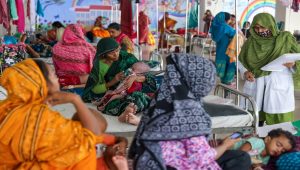
Several caregivers at the hospital similarly reported that children experienced a second deterioration in their physical condition shortly after appearing to recover, while others said their children became infected after another family member had fallen ill.
Families struggle to prevent household transmission
A similar story has emerged at the DNCC hospital. Two-and-a-half-year-old Kausar was the first child in her family to contract measles. Within days of returning home, her six-year-old sister Nusrat Jan Iqra developed a high fever, severe weakness and a spreading rash.




“Kausar had it first,” their father Ahmed told TIMES of Bangladesh. “Just two days after we brought her home, Iqra developed a fever. The doctor told us to monitor her for a day, but when the rash appeared, I didn’t delay. I brought her straight to the hospital.”
Despite treatment, Iqra’s condition remains unstable.
“She cannot eat, and her fever won’t break,” her father said. “It’s difficult even to administer medicine; she is mostly surviving on saline.”
The family’s ordeal has been compounded by missed vaccinations. According to their father, Iqra missed her scheduled vaccines due to negligence, while the younger children could not receive theirs in 2024 because vaccine doses were unavailable.
Now, the parents fear for their youngest child, who is only two months old.
“Three of my children have already been infected,” Ahmed said. “We try to keep them apart, but in a small home, it’s impossible. They naturally gravitate towards each other.”
According to the World Health Organization, measles is among the world’s most contagious diseases and spreads through coughing, sneezing or even breathing near an infected person.
A single infected person can transmit the virus to between 12 and 18 others, making unvaccinated children and pregnant women particularly vulnerable.
Duty doctors at the hospital said they routinely advise parents to isolate infected children, but families often struggle to comply due to space constraints and other limitations. Without greater family cooperation and awareness, preventing household transmission remains difficult.
Isolation remains key alongside vaccination
Public health expert Professor Dr Be-nazir Ahmed said vaccination alone is not sufficient to control measles transmission and stressed that proper isolation of infected children is equally important.
“Prioritising isolation is extremely important,” he told TIMES. “In reality, isolation is not happening in our country.”
He added, “Isolation, hand washing and mask wearing must be prioritised. This is why we will not see immediate results from vaccination alone. But there is very little public messaging about these measures.”
However, Sylhet Divisional Director (Health) Dr Mahbubul Alam said measles patients are generally contagious for up to four days after the onset of the rash and are unlikely to infect others after the fifth day.
“After the measles virus enters the body, an infected person can usually transmit the disease to others for the next four days,” he said.
“From the fifth day, the ability to transmit the virus is no longer present. Therefore, it is highly unlikely that a child who has recovered and returned home would infect other family members.”
He said if multiple members of a household become infected, they may have contracted the virus from the same source around the same time.