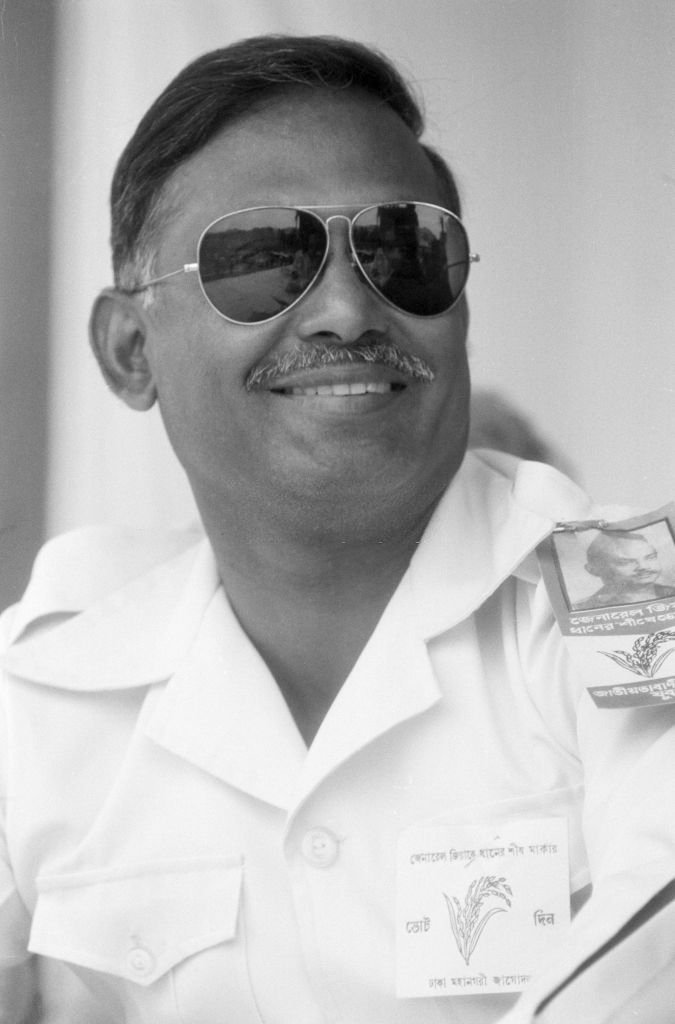
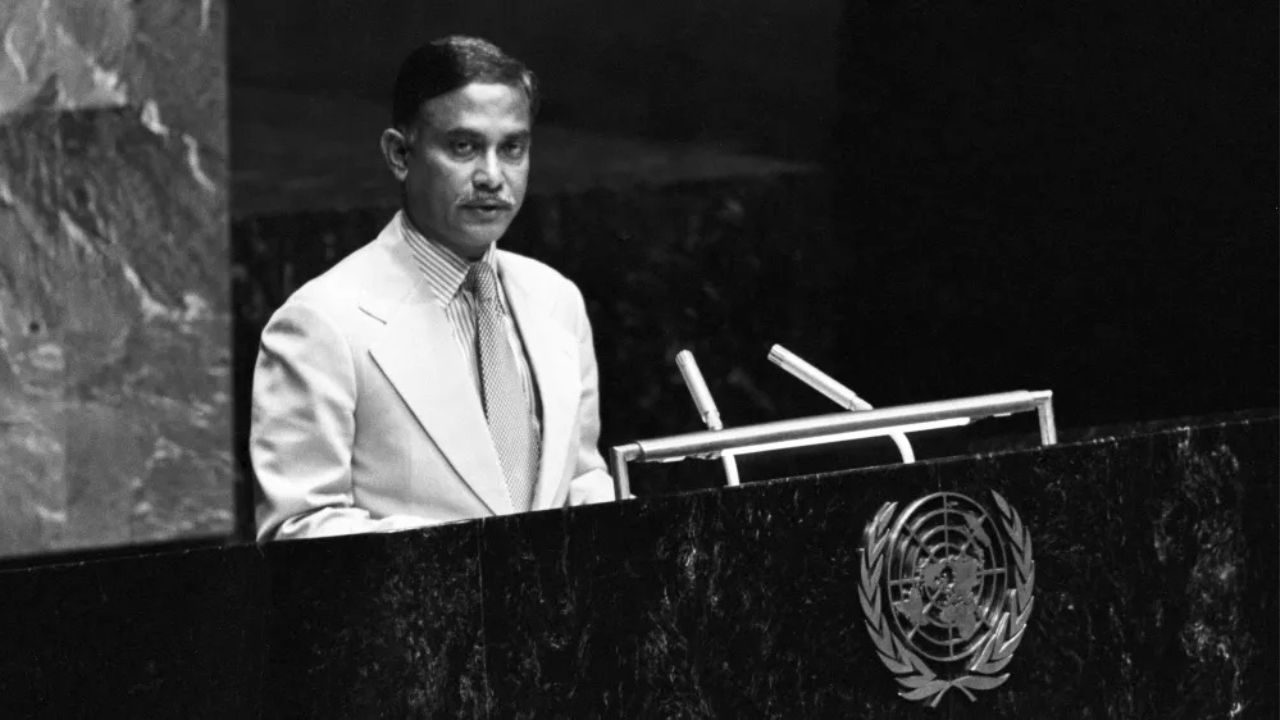
This interview of the then president Ziaur Rahman first appeared on the Far Eastern Economic Review magazine on 12 October 1979.
Zia took oath as the seventh president of Bangladesh on 21 April, 1977. He initially took charge after the resignation of then-president Abu Sadat Mohammad Sayem, and later secured a public mandate by winning the presidential election on 3 June, 1978.
TIMES of Bangladesh is republishing the interview without any changes in honour of Ziaur Rahman.
The interview
In an interview with the Review’s Rodney Tasker and S Kamaluddin at his home in the Dacca cantonment, President Ziaur Rahman explained his programme for Bangladesh.
Zia, looking relaxed in a sports shirt and slacks, also answered the critics who say that despite the official return of democracy to the country, with a civilian administration and parliament, he is still basically a military leader.
When you effectively took power soon after the fall of Mujib, you said that the military, including yourself, would soon return to the barracks and make way for a civilian administration. Why have you found it necessary to stay on as leader?
At that time [August 1975] … we really didn’t have a clue as to what was going to happen. Then I was deputy chief martial-law administrator. And as the time passed and the situation developed, I got sucked into this situation.
With the development of the political scene in the country, I think I got something to hold me.
Then we had to move for the referendum, and as the next stage we held a presidential election and then merged the parties to reform into one single party [the BNP], and proceeded to contest the parliamentary election.
Martial law was lifted, and now we have a totally civilian government and full democratic processes.
Doesn’t the fifth amendment to the Constitution (which retains certain authoritarian measures, although parliament has the power to censure or impeach the president) embody the essential aspects of martial law, thereby compromising democracy?
I don’t think there is any logic [in that suggestion]. During the martial-law period, we had to take certain measures which had to have the support of the martial-law regulations.
It is always done all over the world when martial law [makes way for] a civilian government, to give validity to those measures these are legalised by passing [them into] law democratically in the parliament.
The fifth amendment has been discussed in the parliament and passed by the parliament. So this is legal.

The opposition appears to be fragmented. Would you say this is a healthy situation, given the fact that you want to return the country to full democracy?
The Awami League was the last party in power and it has a very large organisation. And because of difficulties within the party, I think, for obvious reasons, it is having to meet this situation. So this is with other parties.
We have constant contact with them, in actual fact, and have their views on various matters.
Your cabinet and party contain both those who supported Mujib and those who worked to bring about his downfall. Don’t you think this is strange?
We have many people in our party who were in other parties earlier. But our party is grouped. Its root is in the people, and we have a concrete programme, both political and economic. And the past 18 months or so have proved the truth of this.
We are fast organising our party and spreading it all over the country. And we are having a lot of party meetings at worker level all over the country explaining the programme. The total object of these political activities is to unite the nation and carry the nation towards economic production.
Only that will bring good to the country, because we find that if our politics are unable to bring economic development, it is going to be difficult. Our party’s structure is so organised as to involve the various cross-sections of society.
We have given all of them a political platform in our party, and through the party platform we want to mobilise and organise them.
We have given a political and economic programme to the youth, to the students, to the womenfolk, to the farmers, to the fishermen, to the labourers, to the industrial workers, to the people concerned with culture and so on.
So that all the cross-sections of society get a political direction through which they can mobilise themselves, and organise with a view to achieving a total national development in all spheres.
Some members of your government are accused of being collaborators with the Pakistanis in the 1971 struggle. Do you agree?
Some people say certain things about some in our party, but when I ask them to give me concrete information as to what they did, nothing comes out. So that’s how it stands. Nobody could prove anything. And I think it is unfair to bring an allegation against somebody which is unfounded.



Some of your critics say that you are too concerned with consolidating your own position, and therefore neglecting the planning of your economic programme.
What we are trying to do is to build up a party leadership … What has been lacking in our country is the leadership at the various tiers, including the national level.
We have our party’s training centre — this is the first time that any party in the country has had a formal training centre through which the party hierarchy and important workers go for their training.
We have an economic programme. And the strategy for economic development is rural development.
As you realise, the initial stage of getting the country on the move is quite difficult, both in the formulation of the concept of our strategy for development, and to build up the organisational structure.
During the past two years, we have doubled development expenditure. It is true that not much could have been done, in any case, in the early stage of the negative situation. It takes a bit of time. We had to tackle every sector. We had to bring the country back from martial law to democratic processes.
I hope you know that martial law was not declared by any military fellow. It was declared by a political leader of the Awami League (former president Khondakar Mushtaq Ahmed). So that was the situation, and it just came on the shoulders of the armed forces.
Yes, there is a lot of corruption always in the country, and so I find, all over the world.
So many factors have played their part; our increasing development activity, world inflation, more money in circulation, we have pumped more money into development, salary rises, social conditions, and importation of the tendency for corruption from abroad. New ideas are flowing in. People are going out and learning new techniques of corruption.
We are organising our administrative system, and the process is going to take some time. We are politically organising our country, and it will be possible to check this corruption.
We are proceeding by stages, and we will be able initially to check corruption and reduce it, and for this we are mobilising the people. We are trying to create a check-and-balance method within the administration and on that administration through the people, and people’s representatives, and on the people’s representatives by the people.
Turning to foreign relations, Bangladesh seems to be gaining prominence in the non-aligned movement. Broadly, what is your country’s current foreign policy, particularly as regards relations with the Soviet Union and China?
Since 1975, what we have done is to establish relations with many more countries. We have been outward-looking, developing better relations with everybody, because our total aid from abroad has increased.
Since 1975, we have established formal diplomatic relations with China, Saudi Arabia, Kenya, Pakistan and with one or two other countries. Soon we are going to open our missions in the Philippines and in Jordan.
The object of an outward-looking foreign policy is to widen our friendship, ensuring stability in the region. We have got to have stability in the region so that we have stability in our country, which we need so much for our internal development in the economic field.
This can be achieved by not taking sides with any power bloc, and having a good relationship with all countries in the region.
Does this mean that you are moving away from what has been described as a special relationship with the Soviet Union during Mujib’s time?
I don’t think so. We have a very good relationship with the Soviet Union, and [the Soviets] are participating in some of the projects here. And delegations from the two countries are being exchanged from time to time.
Regarding relations with India, are you trying to make Bangladesh less reliant on New Delhi’s goodwill?
With India, trade and commerce have increased over the past two or three years. We have a good relationship with India. We have, at ministerial level, a joint commission which is working out a long-term agreement on [joint use of] the waters of the Ganges basin.
We hope soon to have a long-term solution.
Turning to the economy, with the drought seriously affecting the crop this year, presumably more of the budget is having to be diverted to buying food. Does this mean the economy in general will suffer?
The damage caused by drought has been very substantial, and we have taken measures to tackle the situation. At the same time, we have taken measures so that our development programme will not suffer.
In fact we are undertaking measures to have additional projects, especially for rural development, in which agriculture will be predominant.
And as you know, in Lusaka (the Commonwealth summit) and Havana (the non-aligned summit) we moved for food security in agriculture, which was accepted in Havana, and Bangladesh has been chosen as the coordinating country, which is very happy news for us.
We are working for some other arrangements so that we can line up some foreign funds — a lot of them — for agricultural development.
The problem we are finding is a shortage of our own internal currency.
For that, also, we have taken certain measures so that we can raise money from within by a combination of measures — financial and economic measures — so that we can get the matching funds in internal currency which are needed to implement these special projects in the agricultural sector, and also mining, gas and oil exploration.
You have talked about Bangladesh becoming self-sufficient in food production, and even of having a surplus for export. Isn’t this being very optimistic, particularly as investment in agriculture is reportedly slowing down?
No, it is not. Investment in the agricultural sector is not being slowed down. It is difficult to organise the whole thing because the problems are vast. But now we have reached a stage from where we will be moving fairly fast.
You rely heavily on foreign aid. Do you think the international agencies and foreign donor countries will continue to pour funds into Bangladesh indefinitely, given the slow progress towards self-reliance?
Up to this time, it has been very difficult for us. We had to come up from a very low position, or what we call ‘rock-bottom’.
Now we are in a position where we can draw in more foreign investment. For example, agriculture: why we are picking up in agriculture is because this is one sector where we can have a very substantial surplus, and we can export.
In the next three years we have the capability of exporting, after meeting our own requirements of foodgrain, to the tune of US$2 billion or maybe US$3 billion-worth at present rates. This is something that would look virtually impossible right now, but it is not so. One has to know the country and the various factors.
Normally our shortfall is in the order of 1.6 million or 1.7 million tons. This year, the damage caused by the drought would … well, there are a lot of varying figures, but the figure I get is about 3 million. We are having to import 1.5 million tons more than we usually import every year.
With the population increasing at a rate of 2.5-3%, what are you doing to implement family planning among the people?
Until 1975, nothing was done. There was no planning. After 1975 we trained a large number of men and women for working in the villages on these population control projects. Now we have almost 38,000 men and women deployed all over the countryside, but their supervision is inadequate. We are taking measures to monitor and control them and put them into work.
A large number of men and women are coming for birth control operations and the facilities we are able to provide. We didn’t want to move too fast.
This is quite a sensitive area. We had to move gradually, motivating the people to a high degree, and we are getting the results now. The family-planning sector is one where we have got to succeed, and we have identified this as our No.1 problem.
Because if we are to double the present population level by the end of this century, we just don’t exist. We have to hold this population, at best at 100 million and from there gradually bring it down. Otherwise it will be too difficult for the country.
Can the political and social changes brought about by so-called Islamic revivalism, as in Iran and Pakistan, happen in Bangladesh?
In 1977 we changed our Constitution, and the Constitution brought in Islamic provisions. We give religion due importance in our national life.
Our people are very religious. I don’t think any Muslim country has such a large number of mosques. We are modernising and rehabilitating madrasas (Islamic high schools). We are going to have an Islamic university in our country.