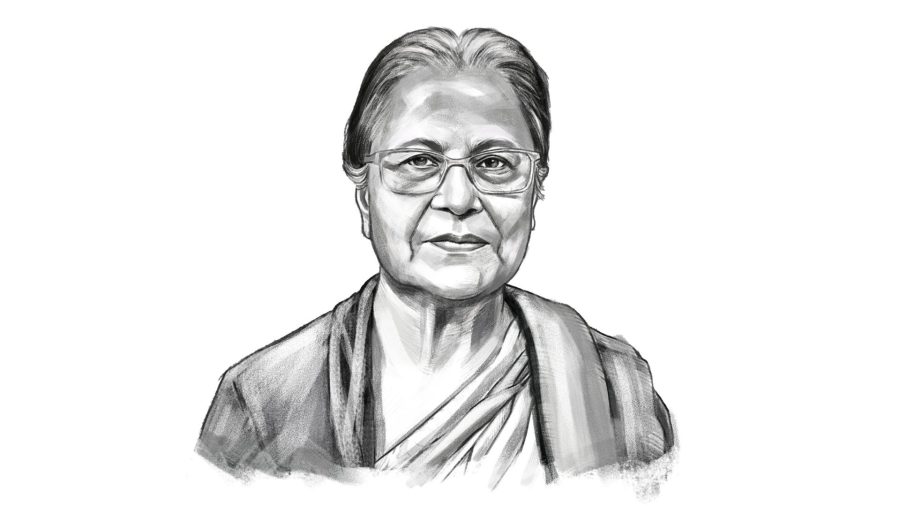



Long before gender equality became a widely discussed issue in Bangladesh, there were women who were using their voices to challenge the social structures that kept women unheard and confined. Among them was Ayesha Khanam, whose decades-long activism helped shape the country’s struggle for women’s rights.
Born on 18 October 1947, in the quiet village of Gabragati in the Netrokona district, Ayesha Khanam’s early years were shaped by the harsh realities of post-partition conservative rural society, where female literacy was discouraged, and women were confined to their homes.
By navigating these rigid social expectations and witnessing the systemic inequality women faced around her, Khanam developed a fierce inner resolve, turning the structural limitations of her youth into the catalyst for her future activism.

Ayesha Khanam’s entry into activism was defined by her rise as a fiery student leader during the turbulent 1960s. At just 15 years old, she stepped onto the political stage as an active organiser in the 1962 East Pakistan Education Movement. As a sociology student at Dhaka University, she quickly climbed the ranks of progressive politics and became vice-president of the Bangladesh Chhatra Union’s central committee while consecutively serving as General Secretary and Vice-President of Rokeya Hall. Through her influence, she mobilised female students to challenge both martial law and deep-seated gender discrimination.
Her activism peaked during the 1969 Mass Uprising in defiant opposition to Ayub Khan military regime, where she took charge of the Student Action Committee and boldly led female delegations to mass rallies across the country.



By early 1971, she had transformed her student networks into a revolutionary vanguard. Her leadership culminated in an iconic pre-independence mobilisation where a procession of female Dhaka University students marched defiantly through the streets. When the Liberation War erupted that same year, she moved beyond campus activism to play a multifaceted role on the front lines of the resistance.
After receiving specialised medical care training, she fully immersed herself in the operations of refugee and freedom fighters’ camps, dedicating her days to nursing and treating wounded freedom fighters. She also served as an active announcer and scriptwriter for the historic Swadhin Bangla Betar Kendra, delivering powerful broadcasts aimed at boosting morale and sustaining the spirit of the resistance.
Following the war, Ayesha Khanam dedicated her life to establishing women’s rights based on democracy and secularism. She focused intensely on rehabilitating women who were tortured by the invading Pakistani army and supporting the families of martyred freedom fighters.
In 1972, she joined the Bangladesh Mahila Parishad (BMP) and went on to serve in several positions before becoming president in 2008. Under her leadership, the organisation implemented a Uniform Family Code, which aimed to replace religious personal laws with a unified legal framework to secure equal rights for women across all faiths regarding marriage, divorce, and inheritance.
Ayesha remained a central figure in the political empowerment of women, the prevention of gender-based violence, and the implementation of international treaties such as CEDAW (the UN Convention on the Elimination of All Forms of Discrimination Against Women)
After a prolonged battle with lung cancer, on 2 January 2021, Ayesha Khanam passed away at the age of 74. Her enduring legacy lives on as a foundational pillar of Bangladesh’s progressive women’s movement and grassroots legal advocacy. To honour her lifelong pursuit of spreading knowledge and fostering independent thought, the Bangladesh Mahila Parishad established the “Ayesha Khanam Library” across 57 district offices, ensuring that her decades of work continue to educate and inspire future generations of activists.