


More than 400 people, the majority of them minors, were detained in France on Tuesday as student-led protests at high schools escalated, said French Interior Minister Laurent Nuñez.
The demonstrations, which began in Paris and have spread across the country, have seen students block access to schools for several days, BBC reports.
Protesters say they are highlighting longstanding problems within the education system, including overcrowded classrooms, teacher shortages and deteriorating learning conditions.
French officials said Tuesday’s unrest left at least 10 teachers, several students and 48 law enforcement officers injured.
The Education Ministry reported that around 400 schools were affected by the protests nationwide.

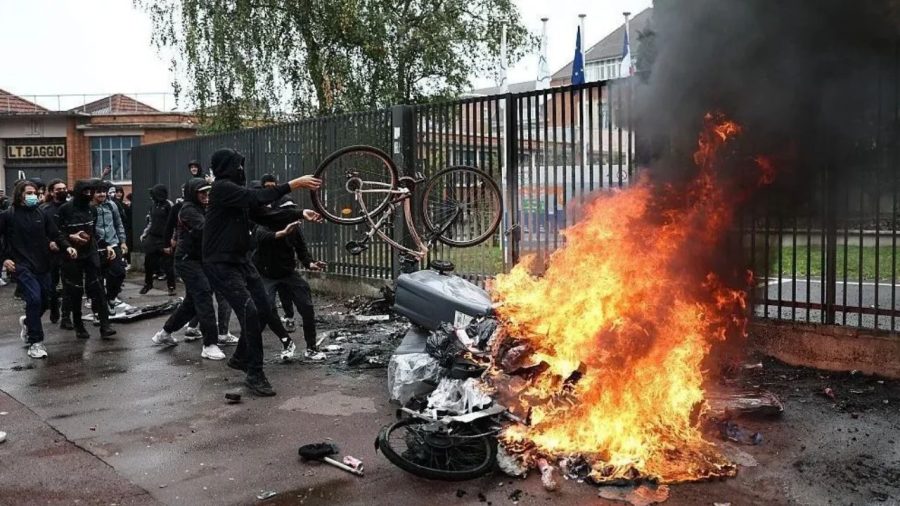
Images and videos circulating on social media showed rubbish bins set on fire and damage to public infrastructure, including bus shelters.
Students involved in the demonstrations insisted their movement is aimed at drawing attention to the state of the education system rather than provoking violence.
“We’re here to deliver a message,” a 16-year-old student told AFP. “We’re not here to smash everything up for no reason. We’re here precisely to say that the education system is completely broken. There are 34 of us in each class, and it’s just not feasible. The teachers are overworked.”



Education Minister Édouard Geffray said students have the right to protest but condemned incidents of violence, describing them as “indefensible”.
Speaking to BFMTV, Interior Minister Laurent Nuñez said 440 people had been detained, though the final figure was still being compiled. He added that roughly two-thirds of those detained had been placed in police custody.
French media reported that some protesters threw projectiles at police officers, who responded with batons and tear gas.
Ryad Rani, president of the student union Union Syndicale Lycéenne, accused the government of resorting to “repression” and alleged that police had used excessive force against demonstrators.
Responding to criticism from several politicians over the policing of the protests, Nuñez defended the officers’ actions, saying the response had been conducted in an “extremely proportionate manner”.
In a post on social media Tuesday evening, Geffray reiterated that while the right to demonstrate is a fundamental freedom, it cannot be used to justify violence.
“The right to demonstrate is a fundamental freedom that cannot serve as an excuse for such actions,” he wrote. “To legitimise them or, in this context, to call for extending the blockades is to endanger our students as well as public employees. It is irresponsible.”
The protest movement began last week in the Île-de-France region surrounding Paris and has since expanded to other parts of the country. French lycées are equivalent to high schools in the United States and sixth-form colleges in the United Kingdom.
On Monday, Prime Minister Sébastien Lecornu warned against any further escalation after 164 people were arrested during earlier demonstrations.
In a post on X, Lecornu cited reports of fireworks, fires and violence near schools, saying nothing could justify putting students, school staff or police officers at risk.
Tuesday’s student demonstrations coincided with nationwide strike action organised by unions representing teachers, healthcare workers and civil servants. The unions are protesting issues including low pay and working conditions.
According to Nuñez, those broader nationwide protests drew at least 200,000 participants and were largely peaceful.