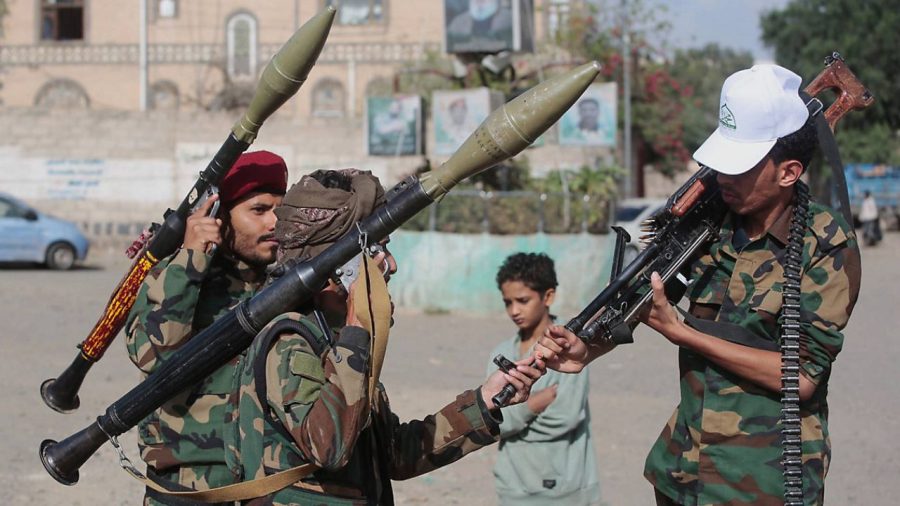



Officially named Ansar Allah (meaning “helpers of God”), the Houthis began in 1994 as a regional movement in northern Yemen founded by Zaydi Shia cleric Hussein al-Houthi.
Today, under the leadership of his brother, Abdul-Malik al-Houthi, the group has transformed from a local militia of 30,000 fighters in 2015 into a massive armed force of roughly 350,000 by 2024.
After taking control of Yemen’s capital, Sanaa, in 2014, the movement seized crucial coastal territory along the Bab al-Mandeb strait, Mocha, and Mayyun Island.
By positioning themselves along these narrow shipping choke points, where 5.6 million barrels of crude oil passed daily before the conflict, the Houthis gained the ability to launch long-range strikes across the Middle East and disrupt major international sea routes in the Red Sea.
Domestic stockpiles, Iranian assistance, and global supply networks
The Houthis built their firepower through three main sources – captured state weapons, Iranian military support, and global procurement chains.
Following 2014 takeover of Sanaa, a tactical alliance with former president Ali Abdullah Saleh allowed Houthi forces to capture military bases like Al-Sawad Camp in Sanhan.

This handed them legacy state weapons, including Scud-B/-C, Tochka, and Qaher-1 ballistic missiles, alongside C-802 anti-ship cruise missiles.
Iran’s Islamic Revolutionary Guard Corps (IRGC), its Quds Force, Hezbollah, and Iraqi armed groups provide technical expertise, component kits for assembly in local Houthi workshops, and training in Iran, Lebanon, and Iraq.
Global commercial networks supply dual-use parts, which accounted for over 80 per cent of seized shipments in 2024–2025.



Between 2021 and 2025, 35 per cent of documented seized materials originated from China, including DLE-170 drone engines and Chengdu data radios, compared to 21 per cent from Iran.
A financial network run by Saeed al-Jamal procured goods from Russia, while Moscow provided targeting data and military intelligence advisers.
Ballistic missiles, air defence conversions, and AI guidance
The Houthis command a varied missile force capable of striking targets across Yemen, Saudi Arabia, the United Arab Emirates, and Israel up to 2,000 kilometres away, including Tel Aviv’s Ben Gurion Airport.
Their long-range inventory features the two-stage, solid-fuel Palestine-2 (exceeding 2,000–2,150 km range with a 500 kg warhead, claimed as hypersonic), the Toufan (1,350–1,950 km range), the Hatem-2 (1,450 km range), and the Burkan-3/Dhu al-Fiqar (1,000 km range).
According to Yemeni government spokesperson Brigadier General Majed al-Nazili, the Houthis have also modified Iranian air defence weapons into loitering cruise missiles with IRGC help.
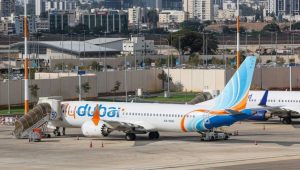
These heat-tracking weapons can linger in the air for up to 25 minutes, creating a severe hazard for civil aviation and international flights over Yemen and the Red Sea, as noted by analysts Eleonora Ardemagni, Brigadier General Mohammed Al-Kumaim, and Ali Al-Dhahab.
For maritime attacks, the group uses Quds cruise missiles (800+ km range), Mandab-1 and Mandab-2 anti-ship cruise missiles (120–300 km range), Asif anti-ship ballistic missiles (450 km range), and close-range anti-tank guided missiles.
A northern Yemen weapons cell even used Anthropic’s Claude AI platform to write guidance and control software.
Drones, naval attack craft, and regional impact
Lacking a functional navy and air force, which is reduced to a single non-operational US-made Northrop F-5 fighter jet, the Houthis rely heavily on uncrewed systems.
Their drone fleet includes the Samad-3 (1,600+ km range), Waad-1 and Waad-2 loitering munitions, the Jaffa drone, FPV quadcopters, and hydrogen-powered prototypes.
At sea, they deploy explosive remote-controlled drone boats assembled in Yemen using commercial outboard engines imported from China, Japan, or Europe.
Between November 2023 and July 2024, the UN recorded over 134 attacks on vessels using more than 800 missiles, drones, and drone boats.
Analyst Saj Ahmad of StrategicAero Research notes that Houthi missile launches directed northwards at Saudi Arabia, which have hit Aramco facilities in Yanbu and targets in Riyadh and Taif, damaging the East-West Pipeline, pose serious risks to active Saudi civil aviation corridors.
In response, the US has sanctioned over 200 linked entities, while National Resistance Forces under Tareq Saleh intercepted a 750-tonne naval weapons shipment bound for the group.