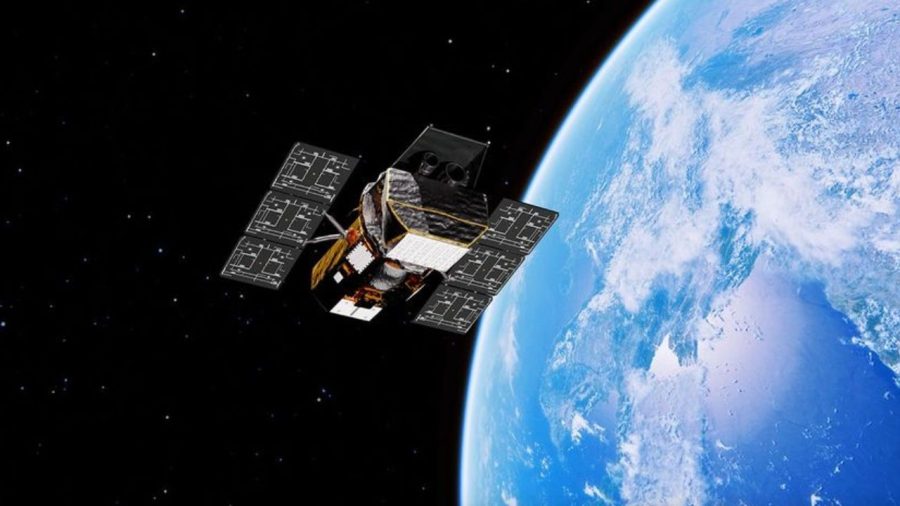



NASA’s celebrated Neil Gehrels Swift Observatory is rapidly descending from its orbit and is expected to fall to Earth shortly before marking the 22nd anniversary of its launch, following the failure of a daring rescue attempt over the summer.
The 1,452-kilogram space telescope currently orbits approximately 325 kilometres above Earth, reports CNN.
However, engineers at NASA estimate that operating the telescope will become challenging once it drops below 300 kilometres in early to mid-October. Swift will subsequently plunge from orbit and is expected to burn up in the Earth’s atmosphere.
According to space-tracking company LeoLabs, while some spacecraft hardware might survive re-entry due to its dimensions, the risk of debris causing physical harm or significant property damage remains very small, with surviving pieces likely falling into the ocean or uninhabited territory.
NASA did not respond to requests for comment regarding potential re-entry risks.

Rescue mission converted into flight demonstration
The observatory’s decline follows the failure of a rescue effort involving LINK, a satellite developed, built, and launched in just nine months by Arizona-based Katalyst Space Technologies.
Launched aboard a Northrop Grumman Pegasus XL rocket in early July, LINK was intended to grapple Swift and elevate it into a stable orbit. However, the rescue mission failed weeks after launch when the satellite spun out of control in space.
Shawn Domagal-Goldman, director of NASA’s Astrophysics Division, described the endeavour as a “high-risk, high-reward mission” necessary to prevent Swift from re-entering the atmosphere by the end of the year.
Despite the outcome, NASA and Katalyst stated that the effort provided invaluable operational lessons, particularly in testing satellite manipulation and advancing spacecraft servicing technologies to prolong low Earth orbit missions.




Owing to ongoing orientation difficulties, Katalyst adjusted LINK’s mid-August rendezvous with Swift into a flight demonstration rather than a recovery mission.
Although engineers successfully used LINK’s thrusters to counteract its spin and uploaded updated flight software, the manoeuvre exhausted the satellite’s propellant.
Consequently, Katalyst and NASA concluded that LINK lacked sufficient fuel to safely execute the planned capture and orbit-raising phase.
During the first week of September, LINK approached within 12 to 15 kilometres of Swift to practice approach procedures for spacecraft not originally engineered for orbital servicing.
The satellite deployed its three robotic arms – originally intended to grasp Swift—and test-fired its three electric propulsion thrusters. LINK operated in space for 85 days before re-entering Earth’s atmosphere on 25 September.
Ghonhee Lee, chief executive officer of Katalyst Space, noted that the company progressed from initial concept to operating the first commercial space robot in under a year, establishing a foundation to develop future spacecraft servicing hardware.
Final scientific observations
First launched in November 2004, the Swift Observatory has served as a versatile astrophysics tool in low Earth orbit, operating without a designated replacement.
Named after fast-flying birds for its capability to rapidly pivot toward transient cosmic events such as flaring black holes, the telescope was originally engineered to analyze gamma-ray bursts, while also observing cosmic flashes, comets, and asteroids.
Although instruments were deactivated for months to save power and slow its altitude loss, mission scientists have reactivated them to collect final data, accelerating the observatory’s decline.
The orbital decay stems from atmospheric drag, magnified by heightened solar activity during the peak of the Sun’s 11-year cycle in 2024.
Intense solar flares and coronal mass ejections expanded the Earth’s upper atmosphere, increasing drag on the spacecraft and prompting predictions of its autumnal descent.
S Bradley Cenko, Swift’s principal investigator at NASA’s Goddard Space Flight Center in Greenbelt, Maryland, remarked that namesake Neil Gehrels would have celebrated the daring rescue attempt as part of Swift’s legacy of trying bold, unprecedented concepts.