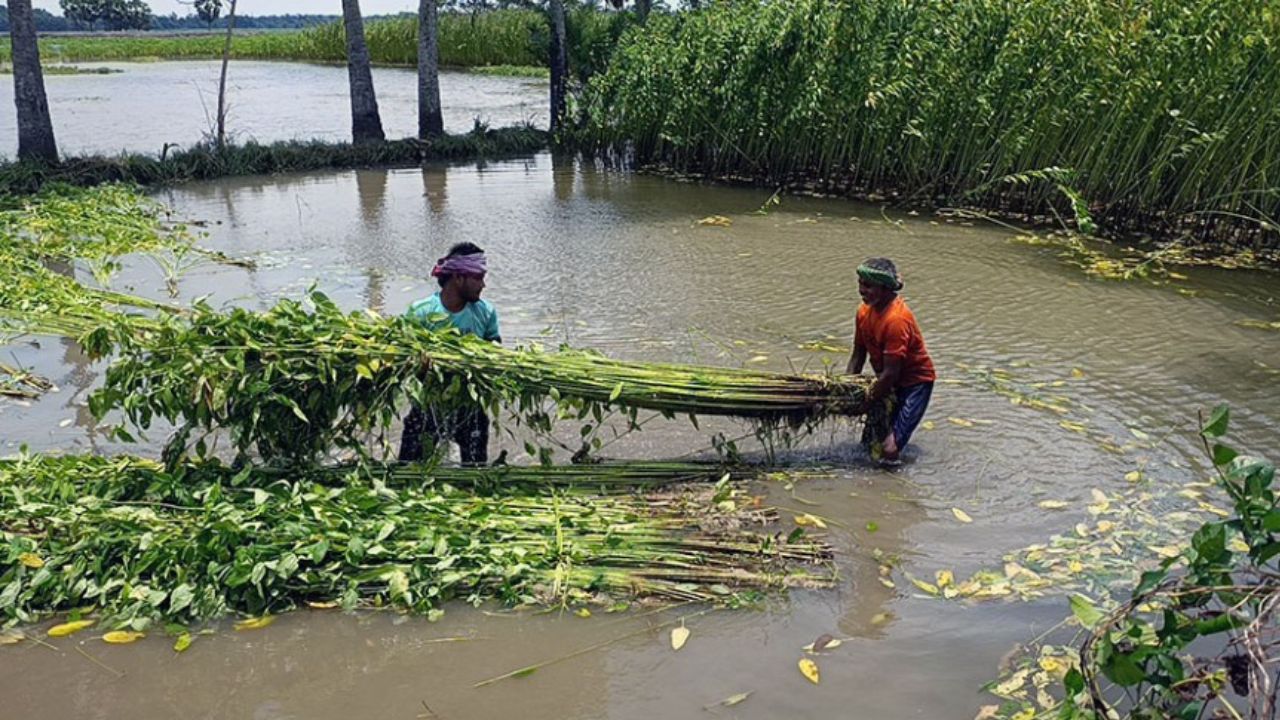

Weeks of heavy monsoon rain and persistent waterlogging have left jute farmers in Jashore Sadar facing heavy losses, forcing many to harvest their crops nearly a month earlier than usual to prevent complete destruction.
Large stretches of farmland have been inundated during the peak growing season, causing the base of jute plants to rot. Farmers say premature harvesting is reducing both fibre yield and quality, while soaring labour costs in flooded fields have sharply increased production expenses. They are calling on the government to ensure a fair price for jute and provide immediate support.
Jute is normally harvested towards the end of the Bengali month of Srabon and during Bhadro. This year, however, repeated rainfall since Ashar and poor drainage have left fields submerged. Low-lying areas, including Harinar Beel in Ramnagar and Chanchra unions, remain under knee- to waist-deep water.
Affected farmers said harvesting immature jute has resulted in weak, soft fibres that fetch lower prices in the market.

The flooding has also driven up harvesting costs. Palash Kumar Sarkar, a farmer from Ramnagar, said one labourer can usually harvest jute from five kathas of land in a day, but flooded conditions now require one labourer for every katha. As a result, harvesting and washing costs have risen to about Tk1,000 per katha in labour alone.
Another farmer, Debashish Pal, said his one-and-a-half bighas of jute land had gone under water. He said he had already spent at least Tk10,000 per bigha on fertiliser, weeding and cultivation, and warned that unless the government fixed jute prices at Tk4,000-Tk5,000 per maund, it would be impossible to recover costs.




The waterlogging has also jeopardised the upcoming Aman rice season. Seedbeds in many low-lying areas have rotted after remaining submerged.
Farmer Sukumar Pal said the loss from jute had been compounded by the destruction of a five-katha rice seedbed prepared for planting eight bighas of Aman paddy, leaving him with no option but to buy fresh seedlings.
Local farmers Khokon Biswas and Swapan Kumar said they had expected to harvest after another month for better yield and prices, but were now struggling to rett and wash jute in the flooded conditions.
Jute is currently selling for Tk3,000-Tk3,700 per maund in local markets, depending on quality. Farmers and traders estimate that prices need to reach at least Tk4,000-Tk5,000 per maund this season for growers to cover rising production costs.
Jashore Sadar Upazila Agriculture Officer Razia Sultana said 1,720 acres of land had been brought under jute cultivation in the upazila this season. She said waterlogging had developed in some low-lying parts of Ramnagar and Chanchra unions where there was no outlet for accumulated water.
“We are inspecting the affected areas. Farmers are being advised to harvest fields where the crop is ready or where rotting has begun. If water remains stagnant, the entire crop may be lost. Early harvesting can at least prevent total damage,” she said.