
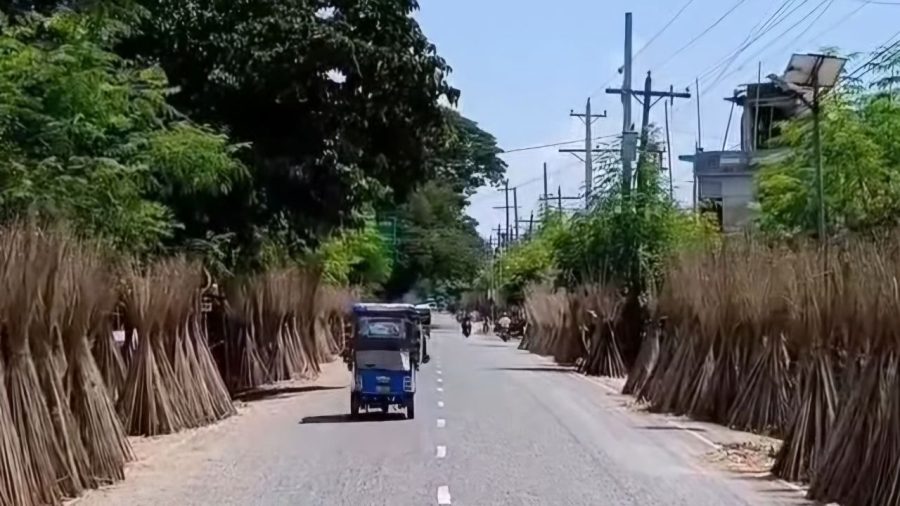



Once considered a worthless by-product of jute cultivation, jute sticks have now become an important source of income for farmers in Meherpur, helping them recover a significant portion of production costs amid fluctuating jute prices.
Farmers say they are now earning substantial returns from selling jute sticks, and in some cases, the income from jute sticks is exceeding their earnings from jute fibre. The growing demand for the product has encouraged many farmers to continue jute cultivation despite past losses.
Farmers spend around Tk22,000–24,000 to cultivate jute on one bigha of land in Meherpur. The land produces 10–12 maunds of jute on average, which currently sells for around Tk3,000 per maund, bringing about Tk30,000 in revenue.
The same land produces jute sticks worth Tk12,000–15,000 depending on quality, significantly increasing farmers’ overall earnings.
Jute farmer Firoz Ali of Meherpur Sadar said the profit from jute fibre alone is limited after production costs, but selling jute sticks helps recover much of the investment.

“Jute sticks are no longer something to throw away. They have become an additional source of income,” he said.
Traditionally, dried jute sticks were used as fuel in rural households. However, their use has expanded to making fences, cattle sheds and temporary barriers around crop fields.



Farmer Mega Khan of Sheikhpara said jute sticks are useful for household fencing and can also be stored as fuel after drying.
Farmers usually dry jute sticks in open fields, roadside areas or courtyards before storing them in bundles. Recently, jute sticks were seen being dried along the Monakhali-Mujibnagar road.
The market for jute sticks has also expanded beyond villages. Traders now collect them from farmers and sell them in Meherpur town and nearby areas.
Trader Sayed Ali, who has been involved in the business for five years, said demand has increased as the use of jute sticks has diversified.
“We buy jute sticks from farmers for Tk12,000–15,000 per bigha and sell them in bundles across villages and towns. Sales can reach Tk30,000–35,000,” he said.
He added that the trade, though small, is creating income opportunities for farmers, collectors and sellers.
Experts say jute sticks have further economic potential if properly processed. They can be used to produce particle boards, fibreboards, paper and various eco-friendly products.
Meherpur Department of Agricultural Extension Deputy Director Kazi Shahnewaz said jute was cultivated on 16,630 hectares of land in the district this season.
“Farmers are recovering a significant part of their production costs by selling jute sticks. Rising demand and better prices are encouraging farmers to cultivate jute,” he said.
He added that expanding the use of jute sticks could create opportunities for local businesses and small industries.