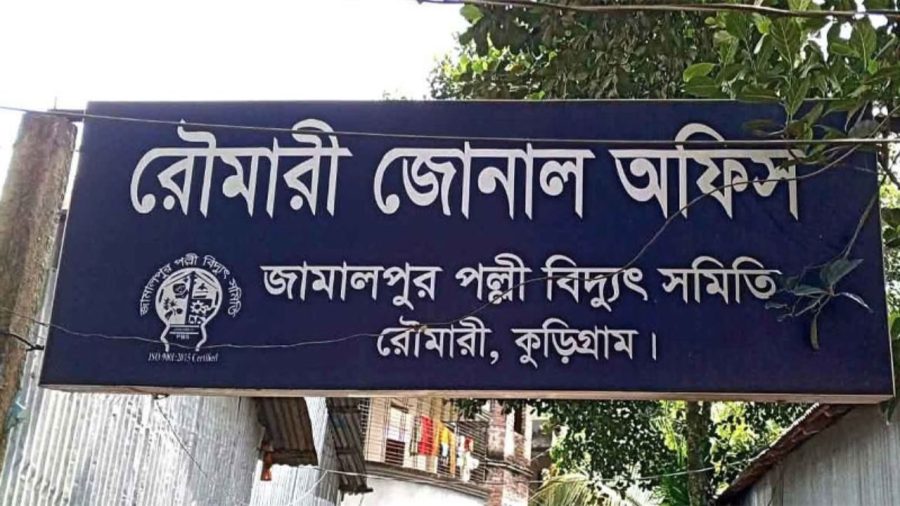



Residents of Rowmari upazila in Kurigram are facing prolonged power cuts, low voltage and what they describe as inflated or inaccurate electricity bills, with several consumers also alleging harassment at the local zonal office of Jamalpur Palli Bidyut Samity.
Consumers alleged that meter readings are not always taken properly and that bills are sometimes prepared based on estimates.
They also complained of errors in customers’ names and alleged negligence by officials at the Rowmari zonal office.
Residents said the upazila experiences load shedding for 16 to 18 hours almost every day. The limited supply, coupled with low voltage, is disrupting irrigation, businesses and production while damaging electrical appliances.
Consumers cite billing discrepancies
Sheikh Farid of Chuliarchar alleged that his July electricity bill showed a meter reading of 8,380, while the August bill showed 8,480. However, the actual reading on his meter this month was 8,230, he said.
He also said the bill was delivered on the afternoon of 7 September, although 8 September was the payment deadline. Five days after he complained about the discrepancy, he said, no action had been taken.
At Salam Enterprise, near the Roamari upazila town, the March bill showed a meter reading of 830, according to business owner Nahidul Haque Nahid.
The meter reader later told him that the meter had not been recording readings for nearly six months. Yet the enterprise received a bill of Tk 1,278 in August without a meter reading, Nahid alleged.

He further alleged that the zonal office did not inform the business that the meter was malfunctioning and continued issuing bills based on the defective meter. In Natunpara, resident Hajizur Rahman Tuhin said a storm severed the electricity connection wire to his house.
After contacting the zonal office on 27 July, he was told that a new wire would be installed on 29 July. He paid Tk 2,157 in official fees on 30 July.
“After a week of harassment, they installed the old wire instead,” he alleged. Although he was told that a new wire would be installed once supplies arrived, the issue remains unresolved, he said.
Collegepara resident Babul Mia said his meter reading had remained unchanged for around one and a half years, during which he was charged Tk 298 every month.
“After repeated complaints, the meter was replaced four days ago, but the bill still shows Tk 298. The current meter reading is 175,” he said.




An employee of a mobile phone company working at a tower in Chaktabari, speaking on condition of anonymity, alleged that he faced repeated delays while seeking a new electricity connection.
He said he applied on 19 July and was told the meter would be installed on 26 August. When he visited the electricity office on 24 August, he was allegedly kept waiting from 10am to 5pm before being told that the line workers would come on 28 August.
He was later told that a capacitor was required, although it had not been mentioned in the demand note, he alleged. The connection was eventually provided on 5 September.
Businesses, households hit
Residents of Baraikandi, Dantabhanga, Char Roamari, Baikamari and Shaulmari said frequent power cuts and low voltage were causing food stored in refrigerators to spoil. Some said their refrigerators had also been damaged.
Auto-rickshaw, van drivers said they could not fully charge their vehicles because of the unreliable power supply, affecting their daily earnings.
Mahfuzul, an auto-van driver, said the vehicle was his family’s only source of income.
“I have four children, a younger brother and my mother to support. I cannot afford my daughter’s school fees and private tuition. Without electricity, my livelihood comes to a standstill,” he said.
Hafizur, who runs an engineering workshop, said the power crisis was hurting his business.
“Power remains unavailable for 16 to 18 hours a day, and low voltage makes it difficult to provide the service customers expect. Yet I have to pay my workers, resulting in substantial monthly losses,” he said.
Parents also complained that the power cuts were disrupting their children’s studies.
Alam Mia, a parent, said evening outages were particularly problematic.
“Electricity often goes out in the evening and returns around 9pm or 9:15pm. It goes out again after an hour or an hour and a half. Even after midnight, when the children should be sleeping, the power goes off and comes back three or four times,” he said.
The manager of Adarsha Diagnostic Centre said the facility has to operate a generator during outages to continue providing medical services, resulting in losses several times higher than its profits.
Supply shortage behind outages: official
Delwar Hossain, deputy general manager of the Rowmari zonal office, attributed the frequent load shedding to a shortage of electricity supply.
“The demand for electricity in Rowmari and Rajibpur is 18 megawatts, but we are receiving only eight to nine megawatts. That is why frequent load shedding occurs,” he said.
Regarding complaints of inflated or “ghost” bills, Hossain said meter problems could be responsible.
Asked how bills are issued when meters are not functioning, he said bills are calculated based on average consumption from previous months.
“This can benefit a consumer or cause them a loss,” he said.
However, he did not provide a clear response when asked about allegations that consumer complaints were being ignored and customers were being harassed.
Shahida Akter, assistant general manager (finance and revenue) of Jamalpur Palli Bidyut Samity, said she was in Dhaka for a departmental examination. She said she would comment later when asked about the allegations of consumer harassment.
Mohammad Shahidul Islam, general manager (current charge) of Jamalpur Palli Bidyut Samity, was contacted several times for comment but did not answer the calls.